

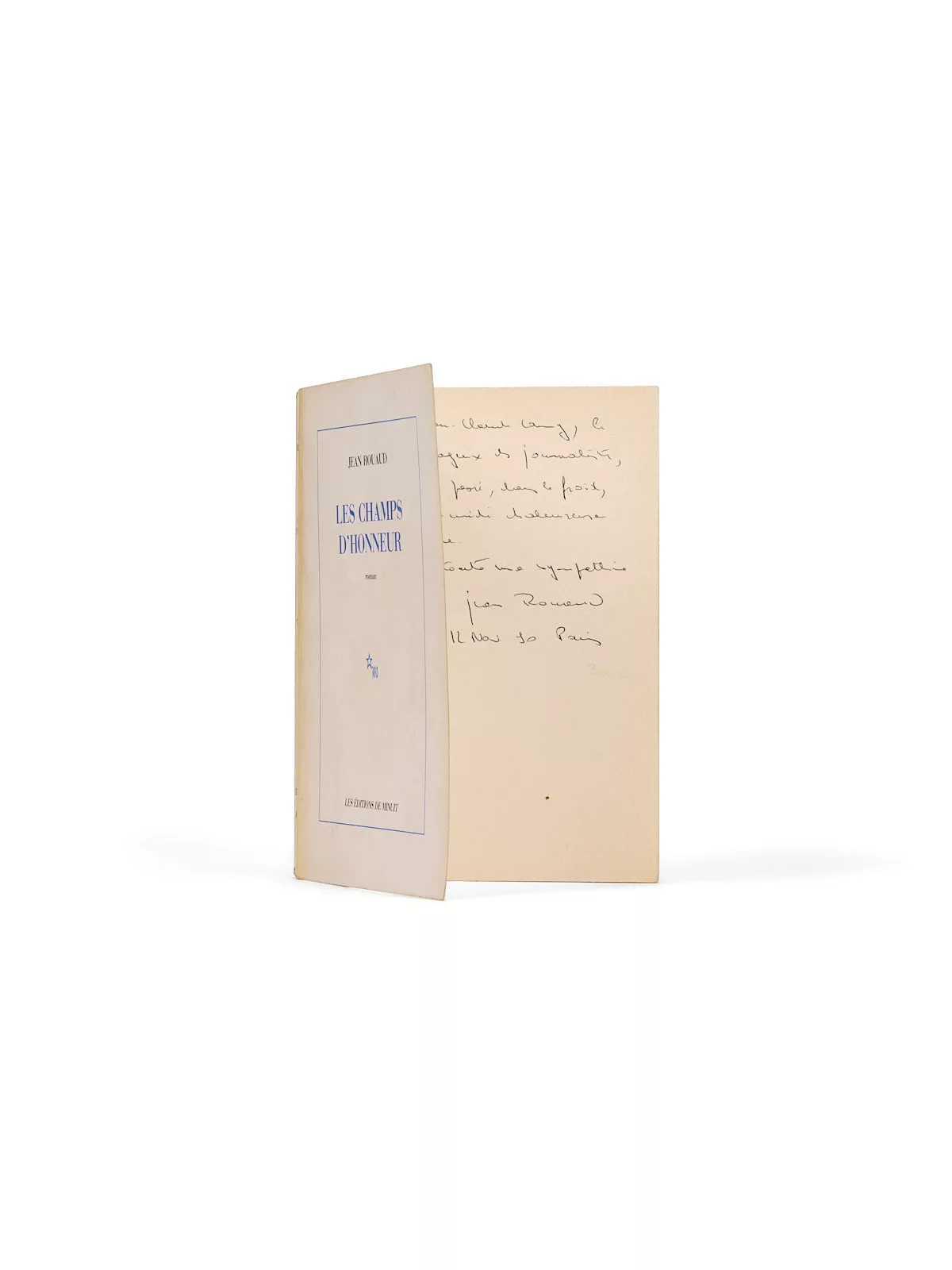
Les Champs d’honneur
Signed presentation inscription: “Pour Jean-Claude Lamy, le plus courageux des journalistes, pour avoir passé, dans le froid, une après-midi chaleureuse au kiosque. Avec toute ma sympathie, Jean Rouaud, 12 Nov. 90 Paris.”
Jean Rouaud’s (b. 1952) first novel, Les Champs d’honneur, surprised critics with its lucid, lyrical prose rooted in a family memory shadowed by the Great War. Published in midsummer, it drew early praise from Françoise Giroud, who wrote in August that “word is spreading, flattering, resonating through the most powerful advertising channel of all, word of mouth; some twenty thousand readers bought Les Champs d’honneur in a single month, a considerable figure for the first novel of an unknown author.”
Critical opinion was divided: some hailed a “miraculous” book that restored to literature its power of emotion and memory, while others suspected an “editorial coup” engineered by Jérôme Lindon, head of Éditions de Minuit, in search of renewal after the successes of the Nouveau Roman and Duras. The controversy soon faded, so unanimous was the acclaim. On 6 November 1990, on the first ballot and by near unanimity (only two votes going to Philippe Labro), the Académie Goncourt propelled this unknown author, a newsstand keeper on the rue de Flandre, into the literary spotlight. Sales exploded, exceeding 500,000 copies, bringing Minuit an unexpected new triumph.
The novel opened a cycle devoted to family and regional history that gradually became a meditation on memory, lineage and the passage of time. Les Champs d’honneur has lost none of its power and remains one of the great French texts of that decade, and indeed of the century’s end, on a subject already treated many times over: the First World War.