

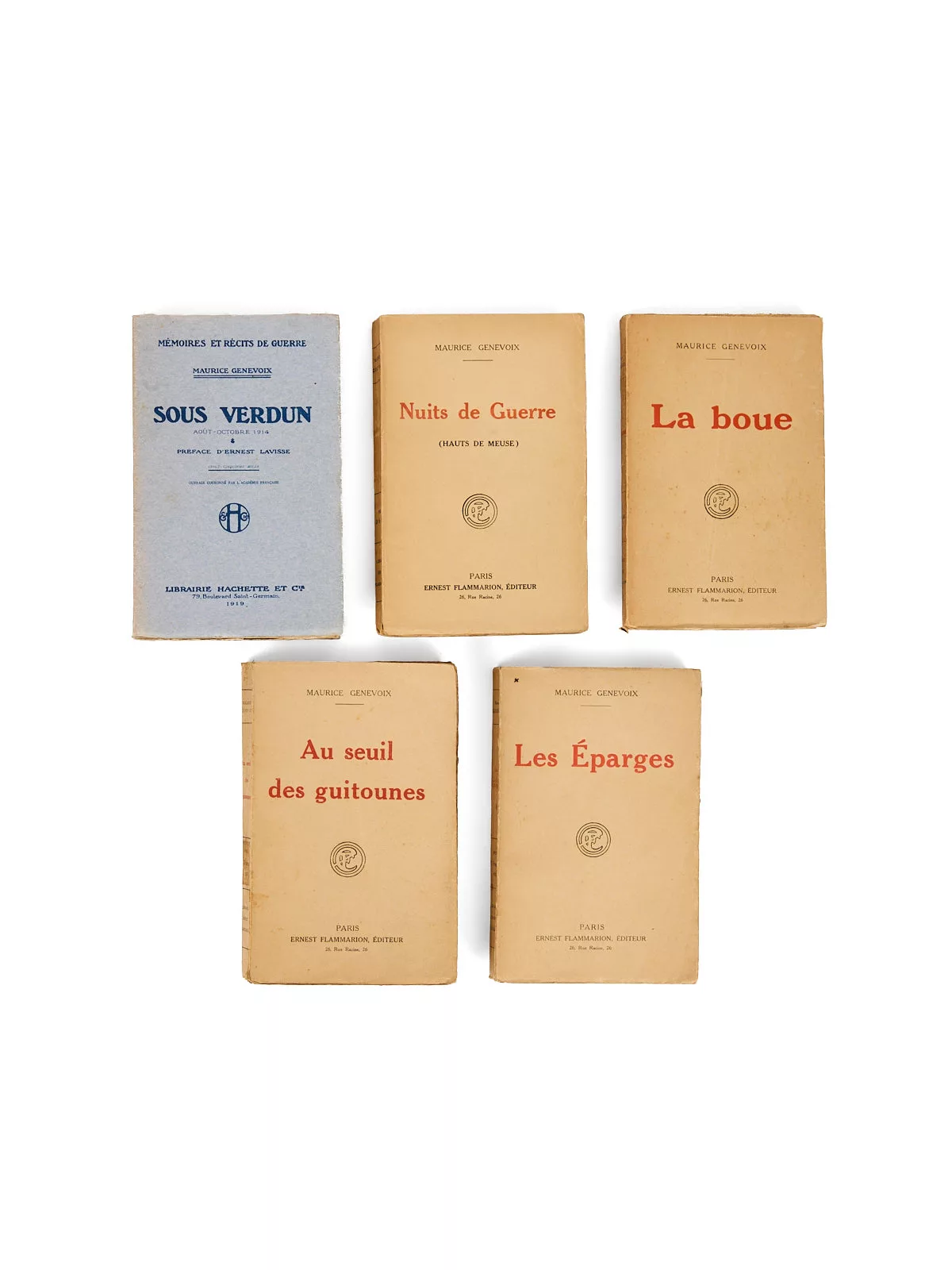
His own copies, kept together in wrappers in his library: this is the only complete set that he preserved in this unbound state.
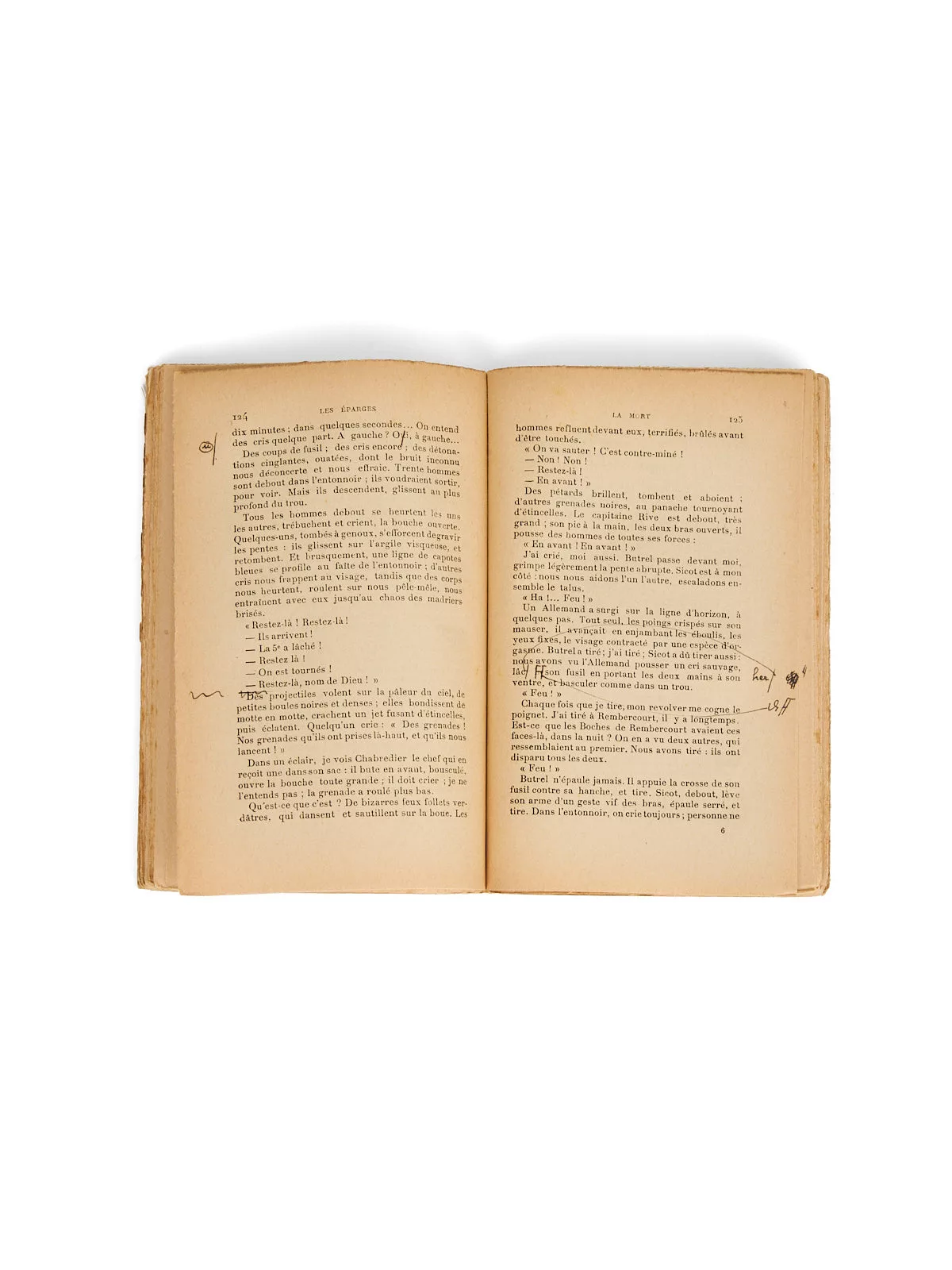
The last volume, Les Éparges, contains numerous autograph corrections.
A young student at the École normale supérieure, Maurice Genevoix joined the 106th Infantry Regiment in September 1914 and went to fight in the Argonne, notably at the Tranchée de Calonne, where he was severely wounded six months later, on 25 April 1915, by three bullets — two in the arm and one in the chest. After seven months of treatment he returned to Paris, to the rue d’Ulm, and, encouraged by Paul Dupuy, the secretary general of the École normale supérieure with whom he had corresponded extensively throughout those six terrible months, he agreed to recount his experience of the front and published Sous Verdun in April 1916. It was followed by Nuits de guerre in May 1917, Au seuil des guitounes in September 1918, La Boue in February 1921, and finally Les Éparges in September 1923: a body of work at once historical and literary, ranking among the foremost accounts published on the First World War.
Where other major works by war writers (Roland Dorgelès’s Les Croix de bois, Henri Barbusse’s Le Feu, Georges Duhamel’s Civilisation, to name only the principal ones) have sometimes been criticized for excessive lyricism or for offering individual rather than collective accounts, Genevoix’s narratives describe with rarely equaled authenticity the camaraderie of the trenches and, above all, the horror, the madness and the cruelty of war, as well as the paradoxes and sometimes aberrant decisions of the high command. So much so that Sous Verdun and Au seuil des guitounes were both cut by censors on publication.
Genevoix drew on an eight-month campaign diary (25 August 1914 to 25 April 1915) to compose his account; the first two volumes, Sous Verdun and Nuits de guerre, omit no day. As John Norton Cru wrote in his 1929 study Témoins, which presents Genevoix’s five war narratives: “These five volumes are not five different works; they are, properly speaking, the five parts of a single work: the transcription and development of the author’s notebook [though Genevoix would later clarify that they were also composed from memory].” Cru added: “Among the authors of the war, Genevoix ranks first, without question. This is not a dogmatic opinion, nor the expression of individual taste. […] It must be acknowledged, whoever may scoff, that Genevoix has a genius for war narrative and his work is incomparable.”
Besides these day-to-day war notebooks, Genevoix also drew on letters sent to his family, to his father, to his brother René, and especially to Paul Dupuy at the rue d’Ulm: “What I had to keep from my family,” he wrote in Jeux de glaces (1960), “I confided freely in these letters, with the concern to be truthful, to share without restraint.”
In writing his war narratives, Genevoix also discovered that writing was both a therapy and a quest. He tried his hand at the novel: Jeanne Robelin was written at the same time as Au seuil des guitounes, and Rémi des Rauches was composed alongside La Boue. It was this last work, by his own account, that made him a novelist. Raboliot would be written only two years after the completion of the war narratives, in 1925.
In 1949, the author decided to bring the five texts together, altering their division and making some changes to the original text so as to form four narratives instead of five. The result was Ceux de 14, “an absolute masterpiece that reads like an ascent toward sacrifice and horror. Its climax is the battle of Les Éparges, the paroxysm of violence, one of the worst ordeals of 1914–18 […] whose extreme violence and continuous bombardment of a confined position prefigure the intensity of the Battle of Verdun. The attention paid to the living men fighting beside him, more than a hundred of whom are precisely identified, gives this text an incomparable human depth, and its literary beauty was admired immediately,” writes the author Michel Bernard, author of Pour Genevoix (La Table ronde, 2011). Eight hundred pages for eight months at the front: undeniably the fullest, most precise and most exact testimony of the combat experience.
A fine complete set. Sous Verdun is in the first postwar edition, printed a few weeks after the armistice. The censored passages remain absent, but typographical corrections establishing the definitive text were made. This copy, unopened, is in strictly as-new condition.
All the other volumes are first editions, strictly first printings without any printing statement; all bear the “Vernelles” bookplate.
The volume of Les Éparges contains some thirty autograph corrections.