


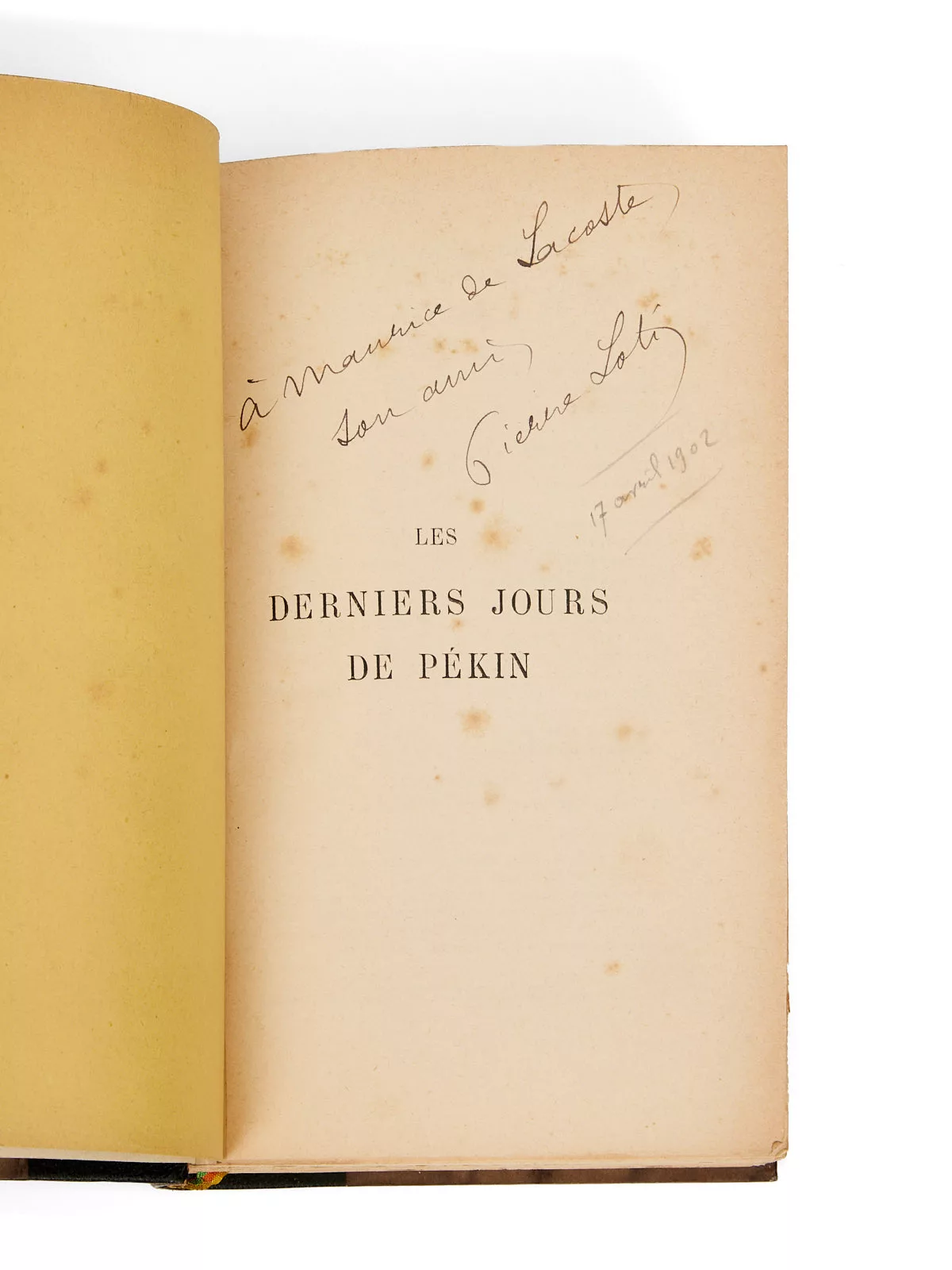
Les Derniers Jours de Pékin
Presentation copy inscribed by Loti to Maurice de Lacoste: “à Maurice de Lacoste, son ami, Pierre Loti.”
On 9 May 1901, Le Figaro published on its front page the first installment of a serialized account that would run until the end of December. Pierre Loti, celebrated for his Orientalist novels, recounts his journey to China, where he had traveled the previous year aboard the battleship Le Redoutable. As a lieutenant in the navy, he took part in the Boxer Rebellion, which had convulsed the country since 1899, pitting Chinese rebels (the Boxers) against foreign colonial powers (the Eight-Nation Alliance, which included France). In a letter to Vice-Admiral Pottier, Loti explains that he had “confined [himself] to noting the things that passed directly before my eyes during the missions you gave me and a journey you allowed me to make into a certain China, until now largely unknown. When we arrived in the Yellow Sea, Peking had already fallen and the fighting was ending.”
It was nonetheless a ravaged city that Loti discovered: in the summer of 1900, the capital had witnessed the confrontation between the besieged foreign legations and the Boxer forces, backed by imperial power. The siege, later known as the “55 Days of Peking,” ended in victory for the foreign powers and the massacre of the Chinese rebels. The Boxer War ended in September with the signing of a peace treaty.
Loti’s account ran in Le Figaro until 30 December 1901 and was published in book form in March 1902.
An interesting copy, presented to a close and longstanding naval comrade, Maurice de Lacoste. Born in Metz in 1864, Lacoste entered the naval academy in 1882, fifteen years after Loti. Made first-class midshipman in October 1885, he was first assigned to the Far East naval division. It was during these early voyages that he met Pierre Loti, who had been sailing those waters since the same year aboard the Mytho, one of eleven official transport vessels of the French naval forces in the Far East. It was on board this ship, during a month-long crossing, that Loti wrote part of the manuscript of Pêcheur d’Islande.
Lacoste was promoted to ensign in October 1887, serving aboard numerous vessels of the French Navy. Promoted to lieutenant in October 1893, he was successively assigned to several battleships and then cruisers, the navy’s spearhead and the most powerful warships of the period. He was later assigned to the central directorate of naval artillery, then made frigate captain before joining the staff in 1909.
A fine copy.