

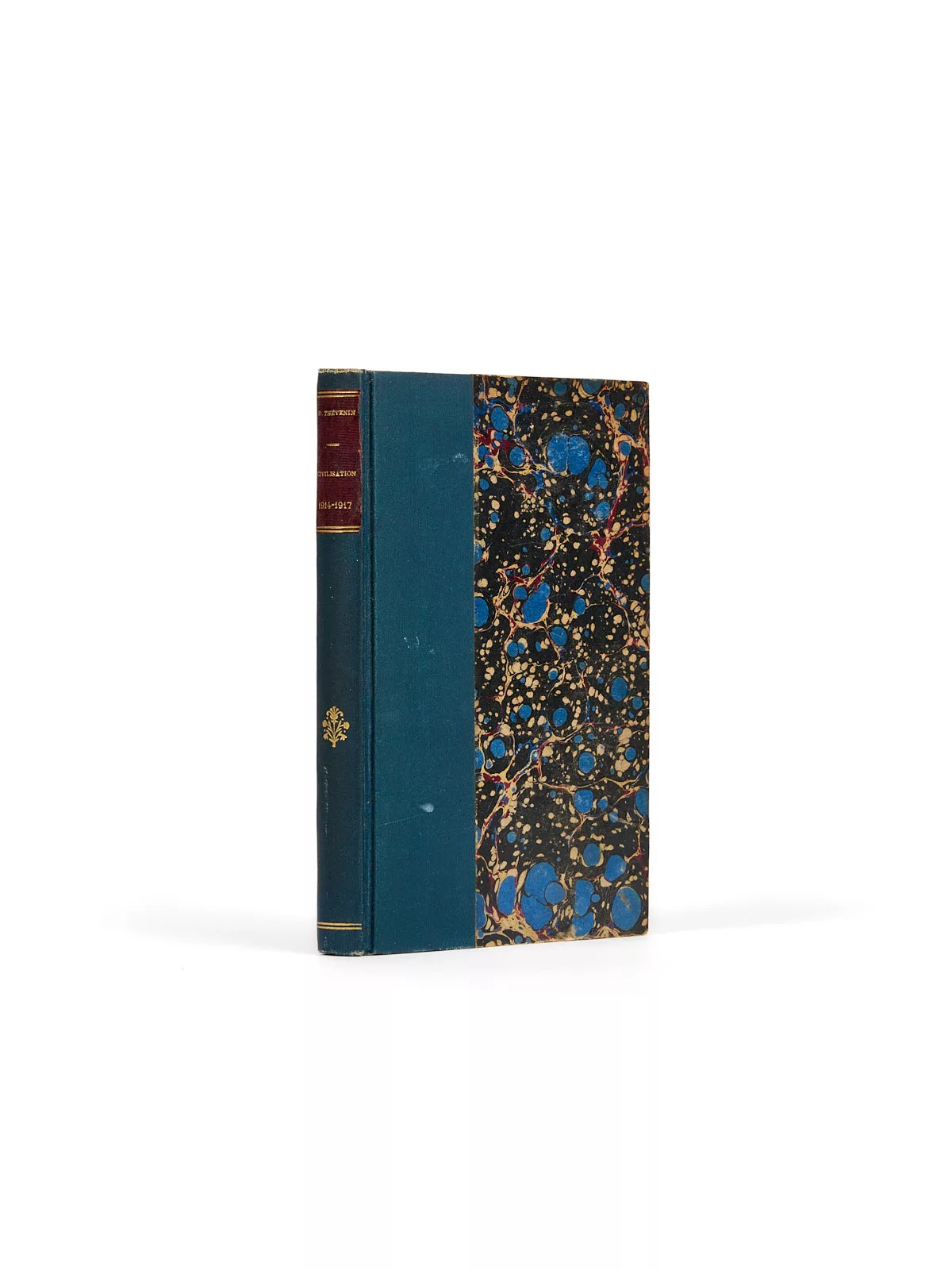
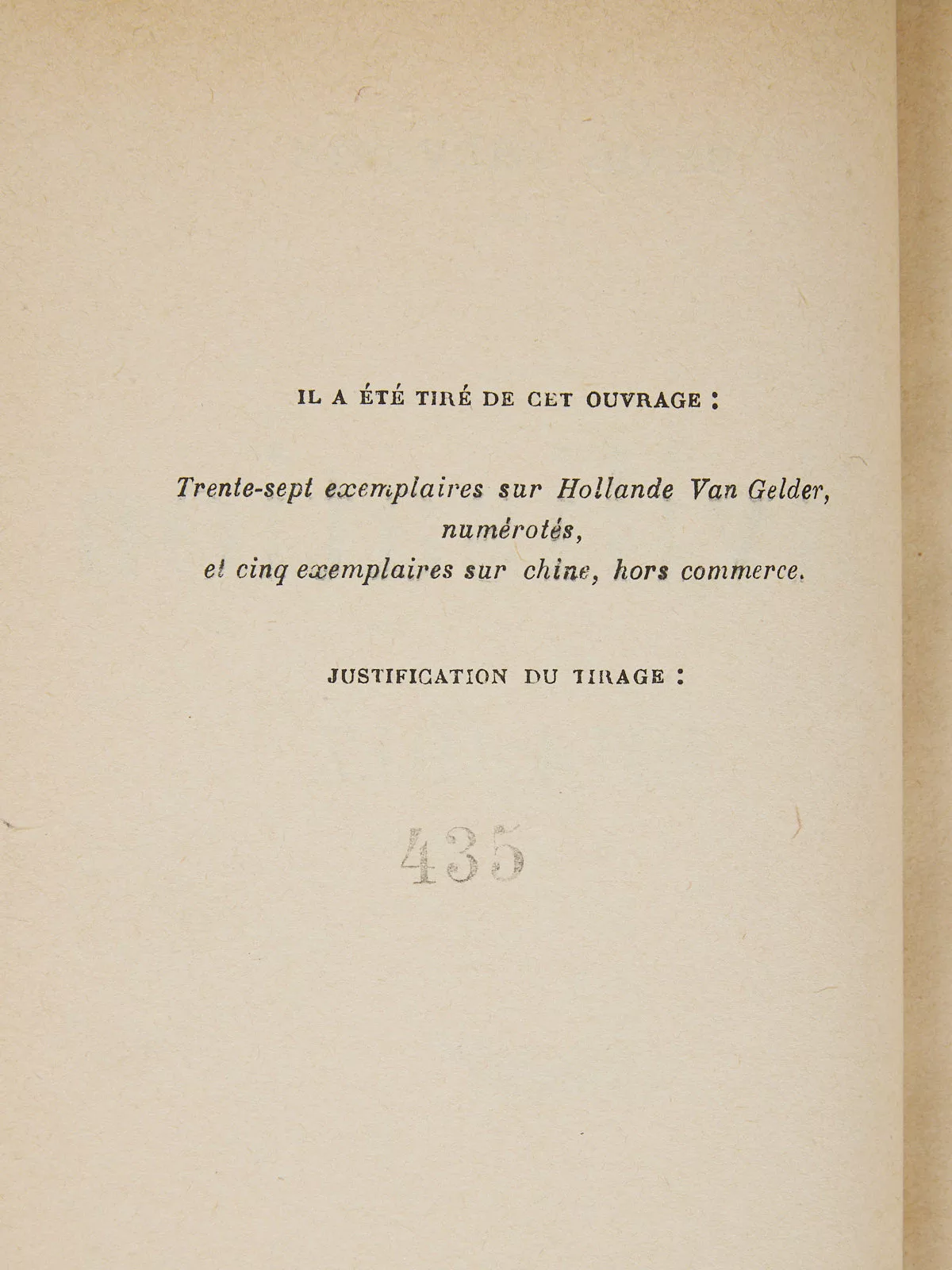
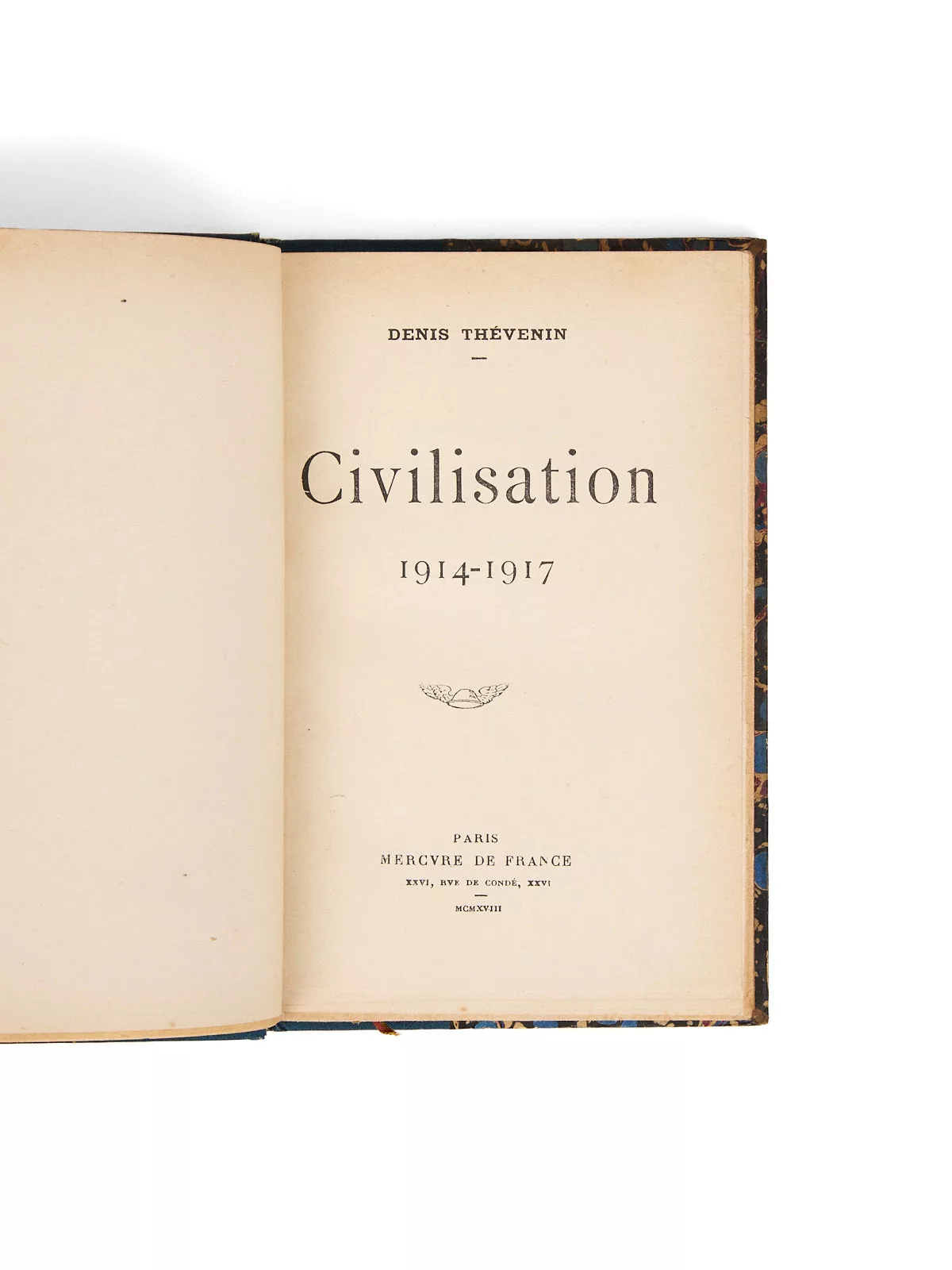
Copy from the first printing (no. 435) — after 37 copies on Hollande paper and 5 on China paper.
As early as mid-December 1914, Georges Duhamel, then working as a physician, wrote to his wife: “I shall owe to the war the fact of having left my usual rut and having seen an enormous array of characters that nothing could have made me imagine.” These first impressions gave rise to his first book, Vie des martyrs, published in April 1917, a title for which Genevoix expressed his admiration in L’Europe nouvelle (January 1918).
Duhamel drew further on this experience as a war surgeon a year later for Civilisation, adopting the guise of various non-combatant narrators. He casts a compassionate eye on wounded soldiers and delivers a powerful account of suffering in the field hospitals behind the front lines — though not without the reservations later expressed by Norton-Cru in Témoins, who tempered the enthusiasm of contemporary critics: “Did the author not play too insistently on the string of pity, for literary purposes, with the intention of producing crowd-pleasing set pieces? (…) One who stylizes or transposes the facts of his experience may claim to have produced a work of literature, never that of a witness.”
Nonetheless, Civilisation was awarded the Prix Goncourt on 11 December 1918, prevailing over Koenigsmark by Pierre Benoît, Les Silences du colonel Bramble by André Maurois, and Simon le Pathétique by Jean Giraudoux. The novel won by six votes to four over Pierre Benoît, finally leading Duhamel to abandon surgery in favor of writing.
In August 1940, Civilisation was banned and placed on the Bernhard list, before Duhamel’s entire body of work was placed on the Otto list. At the Liberation, Duhamel joined the Comité National des Écrivains, from which he resigned in 1946, disapproving of the excesses of the purge.
The first edition of the title comprises the numbered copies of the first thousand, together with five deluxe copies on China paper — hors commerce — and thirty-seven on Hollande paper.
A fine copy of the first printing, its fragile wrappers preserved in near-new condition.