

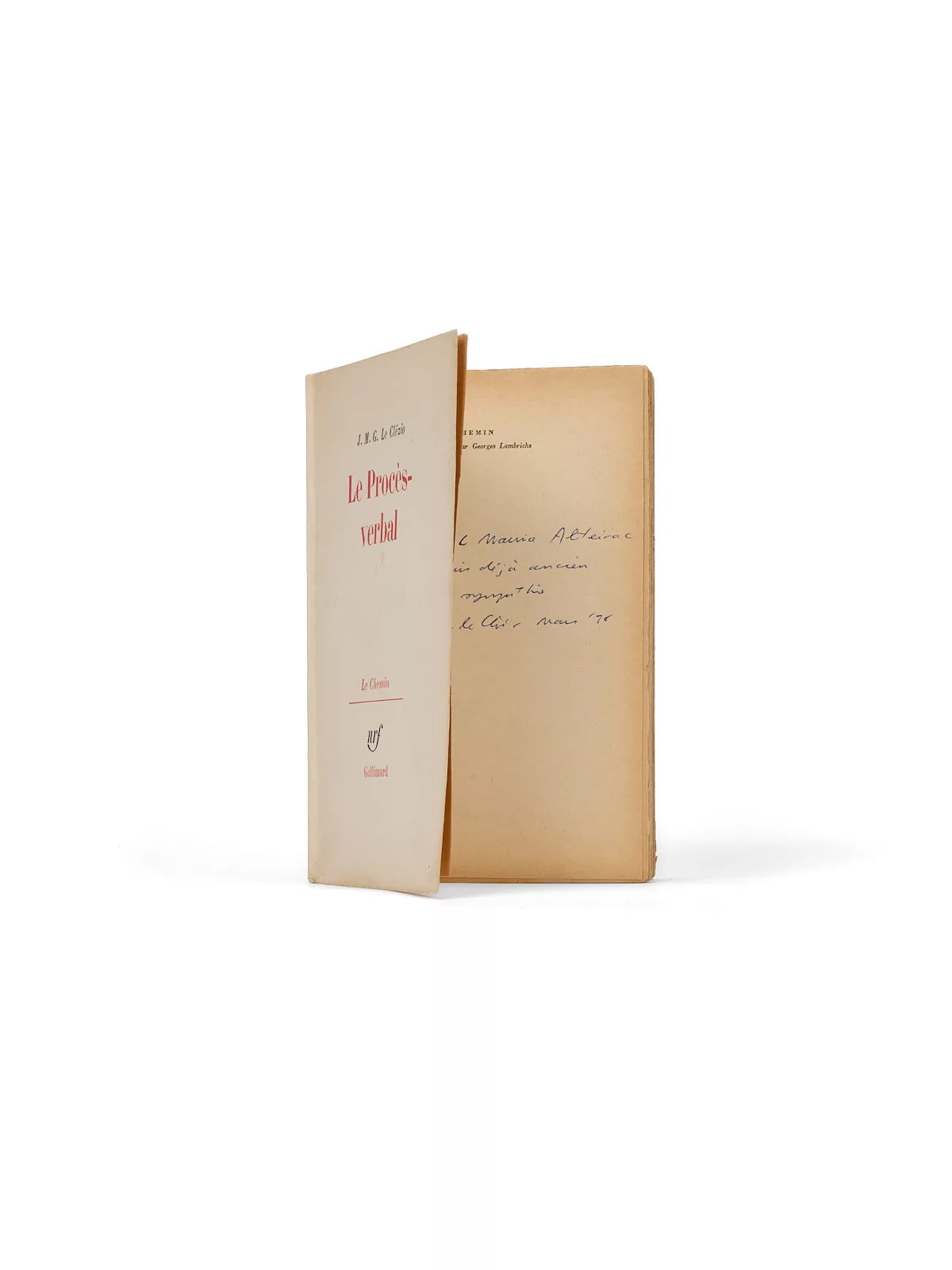
Le Procès verbal
One of the review copies, stamped as such.
Inscribed and signed by the author: “Pour Arlette et Maurice Alteirac, ce souvenir déjà ancien avec ma sympathie, JMG Le Clézio, mars 96.”
J.-M.G. Le Clézio’s first novel, Le Procès-verbal, was awarded the Prix Renaudot upon publication. Hailed as a new and disturbing work of remarkable formal density, it marked the striking literary debut of a twenty-three-year-old writer whose manuscript had sat in a drawer for nearly a year before Gallimard’s reading committee, under Jean Grosjean and Georges Lambrichs, accepted it. Its publication in the “Le Chemin” series, directed by Lambrichs, was significant: it placed the book within a new literary current attentive to the real, tracing the enigmatic trajectory of Adam Pollo, a figure on the margins of society, madness and revolt, who seems “not quite sure whether he has come out of the army or out of a psychiatric asylum.” The narrative is feverish and hallucinatory, saturated with images, shifts in tone, visions and existential meditation. Pollo wanders through a world stripped of political, moral or poetic bearings.
In an interview given to Le Point decades later, Le Clézio recalled the intimate and historical context of its composition:
“It was a strange time. […] I wrote Le Procès-verbal in fragments, at the back of a café, mixing in snatches of overheard conversation, images, newspaper cuttings. […] The novel was finished after the Évian Accords, when I understood that the threat was ending, that we were going to live.”
Behind the feverish writing lies the Algerian War, ever-present, suffocating and destructive. Several of the author’s friends left for the front — some never returned. The war runs through the novel like a silent shockwave, offering a critical and psychological plunge into postcolonial society. Between wandering and shock, it should be read as the inaugural act of a writer who would never cease to question boundaries.
A fine copy of the first printing, with inscription.