

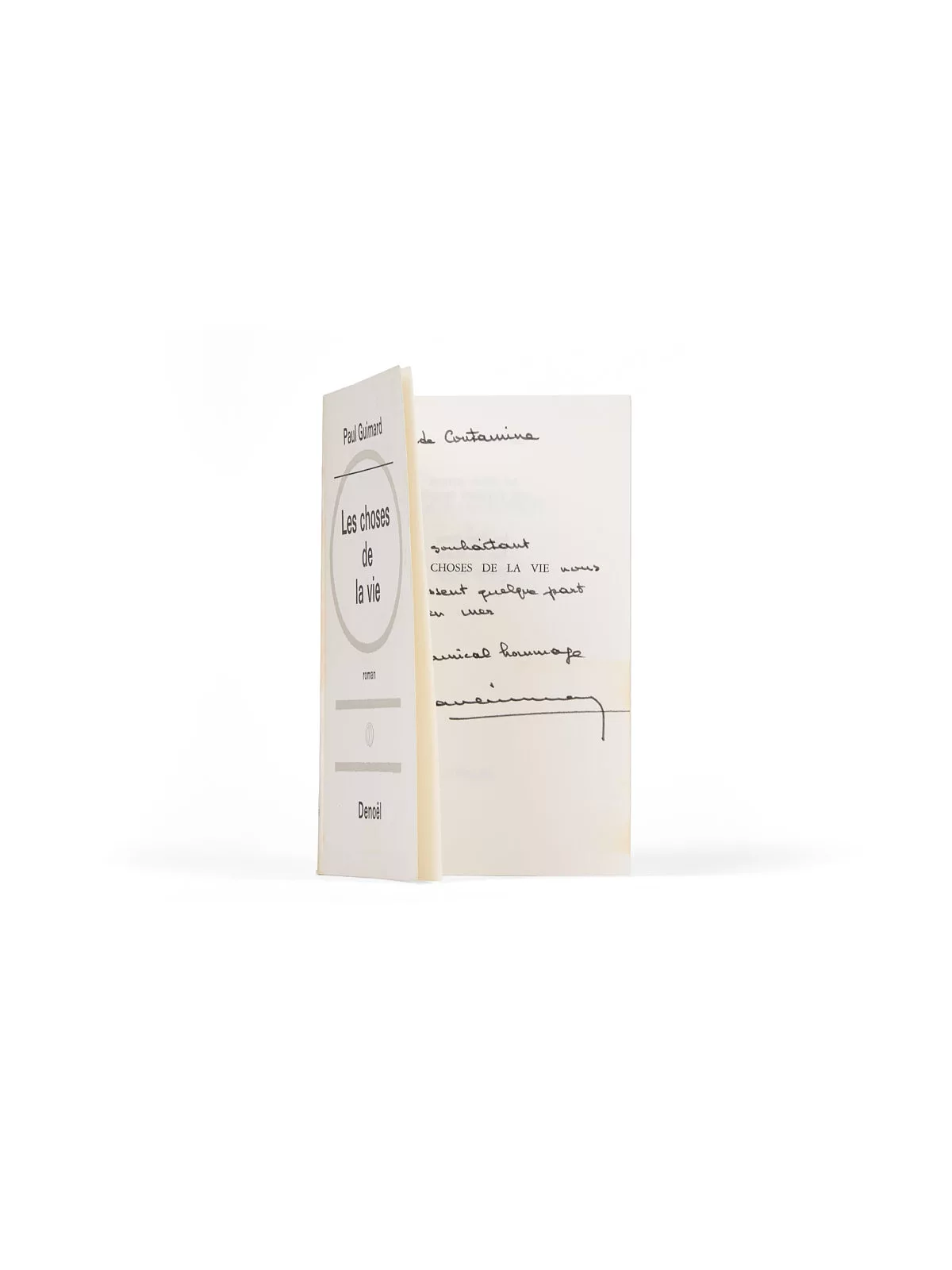
Les Choses de la vie
Copy from the first printing.
Signed presentation inscription: “pour Claude Contamine, en souhaitant que [Les choses de la vie] nous réunissent quelque part en mer. Très amical hommage. Paul Guimard.”
“I am absolutely within my rights, but I am trapped. I am going exactly a little too fast, the van is exactly a little too askew, the truck is exactly a little too close, the road is exactly a little too narrow. Damn it! There isn’t one chance in a million of everything going so wrong, not one in a billion, and it always happens to a fellow who has nothing to reproach himself for, who drives too fast, granted, but without excess (…). Everything was decided in two seconds — I’d like to know which ones.”
Paul Guimard wrote this novel after himself narrowly escaping death in Casablanca in 1963. Its title was inspired by Valéry Larbaud who, at the moment of slipping into death, murmured: “Adieu les choses de la vie.”
A fine title for what Claude Sautet called a “uniquely revealing juxtaposition of the things we meant to do and those we did, the things we meant to say and those we said.” Sautet decided to adapt the novel two years later. With Les Choses de la vie, Sautet inaugurated his cycle of intimate contemporary portraits, which would become his trademark and the foundation of his reputation. It was Pierre Granier-Deferre who, by showing him rushes from La Piscine, convinced the director to cast Romy Schneider in the role of Hélène.
It was her first collaboration with Claude Sautet, for whom she would become a favorite actress. They would go on to make four more films together.
Spine restored.