

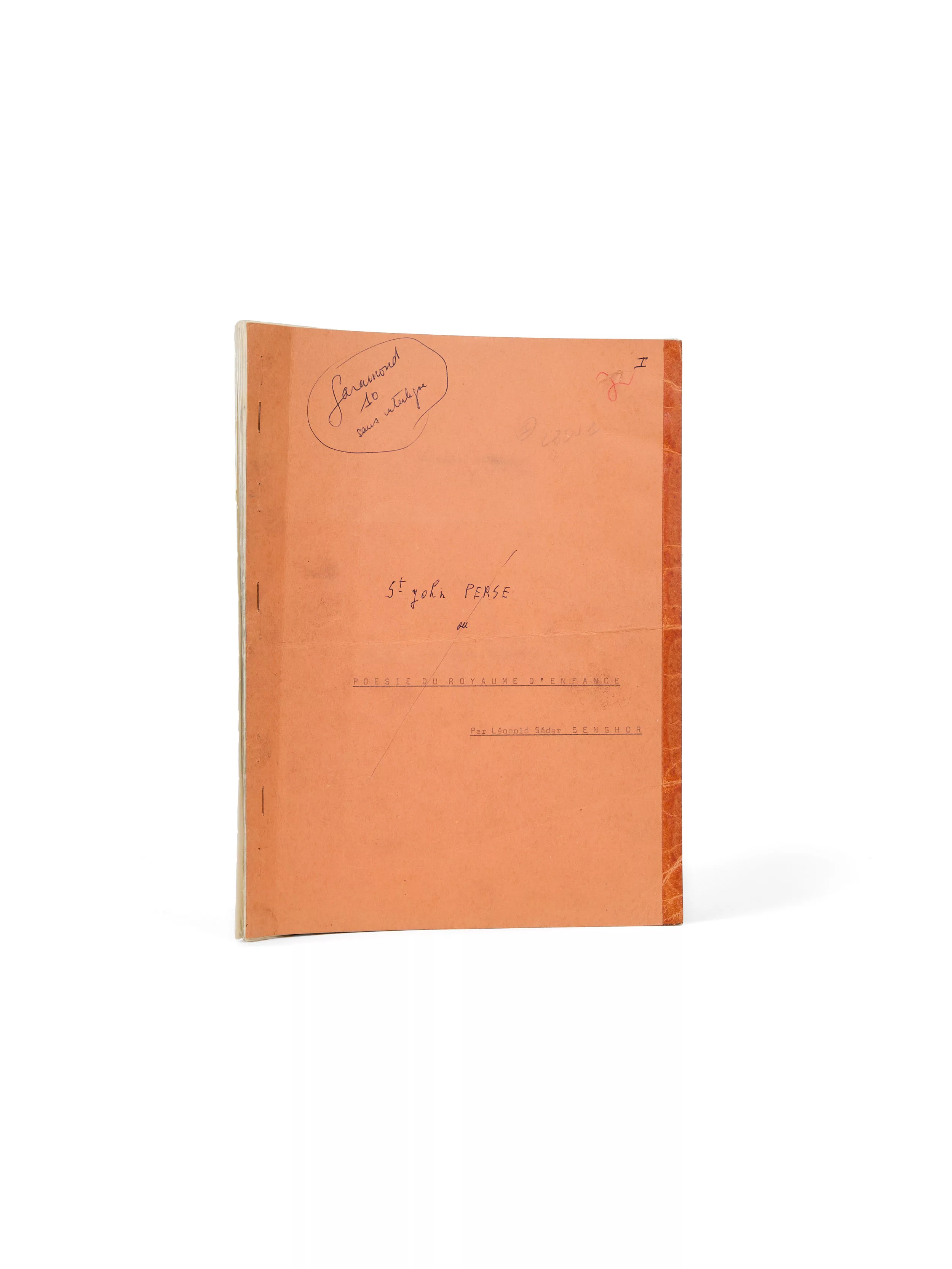
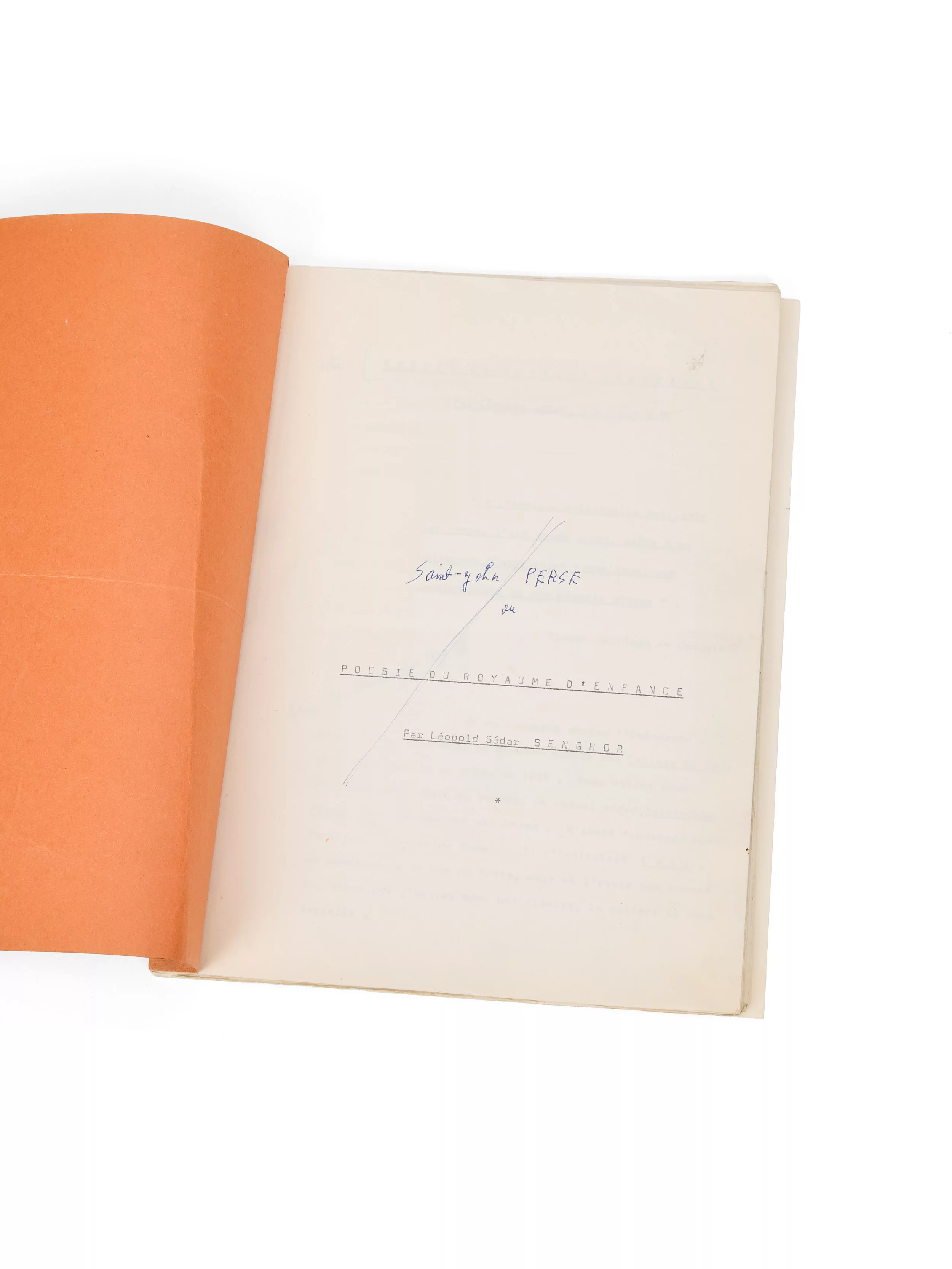
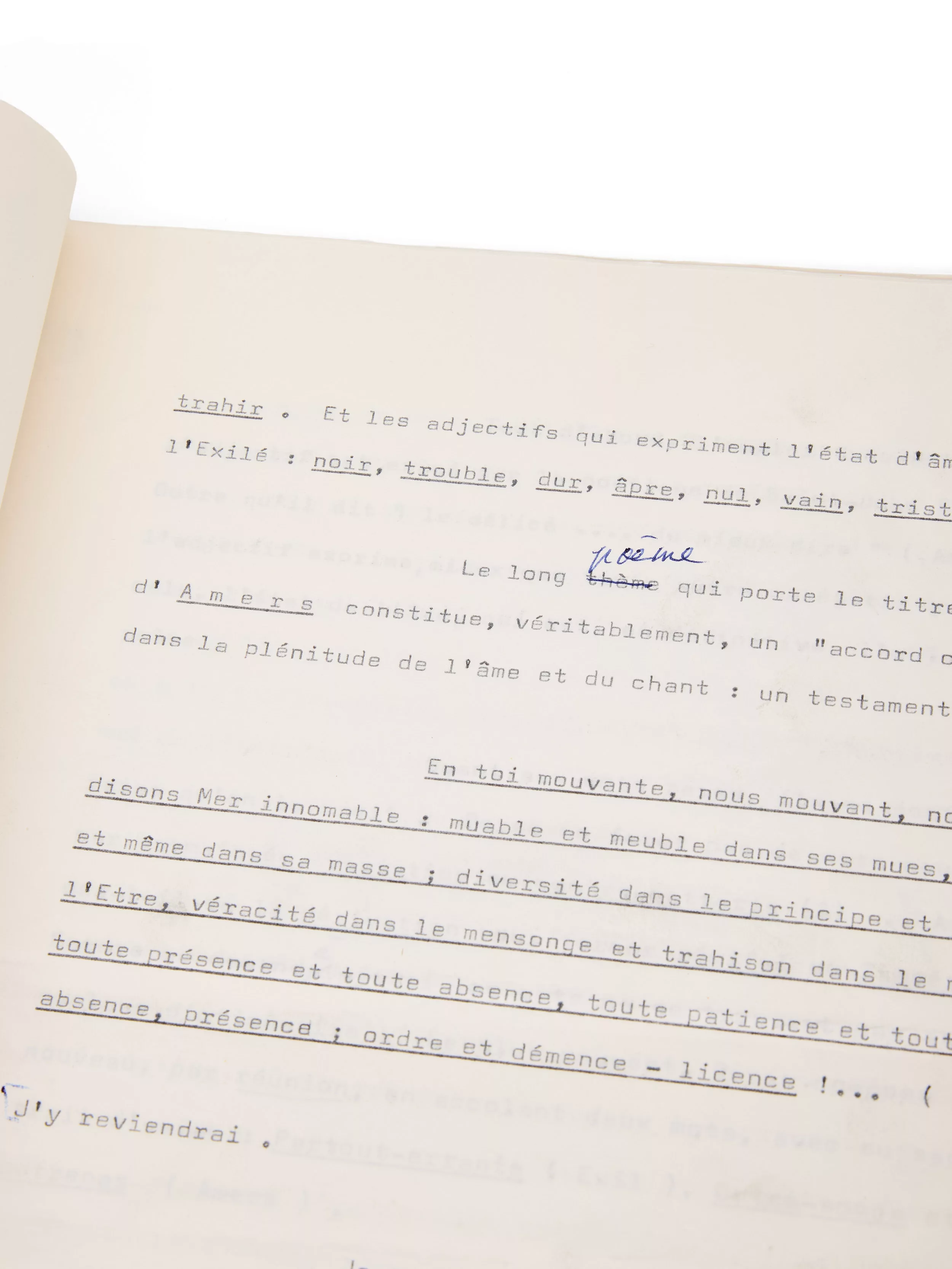
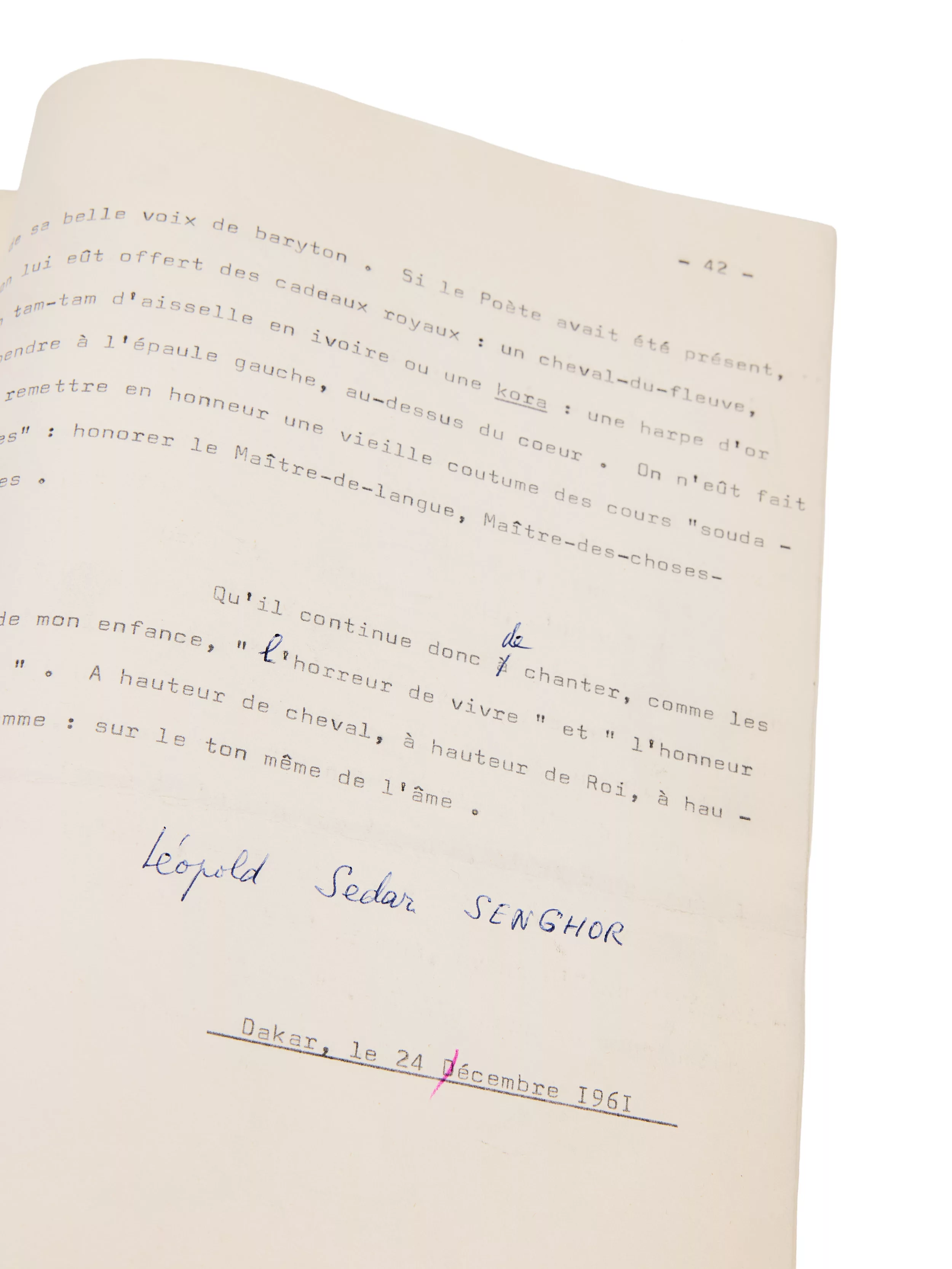
Some twenty corrections, both typographical and consisting of additions and annotations to the text, corresponding to the final published text.
Saint-John Perse published Amers, his longest poem, in 1957, marking a return to the landscape of childhood, followed by Éloges in 1960, in the same vein: the first section of that collection, entitled “Pour fêter une enfance,” consists of six poems of equal length forming a hymn to childhood.
For Senghor, this was a new discovery of Perse’s poetry, and a shock he describes as a “thunderbolt” at the opening of the study he devoted to him, published in La Table ronde in May 1962. It allowed him to grasp the full importance of Perse’s poetry, from his reading of Exil and Vents through to Amers. His first encounter with Perse’s work, however, dates from just after the war, at the Liberation. In the postface to Éthiopiques, written in 1954, Senghor states: “The poets of the Anthologie underwent influences, many influences; they take pride in it. I will even confess — Aragon sets me the example — that I have read widely, from the troubadours to Paul Claudel. And imitated a great deal. […] I will also confess that upon discovering Saint-John Perse, after the Liberation, I was dazzled like Paul on the road to Damascus.”
Saint-John Perse was not indifferent to such a mark of admiration: in a letter to Jean Paulhan sent from New York on 5 June 1962, shortly after the article appeared in La Table ronde, Perse wrote to Paulhan: “I have been sent an issue of La Table ronde containing a most unexpected and most sympathetic study of my work by Senghor, whom I do not know personally… I found in it interesting things connecting with the poetic substance proper to Black Africa.” Far from being mere gratuitous exegesis, this reading won Perse’s genuine approval, and it was through this study that the two men subsequently entered into direct contact.
It is worth noting that among the archives of the Fondation Saint-John Perse is a copy of the typescript [87.C, Critique holdings], apparently sent to the Aix-en-Provence foundation by the author himself. It bears no corrections, and the present version appears to be the only corrected set in existence.
Saint-John Perse ou poésie du royaume d’enfance was later incorporated into Liberté 1, Négritude et humanisme, published by Seuil in 1964.