

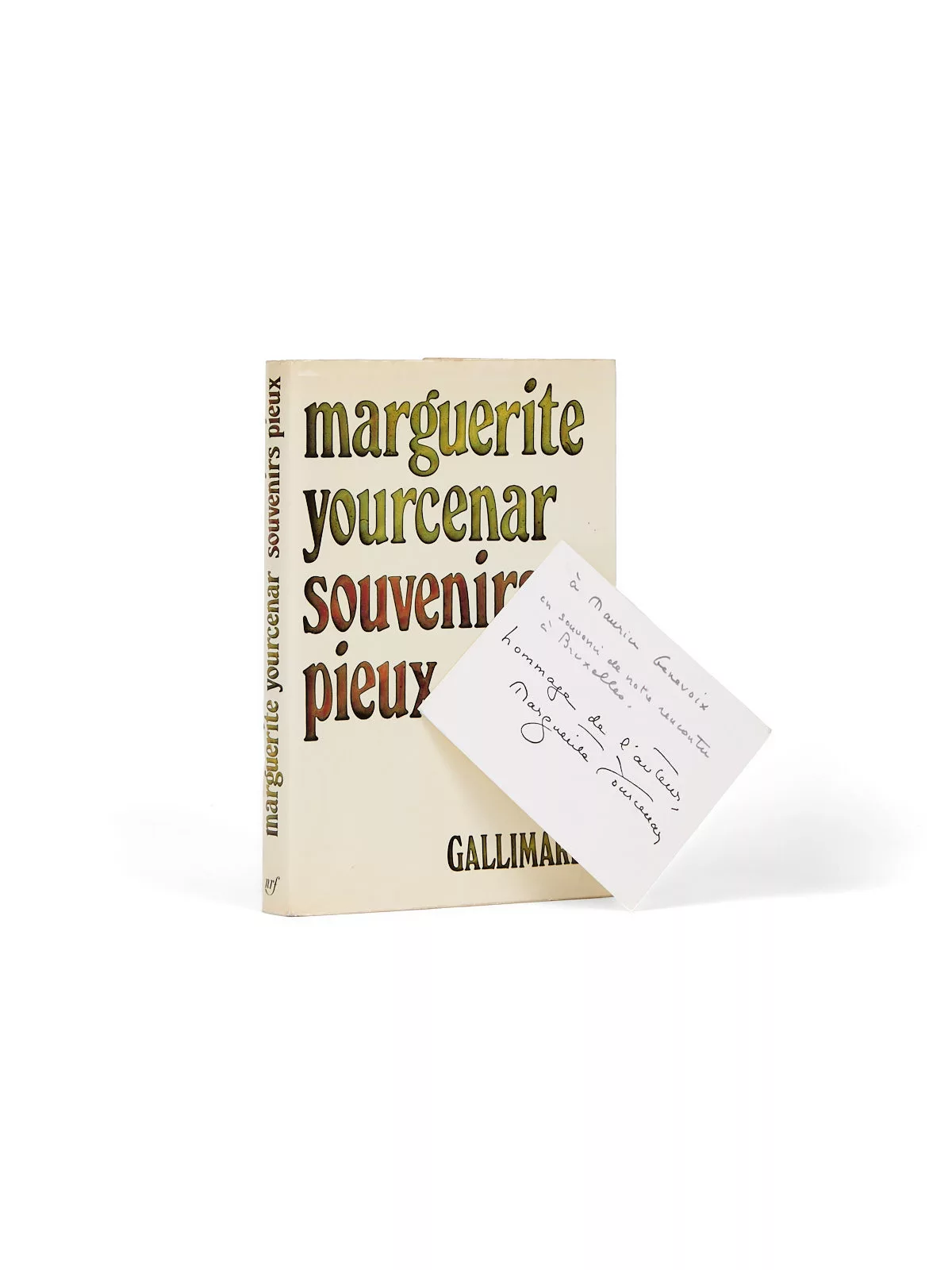
Souvenirs pieux
Signed presentation inscription (on an accompanying card): “à Maurice Genevoix, en souvenir de notre rencontre à Bruxelles; hommage de l'auteur, Marguerite Yourcenar.”
Souvenirs pieux recalls the author’s maternal ancestors and opens the family saga that would continue with Archives du Nord and Quoi? L’Éternité. The book, whose title refers to the traditional devotional cards sent on the occasion of a death, unfolds chronologically, from “l’accouchement” through “la tournée des châteaux” and “Deux Voyageurs en route vers la région immuable,” to the final section, “Fernande,” recounting the childhood and youth of Yourcenar’s mother and her marriage to Michel-Charles de Crayencour, a widower in his fifties who would soon become Marguerite Yourcenar’s father.
The text had first appeared the previous year with Éditions Alphée in Monaco.
A fine presentation copy inscribed to Maurice Genevoix, then permanent secretary of the Académie française, which Yourcenar would join on 6 March 1980 — a historic turning point, as no woman had ever before been received under the Coupole. Before that, however, Yourcenar had been elected to the Académie royale de Langue et de Littérature françaises de Belgique, received there on 27 March 1971. Maurice Genevoix was present on that occasion: the permanent secretary of the Académie française had come to present the prix Habif, the grand prize for French literature outside France, to the Canadian writer Anne Hébert, and it was there that he and Yourcenar first met, an occasion recalled here in her inscription. Genevoix would celebrate her two years later, when she received the Académie française’s grand prize for literature for her entire body of work. Three years after that, Jean d’Ormesson formally invited Yourcenar to join the Académie’s forty members. She replied on 22 October 1979: “[…] as long as I am not obliged to put myself forward as a candidate, something I instinctively find repugnant, all the more so since my being a woman makes the step even more conspicuous, and as long as I am not obliged to maintain a fixed residence in Paris even for part of the year, nothing would certainly make me refuse the honor you so generously wish for me. To do so would seem to me an insult to more than three centuries of French literary history.”