

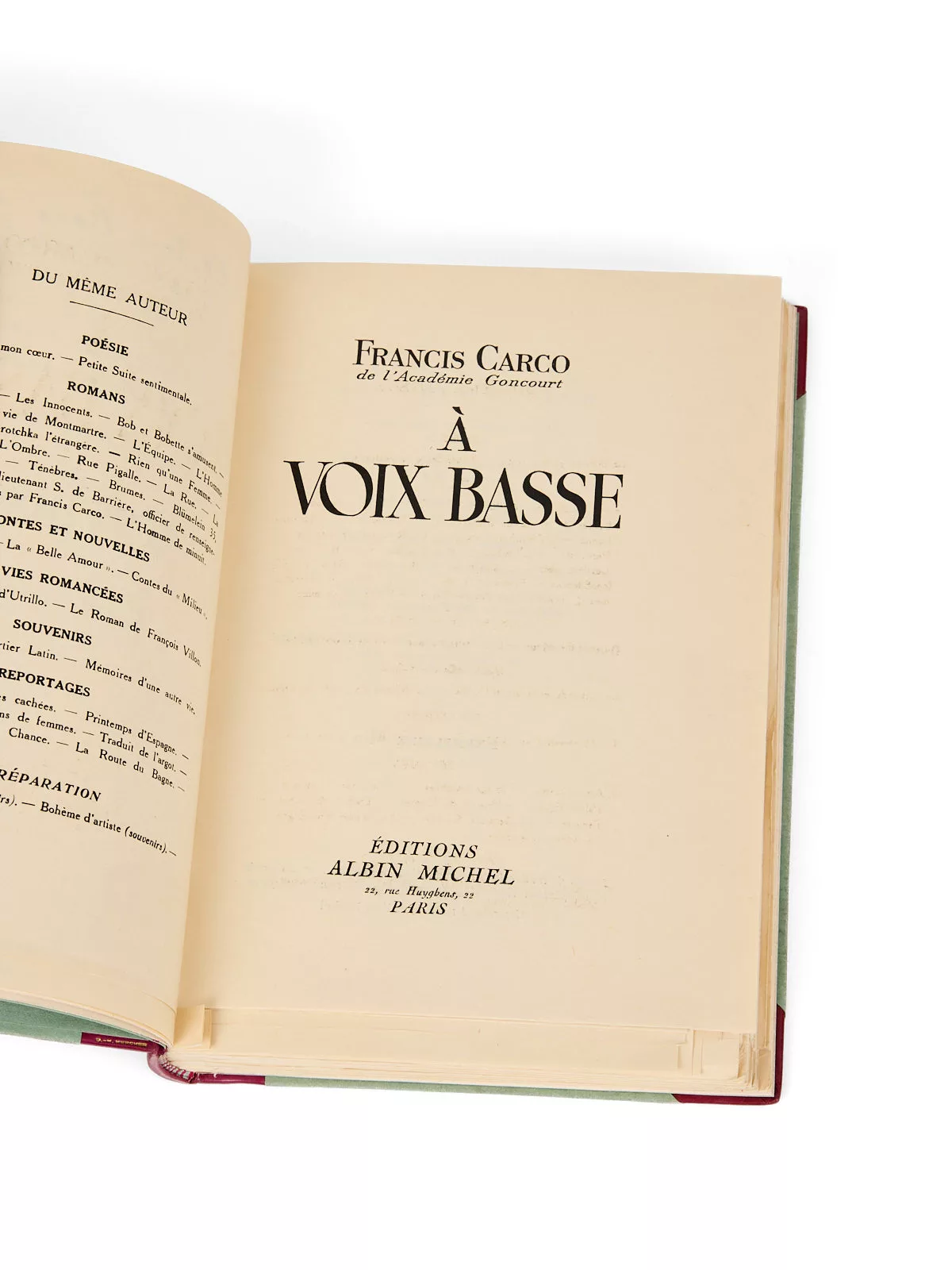
À voix basse
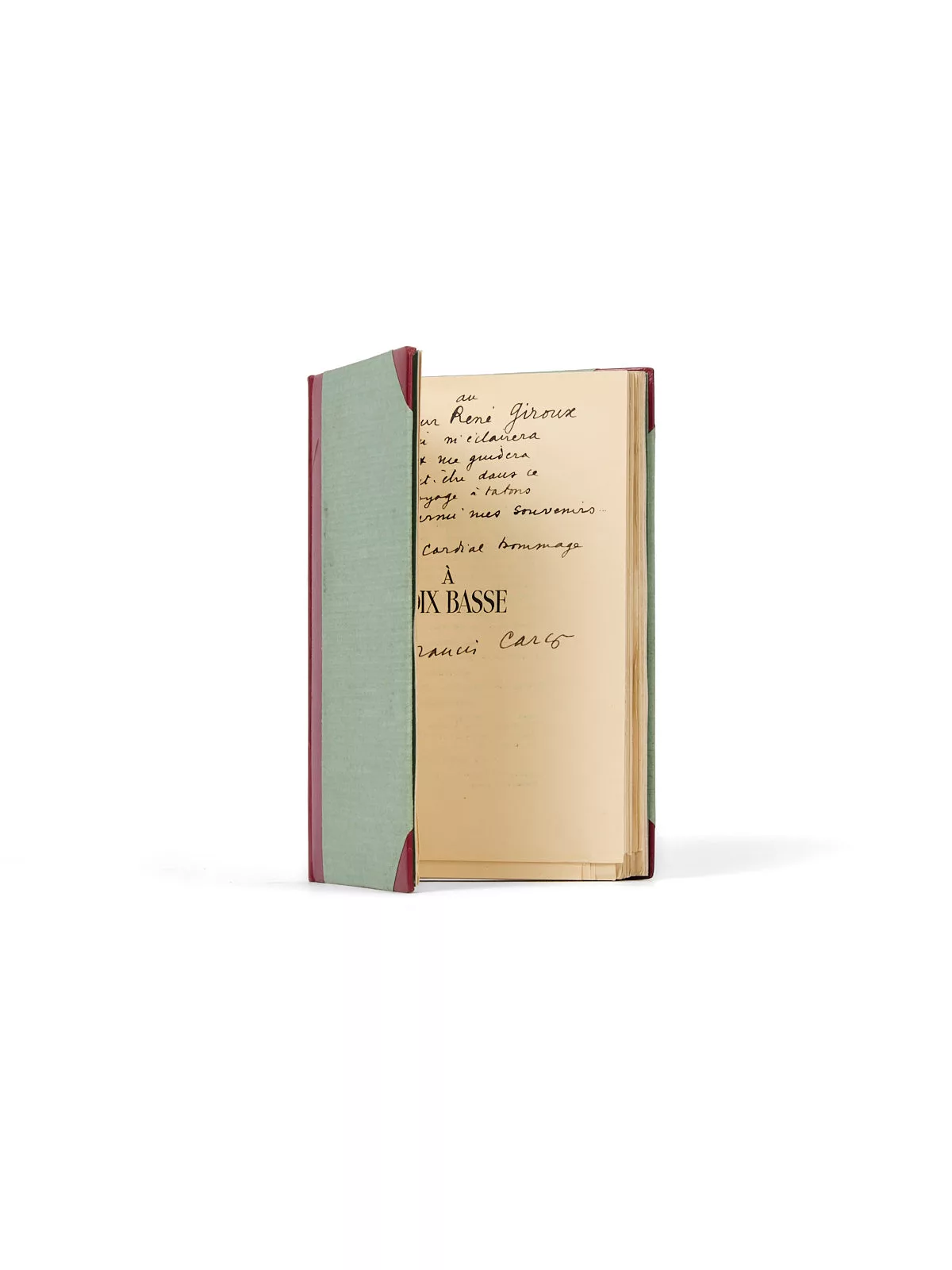
One of 18 copies on Imperial Japan paper following one author's copy on nacré Japan paper (no. M).
Signed presentation inscription: “au docteur René Giroux, qui m'éclairera, et me guidera peut-être dans ce voyage à tâtons parmi mes souvenirs. En cordial hommage, Francis Carco.”
With À voix basse, Francis Carco set aside the underworld figures who had made him famous — from Jésus-la-Caille to his chronicles of the Parisian underworld — to turn to more intimate material: memory itself. Here the writer evokes his childhood and early years in a tone that is almost confidential.
For the general public, Carco remained “the Homer of the underworld,” in Colette’s phrase. But from the 1920s onward, he also became one of the principal architects of the Montmartre mythology, fixing in his books the legend of the Butte and the Lapin Agile. With À voix basse, he fully embraced this memoir-writing vein, then enjoying considerable success; he would return to it four years later in his Mémoires d’une autre vie (Geneva, 1942), which brought together all his works devoted to his memories (De Montmartre au Quartier Latin, Montmartre à vingt ans, Bohème d’artiste…), a practice fashionable during the interwar period as part of a well-established editorial trend in which writers revisited their own legends. As Vincent Laisney has observed, Carco excelled at “the art of fictionalizing his memories,” turning memory into genuine literary material. (Vincent Laisney, in Le mémorancier. Francis Carco, Lettres modernes Minard, 2022).
A fine copy.