

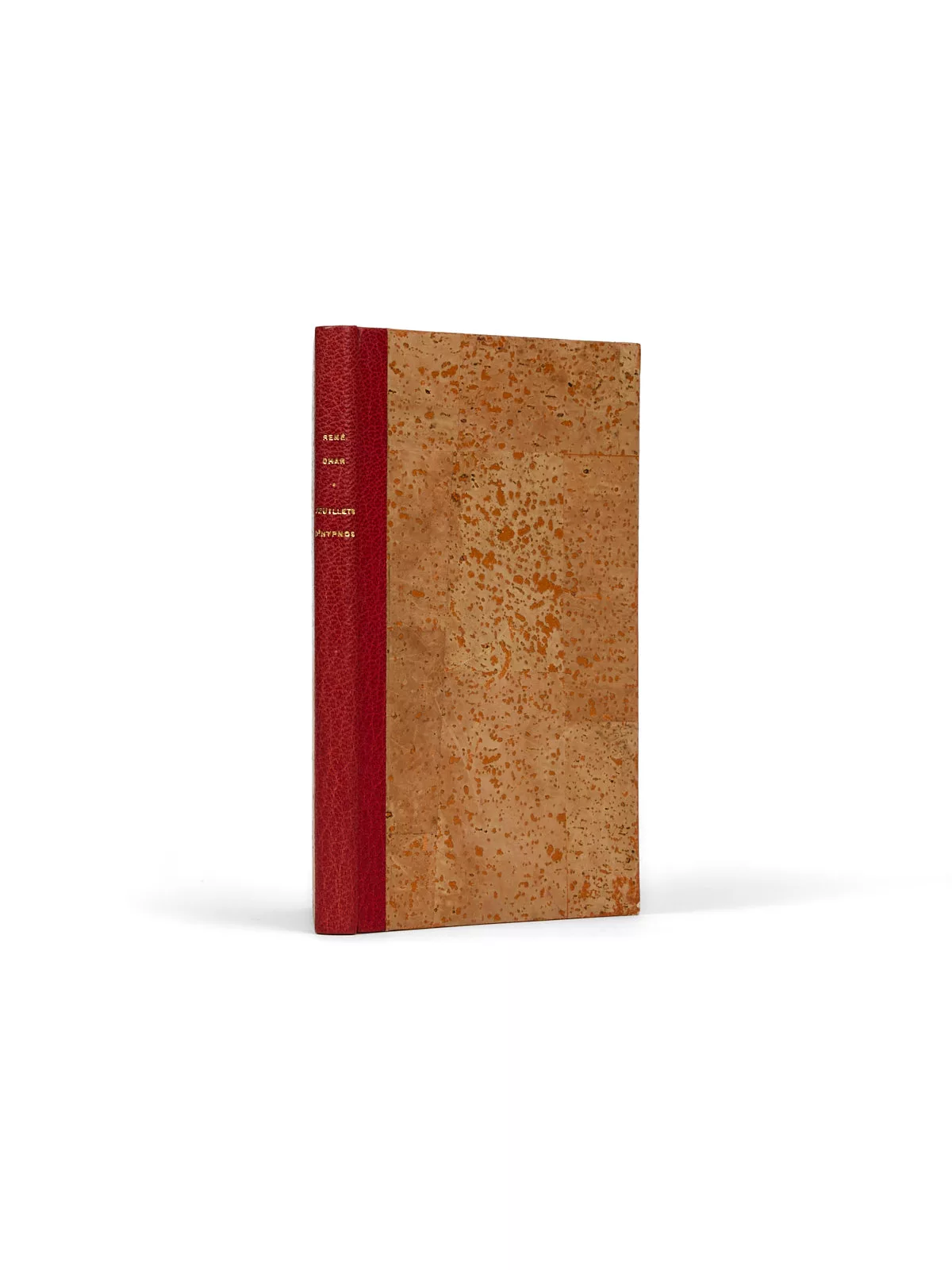
Feuillets d’Hypnos
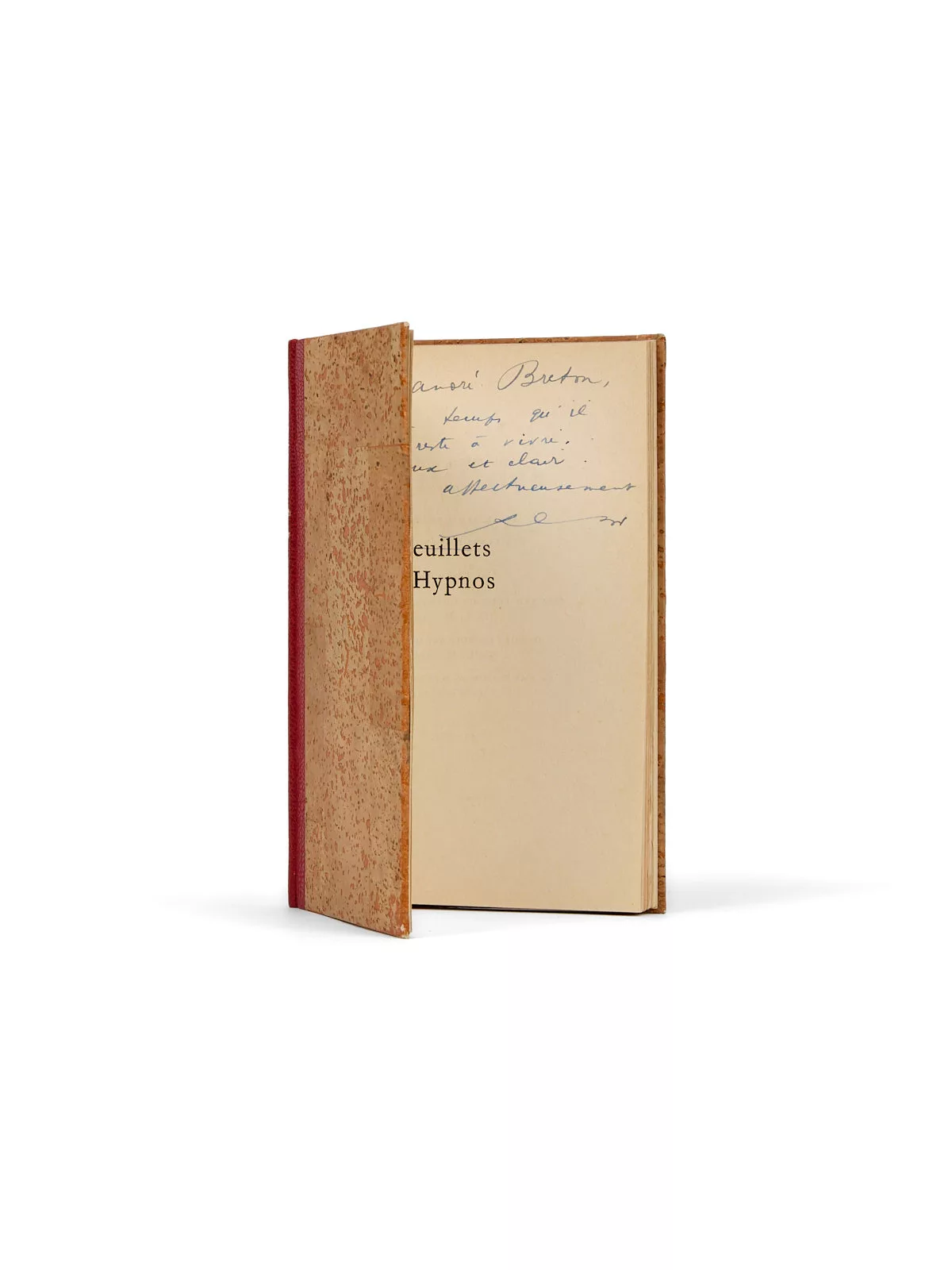
Signed presentation inscription: “à André Breton, pour le temps qu'il nous reste à vivre, orageux et clair, affectueusement, René Char.”
A portrait of René Char is laid into the volume, captioned on the reverse “1944 - photo Irisson - Isle/Sorgue.” It shows the poet, facing forward, in the uniform of “Captain Alexandre” at the time of the Liberation.
The publisher's insert is also preserved.
This “topical testimony,” written on emerging from the underground resistance, stands as one of the decisive texts of 1946 and, for Char, his major postwar book: 237 densely written fragments that form both a chronology of the maquis and an acknowledgment of the “derisory” powerlessness of poetry as a political instrument.
A precious copy inscribed to André Breton, in terms of an almost programmatic intensity, if not ambivalence (“stormy and clear”), which is — to our knowledge — the only postwar inscription to his former Surrealist companion, and probably one of the finest provenances in existence, alongside those of Albert Camus and Paul Éluard, the other great friend of Surrealism. Breton’s library held several inscribed titles by Char, most dating from the early Surrealist period:
Arsenal (1929): “à André Breton, dans cette île des pas perdus, qu’il découvre. Avec toute mon affection, avec toute ma confiance, René Char”;
Arsenal (1930): “à André Breton, que j’admire. Très amicalement, René Char”;
Ralentir travaux (Kra, 1930), with a double inscription by Éluard and Char;
Dehors la nuit est gouvernée (G.L.M., 1938), inscribed;
Poème écrit par les quatre frères Roux (G.L.M., 1939), inscribed by Char as its preface writer;
and finally the Poètes d’aujourd’hui volume (Seghers, 1961), “avec la fidèle pensée de René Char” — the only other inscription besides this postwar Hypnos.
In return, Breton gave Char several titles, all inscribed: the emblematic Nadja, bound by Paul Bonet, along with Introduction au discours sur le peu de réalité, Second Manifeste du surréalisme, L’Immaculée Conception, Les Vases communicants, Qu’est-ce que le surréalisme?, and the last text Breton wrote while still in France, Fata Morgana, published in Buenos Aires in 1942.
All these — except the last — were given to Char in the early days of their friendship, around the turn of the 1930s, following Arsenal: “it is henceforth with the men named Paul Éluard, André Breton, Louis Aragon that my efforts will find expression.” Char co-signed Ralentir travaux with the first two before finally distancing himself from the movement in 1934, without fully breaking away, still contributing to a few tracts. In 1947 he declined to take part in the exhibition on Surrealism while nonetheless paying tribute to “a great moment of his life that never knew a farewell.”
Feuillets d’Hypnos was given to Breton upon his return from the United States, on 25 May 1946. A reunion that was more apparent than real: loyalty to a shared past led Char to display his esteem for Breton, which he would affirm even more strongly the following year in La Lettre hors commerce, siding with Breton when the young Revolutionary Surrealist movement of Christian Dotremont and Noël Arnaud — which Char had initially found interesting — attacked him. A shared rejection of Stalinism drew the two men together, but growing differences would ultimately lead to a rupture: it was above all the experience of the war that irreparably widened the distance between Char and a Surrealist movement whose capacity for action now seemed to him derisorily literary in the face of History’s dangers. This same reproach of irresponsibility would later be voiced by Char to condemn Breton in the quarrel over L’Homme révolté.
“By publishing Seuls demeurent in 1945 and then Feuillets d’Hypnos in 1946, Char emerged openly as a poet freed from Surrealist tutelage. But his emancipation in no way signified a renunciation: Surrealism remained the framework within which Char’s trajectory is understood, and it is indeed within this lineage that the criticism of the time generally situates him, if only to emphasize the distance or progress achieved by the poet (…) Thus, until 1948, occasional reunions took place between Char and the movement. The poet contributed not only to various Surrealist or Surrealist-leaning journals born in the aftermath of the Liberation, but also to the polemics opposing Breton’s group to tendencies, such as Revolutionary Surrealism, that leaned toward rapprochement with Communism: Char, despite hesitations or irritations, maintained toward Breton a loyalty and esteem inherited from their shared past. Yet this mutual recognition should not obscure the gulf that had opened between them since the war, a gulf that would only widen over the years, until the quarrel over L’Homme révolté in 1951–1952, which saw Char clearly side with Camus against Breton. A sign that the distancing begun with Moulin premier in 1936 had, fifteen years later, become a genuine break.” (Olivier Belin, René Char et le Surréalisme, Garnier, 2011, p. 489).
A precious copy.