

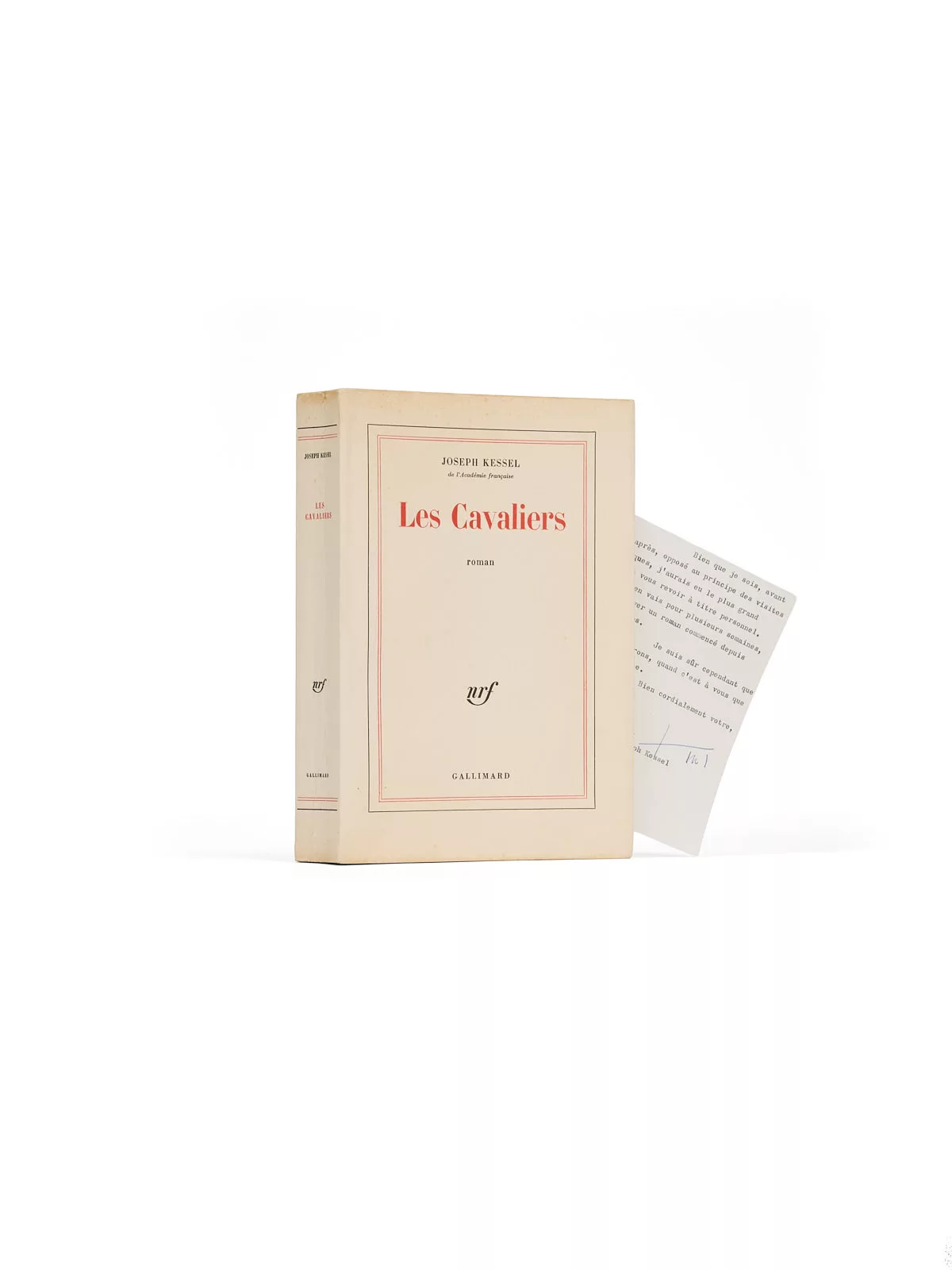
Les Cavaliers
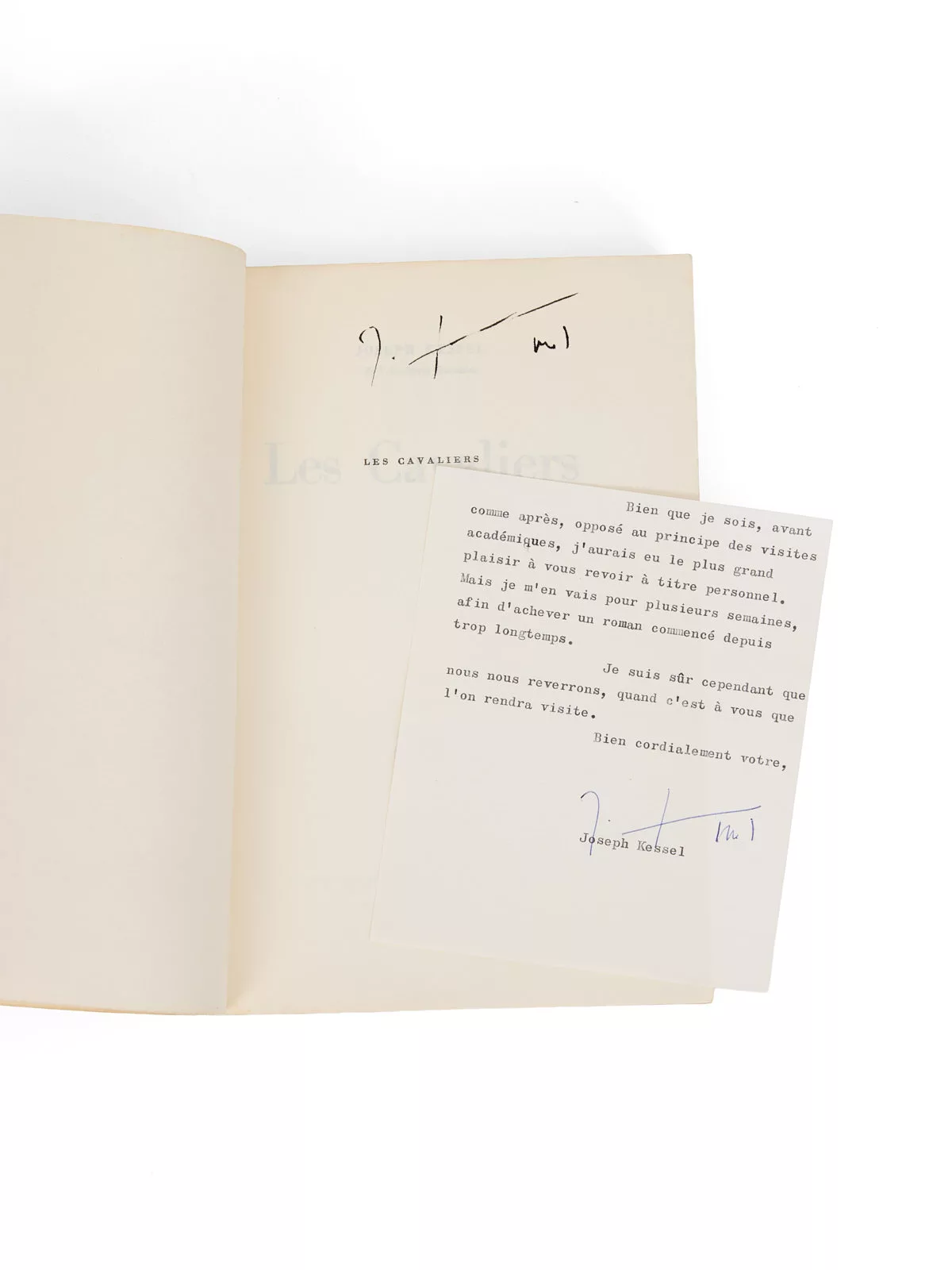
The copy is accompanied by a signed typescript letter announcing Kessel's forthcoming absence to finish Les Cavaliers:
“Bien que je sois, avant comme après, opposé au principe des visites académiques, j'aurais eu le plus grand plaisir à vous revoir à titre personnel. Mais je m'en vais pour plusieurs semaines, afin d'achever un roman commencé depuis trop longtemps. Je suis sûr cependant que nous nous reverrons, quand c'est à vous que l'on rendra visite. Bien cordialement votre, Joseph Kessel.”
The opening pages of Les Cavaliers form a kind of photograph of landscape. It was because Kessel longed to revisit the world of his childhood — the steppes of Central Asia — and because he was forbidden to travel to the Soviet Union, that he decided instead to visit Afghanistan.
Early in 1956 he found a way to make the journey fruitful: a film crew, including the directors Pierre Schoendoerffer and Raoul Coutard, was ready to shoot a film he would write on location, as they went along. This Afghan expedition deserved a book of its own, and Kessel gave a foretaste of it in Le Jeu du roi, the diary of the film in the making — the first pages from which Les Cavaliers would eventually emerge, “his most accomplished, most lyrical novel,” which took him several years to write (Dominique Bona, in Les Partisans), “a record for Kessel who, except for Le Tour du malheur, wrote his books at great speed.”
Jacqueline Breitel, Kessel’s secretary, later described the effort behind the novel: each day he gave her the previous day’s pages; she typed them cleanly, and the next day he returned them more than half crossed out. She estimated that he rewrote Les Cavaliers four or five times, at least. When Gaston Gallimard received the eight-hundred-page manuscript, he was delighted, considering it the best novel by his author since L’Équipage, finished forty-three years earlier.
On publication, the novel was an immense success with both the public and the critics — a rare unanimous tribute, without a single discordant note. Kessel, delighted, saw everything smile upon him: Buñuel had just acquired the rights to Belle de jour, and Les Cavaliers became the object of a frantic bidding war among American studios, eventually won by Columbia Pictures for the enormous sum of one hundred million old francs. John Frankenheimer directed the film, casting Omar Sharif and Jack Palance as the young Ouroz and the old Toursène. For Omar Sharif, an exceptional horseman fascinated by the world of horses, it was a golden role, following his part as Ali in David Lean’s Lawrence of Arabia five years earlier.
Kessel was unable to arrange a review-copy distribution or to inscribe copies for friends: at the end of March 1967, Michel Colomès and Igor Barrère, the two mainstays of the television program “Cinq colonnes à la une,” proposed that he travel to Afghanistan in the footsteps of Les Cavaliers, all the more so as Kessel had received an official invitation from King Zahir Shah of Afghanistan.
The crew left from Orly in the last days of March, before even the deluxe-paper printing had been completed. Kessel, accompanied by his brother Georges, landed in Calcutta on 2 April. The trip lasted more than two months, and Kessel returned to Paris only on 8 June, before immediately leaving again for New York on the 10th to join Michèle. He returned to France in midsummer, then withdrew to Menton until September, and did not return to Paris until December. Only then was he able to sign copies of Les Cavaliers.