

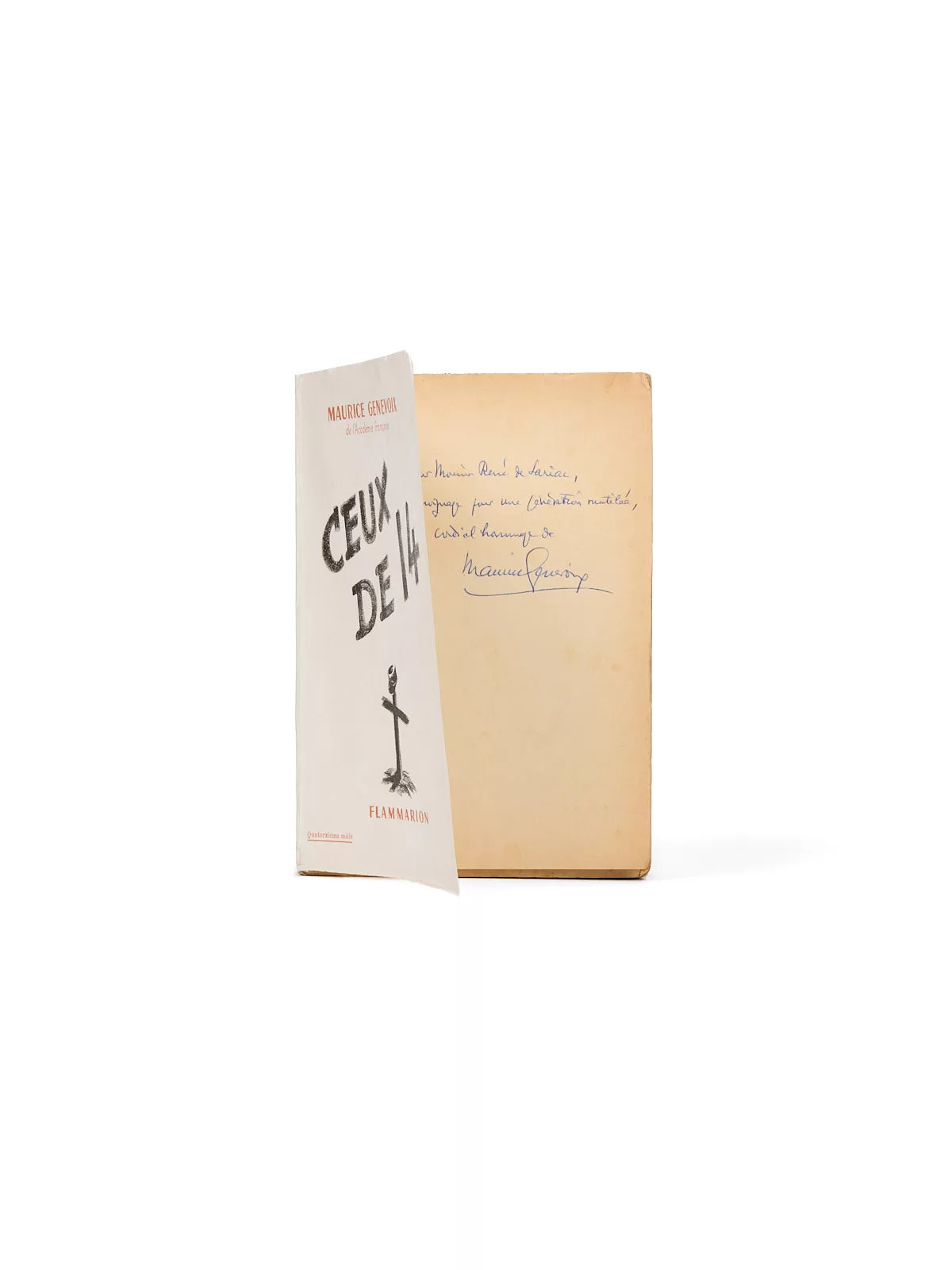
Ceux de 14
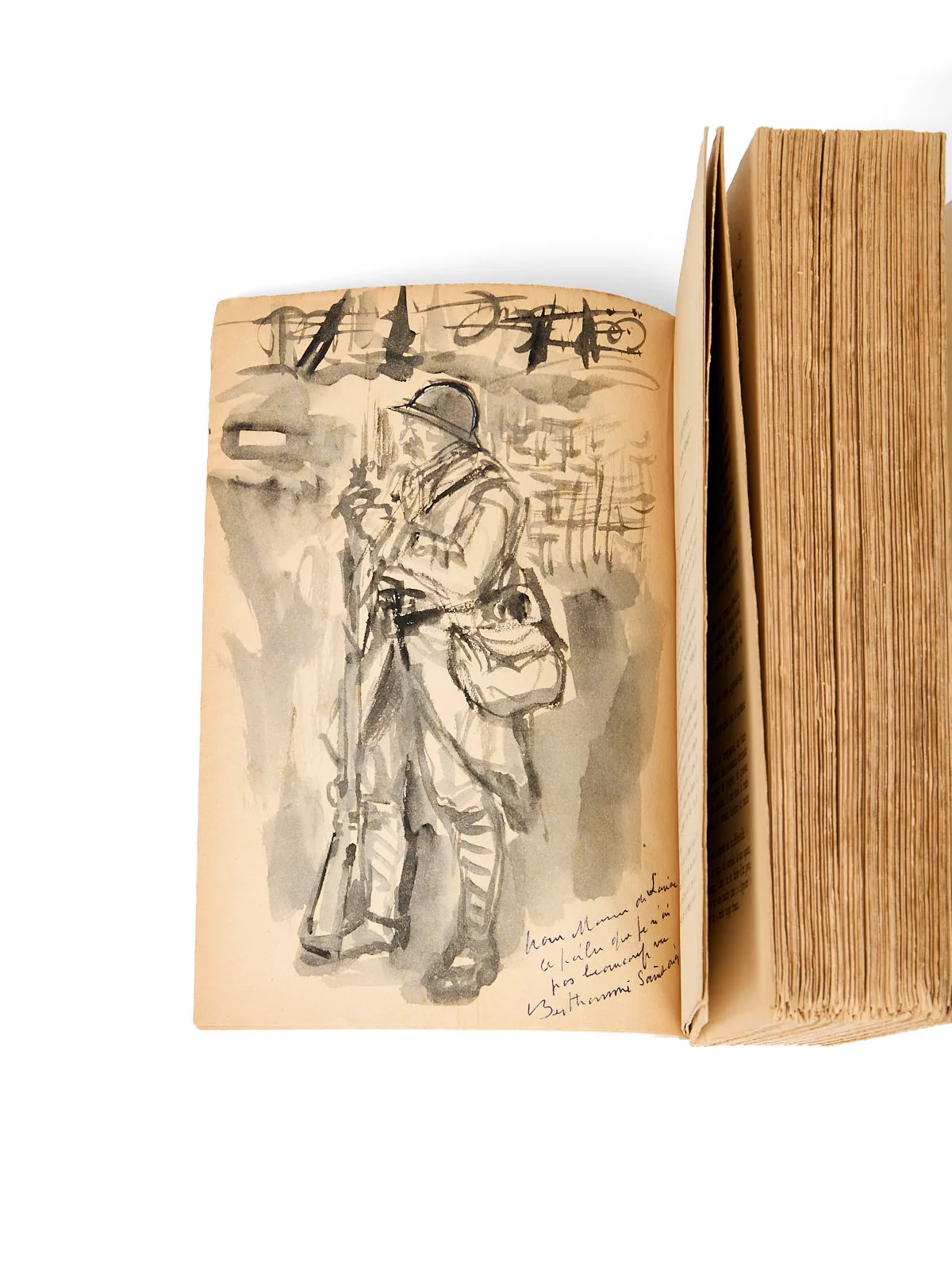
The copy is enriched with a large original watercolor facing the foreword, depicting a soldier of 1914, inscribed and signed by the artist: “Pour Monsieur René de Sariac, ce poilu que je n'ai pas beaucoup vu, Berthommé Saint-André.”
Ceux de 14 brings together Maurice Genevoix’s war narratives. As a young student at the École normale supérieure, Genevoix joined the 106th Infantry Regiment in September 1914 and went to fight in the Argonne, notably at the Tranchée de Calonne, where he was severely wounded six months later, on 25 April 1915, by three bullets, two in the arm and one in the chest. After seven months of treatment, he returned to Paris, to the rue d’Ulm, and, encouraged by Paul Dupuy, secretary-general of the École normale supérieure, with whom he had corresponded extensively during those six harrowing months, he agreed to recount his experience of the front and published Sous Verdun in April 1916. It was followed by Nuits de guerre in May 1917, Au seuil des guitounes in September 1918, La Boue in February 1921, and finally Les Éparges in September 1921: a body of work at once historical and literary, ranking among the foremost accounts published on the Great War.
In 1949, Genevoix decided to bring them together, reworking the division of his narratives and making some changes to the original text so as to form four narratives instead of five. As the writer Michel Bernard, author of Pour Genevoix (La Table ronde, 2011), affirms: “Ceux de 14 is an absolute masterpiece that reads like a rise toward sacrifice and horror. Its summit is the Battle of Les Éparges, the paroxysm of violence, one of the worst ordeals of 1914–18… owing to its extreme violence and the continuous bombardment of a confined position, [it] foreshadows the intensity of the Battle of Verdun. The attention paid to the living men fighting beside him, more than a hundred of whom are precisely identified, gives this text an incomparable human depth, whose literary beauty was immediately admired.” Eight hundred pages for eight months at the front. This is undeniably the most extensive, precise and accurate testimony of the combat experience.
A fine copy presented to the lawyer René de Sariac, enriched with a fine watercolor by Louis Berthommé Saint-André.
Winner of the Prix Abd-el-Tif in 1925, this painter was then the youngest resident of the famous Algiers villa dedicated to the Arts, and from 1931 he contributed to numerous illustrated publications, including several erotic works for texts by Boccaccio, Verlaine, Apollinaire and Baudelaire: “Although he painted many landscapes, he is chiefly known as a painter of figures, and more particularly of women…” (Connaissance des arts, no. 80, October 1958). He never illustrated Genevoix and, born in 1905, had no direct experience of the Great War; yet he could quite plausibly have illustrated it.
14th-thousand printing statement.