

Lettre à Man Ray
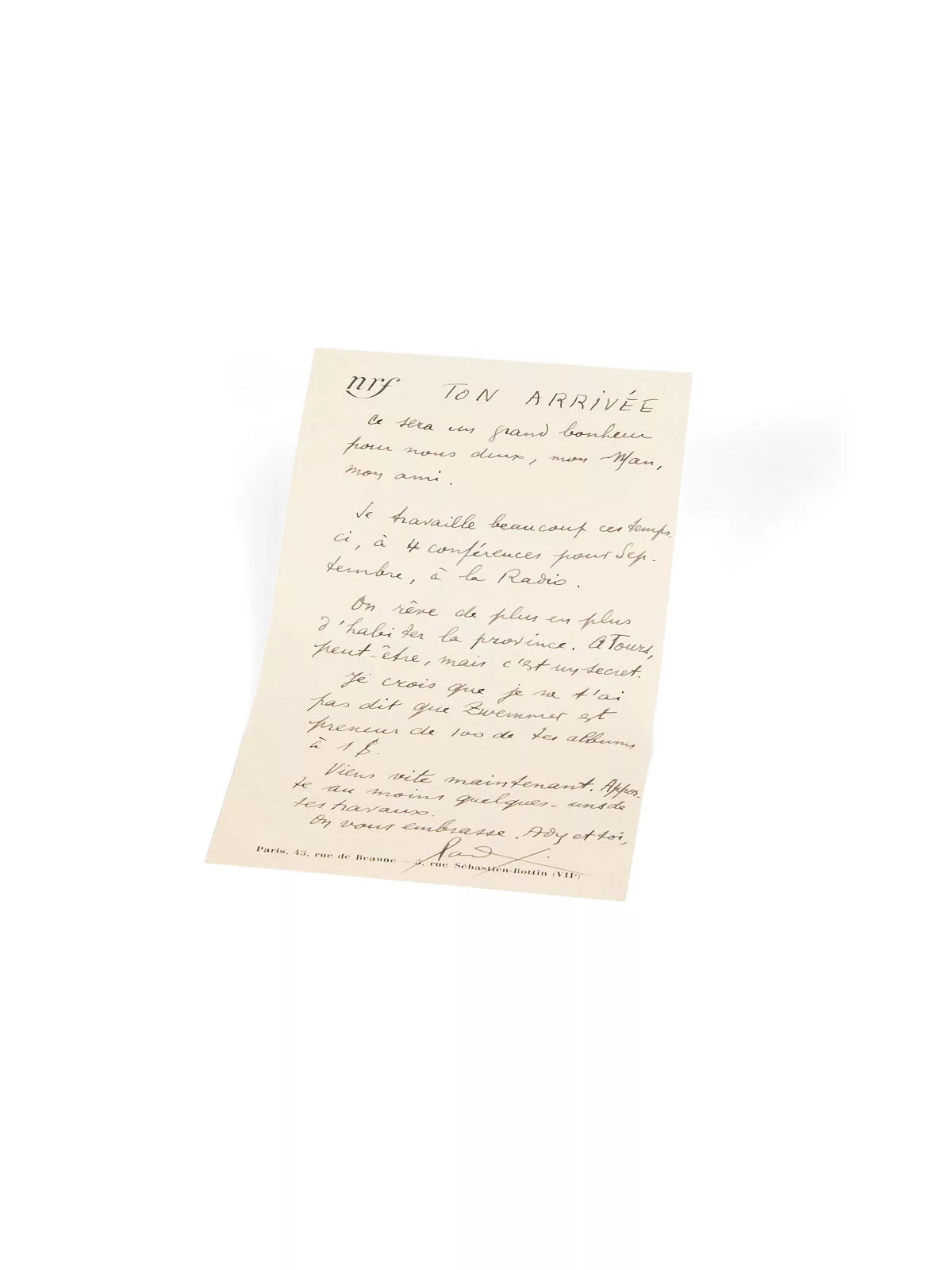
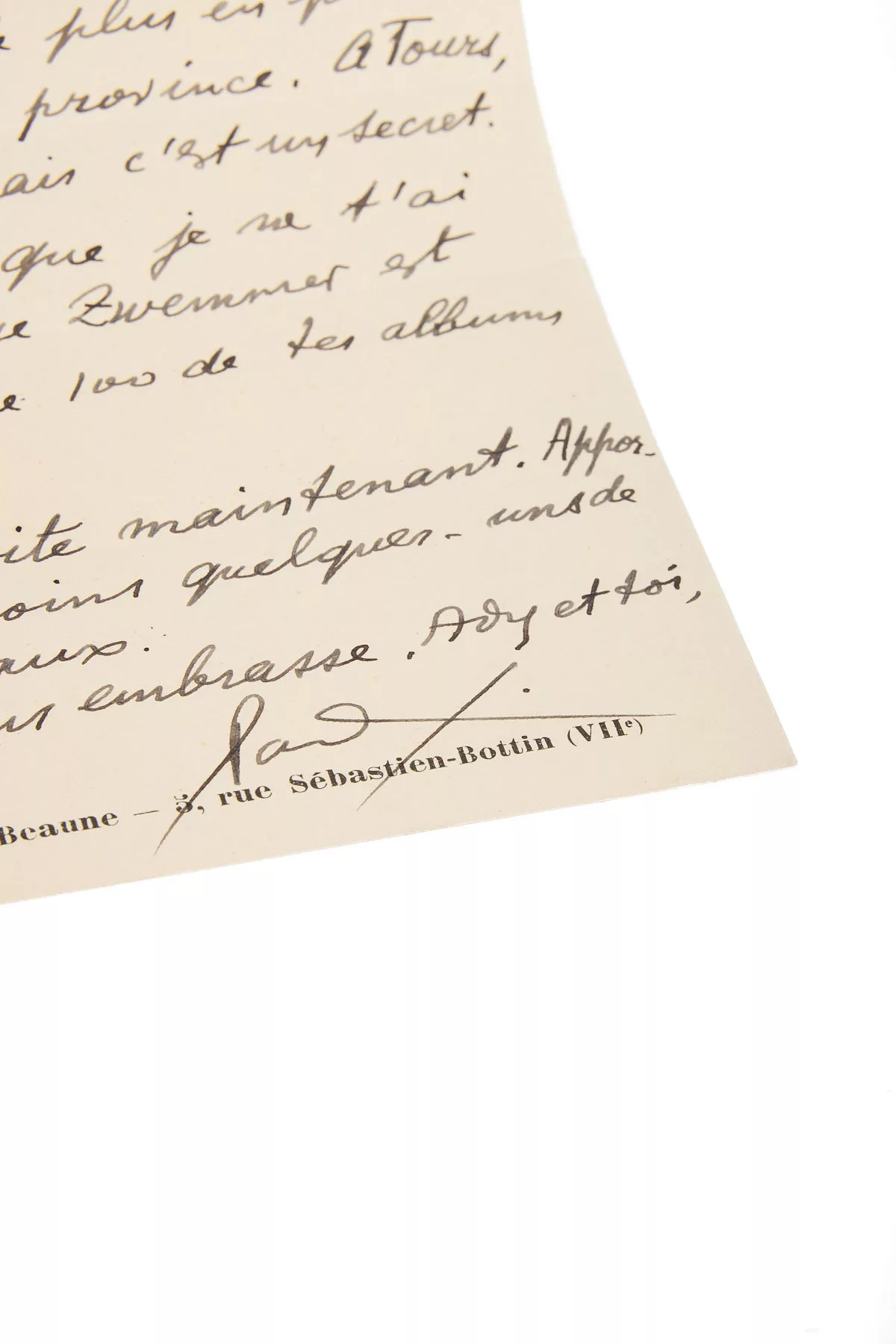
“YOUR ARRIVAL. It will be a great joy for us both, my Man, my friend. I am working hard these days, on 4 lectures for September, for the Radio. We dream more and more of living in the Provinces. In Tours, perhaps, but it’s a secret. I don’t think I told you that Zwemmer [Anton Zwemmer, Dutch bookseller and publisher] will take 100 of your albums at $1 each. Come quickly now. Bring at least some of your work. We send our love to you both, Ady and you. Paul Eluard.”
Aside from taking part in a few radio broadcasts after the war, Paul Éluard wrote for radio only once, in 1947, for the series Carte blanche à…, Le dit de la force de l’amour, a single broadcast, before accepting, in 1949, a series of five programs, Les chemins et les routes de la poésie, of which only the first four can still be consulted at the Institut national de l’audiovisuel (INA). It is to these programs, produced by Alain Trutat and broadcast in October and November 1949, that Éluard seems to be referring here. The poet worked on them throughout the summer of 1949, and the series remains an invaluable document for understanding the kind of relationship the poet sought to establish with his contemporaries: poetry as a “common good” to be shared as widely as possible, a community of survivors that Éluard invites his listeners to join, called to perpetuate itself through communist commitment, as suggested by the closing line of “L’Internationale” at the end of the first broadcast (Céline Pardo, Le poète au micro et l’utopie poétique: Paul Éluard, Les chemins et les routes de la poésie, 1949, in Études littéraires, no. 41).
A moving letter in other respects as well: the death of Nusch in November 1946 had left Paul Éluard grief-stricken for a long time, and his only consolation was the regular company of his daughter, Cécile. Though she was now a grown woman — thirty-one years old in 1949 — father and daughter saw each other frequently and were considering leaving Paris, as is mentioned here. Three months later, Paul Éluard would meet Dominique, in Mexico City: the beginning of another story.