

La Pelle
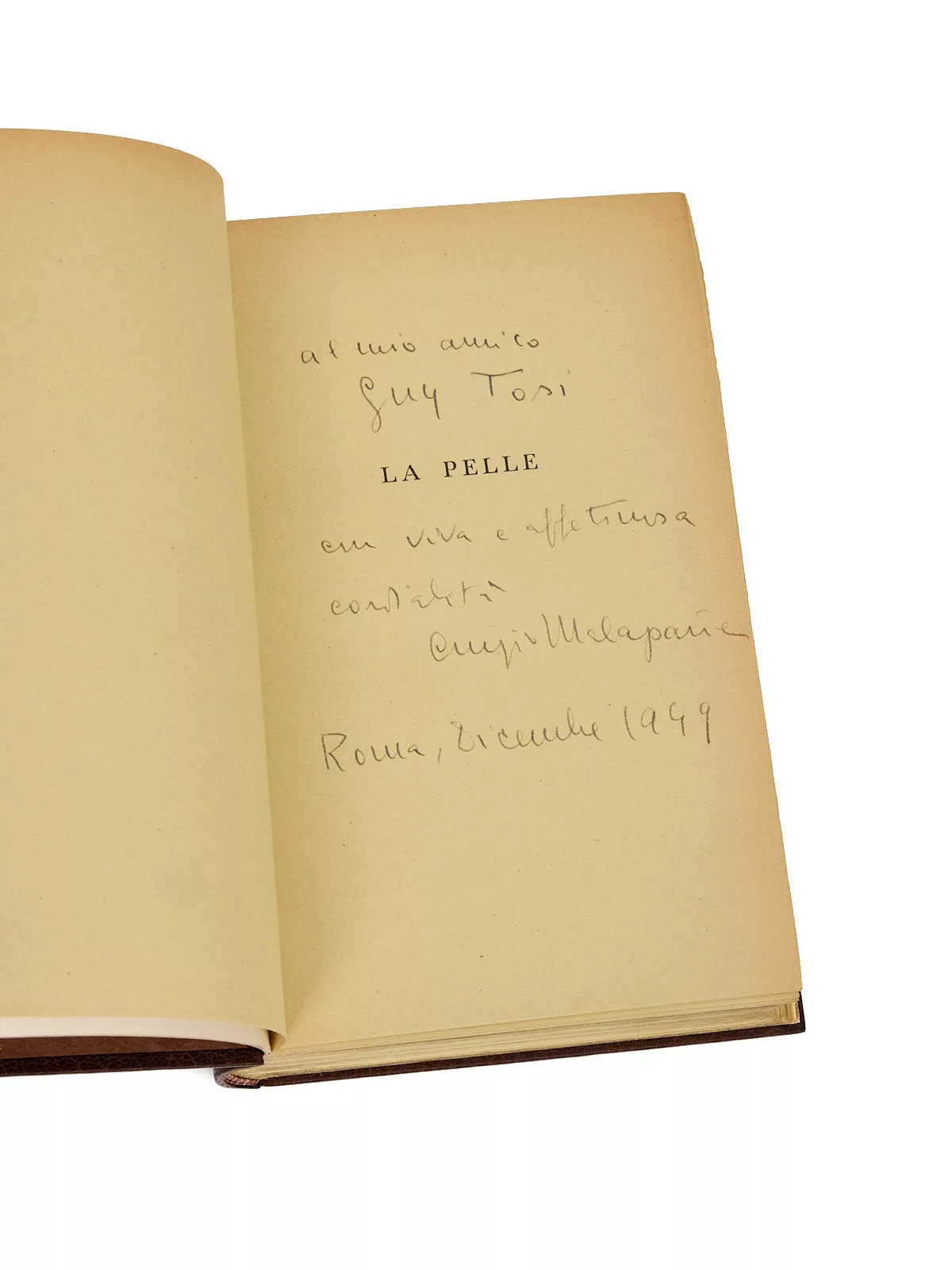
Presentation inscription: “Al mio amico Guy Tosi, en viva e affettuosa cordialità, Curzio Malaparte, Roma, dicembre 1949.”
An exceptional copy of Malaparte’s other landmark work, alongside Kaputt.
As the Second World War ended, American armies discovered Europe through a defeated Italy, ravaged by hunger. This disillusioned observation, rooted in Malaparte’s own participation in the fighting for the liberation of Italy, produced a visionary and baroque narrative of “cruel and affectionate defense of the Italian people,” from which La Peau emerged — a great, atrocious and cruel book. Its twelve chapters bear witness to the bankruptcy of humanism, in a text saturated with references to the great works of ancient and Italian literature.
The Mondadori edition’s notice provides valuable information on the genesis of La Peau: on 10 November 1946, in a letter to Giuseppe Prezzolini, Malaparte mentioned his forthcoming book, La Peste, explaining that while Kaputt had described Europe under German domination, La Peste would describe Europe as retaken by the Allies, chiefly the Americans. When Camus’s La Peste appeared in 1947, Malaparte was forced to change his title, reserving the original one for his first chapter. Malaparte described his book as an account of the liberation of Italy by the Americans, which he had followed since 1944 as a liaison officer, witnessing “a truly astonishing spectacle: a liberating army of young, healthy, handsome men, true archangels, entering a heroic country that had, in effect, closed itself off from the aggressor. And here lies the mystery, the inexplicable: around these archangels, mud and plague — honest women turning to prostitution, upright men becoming thieves, the good turning wicked.” La Peau was thus a sequel to Kaputt, and the war of liberation paradoxically resulted in a kind of “spontaneous generation of evil.” Where Kaputt had denounced Nazi barbarity with extraordinary violence, La Peau answers with a portrait of a corrupted, humiliated Italy.
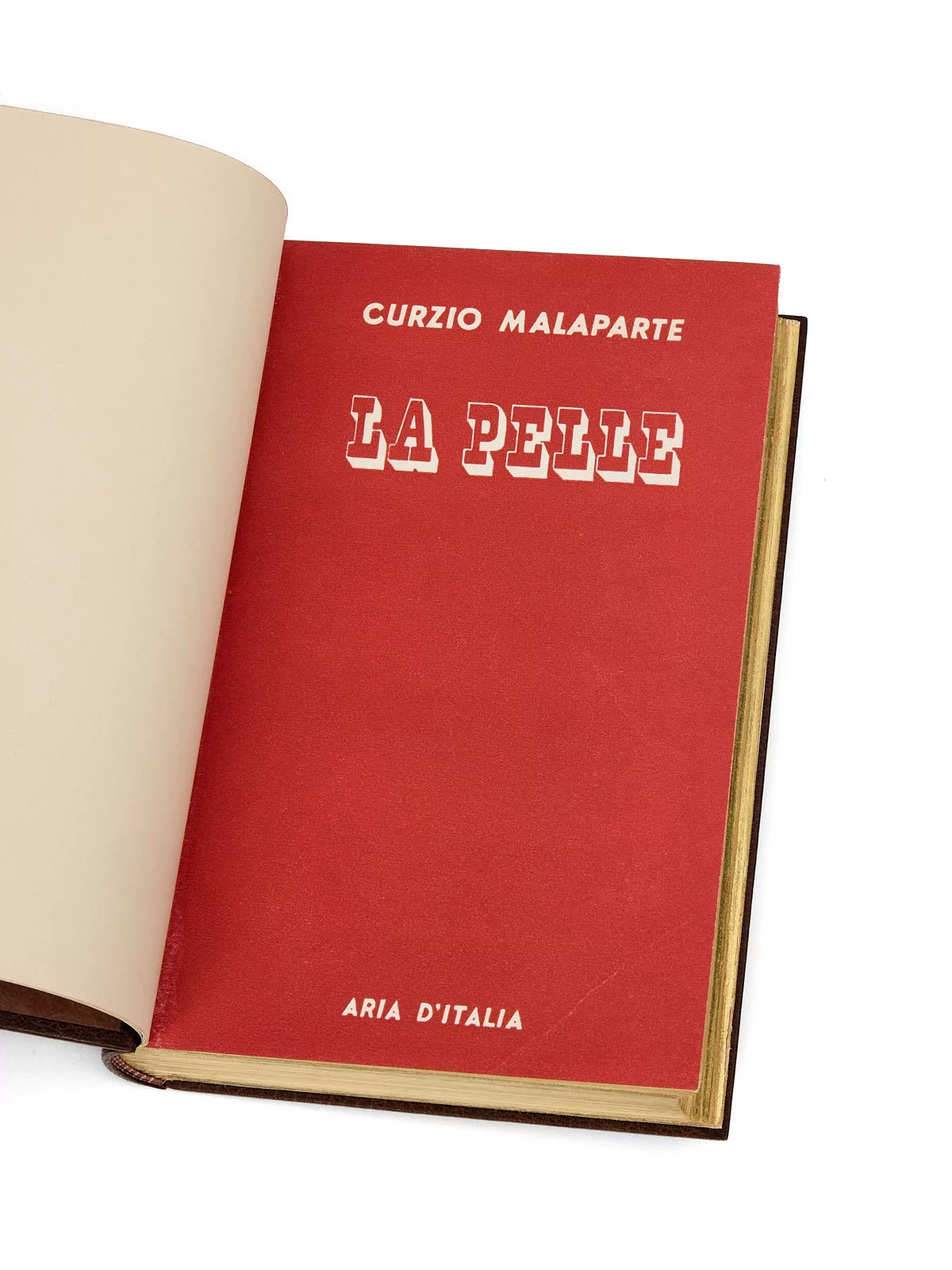
The tone irresistibly recalls Céline and can satisfy every literary taste, so skillfully does Malaparte deploy every register: baroque, grotesque, surrealist, hyper-realist, expressionist, lyrical, humorous and dark. The book was first published in France, in September, by Denoël, translated from an Italian text that no Italian publisher had yet dared to issue. The Italian edition would not appear until several weeks later, completed in print on 6 December 1949.
An exceptional copy, presented upon publication to the man who had been the most ardent champion of Malaparte’s work and who made possible its translation and publication in France: Guy Tosi, literary director of Éditions Denoël.
Professor of Italian and comparative literature at the Sorbonne, Tosi was first and foremost France’s leading specialist on Gabriele d’Annunzio, the subject of his doctoral thesis. He joined Éditions Denoël in 1943 as a reader, becoming its literary director after the war. In that capacity he was the editor of, among others, Louis-Ferdinand Céline, Blaise Cendrars, Henry Miller, and of course Curzio Malaparte, whose manuscript of Kaputt he accepted; it was published in September 1946 to resounding success. Blaise Cendrars, who became close to Tosi at the same time, recognized himself in the book, congratulating Tosi for having published this novel, which he had “greatly loved (…). It is a great book, quite disgusting, just as I like them, a true reflection of the times” (Cendrars, letter to Guy Tosi, 27 September 1946). Cendrars even dedicated a story from Bourlinguer, “Naples,” to the Italian: “To the disgusting and brilliant Curzio MALAPARTE, author of Kaputt, in memory of the Legion, in homage to the young Garibaldian in a red shirt from the forest of the Argonne, to the infantryman of the Reims mountain, and my friendly hand to the deportee of the Lipari islands. Blaise Cendrars (an occasional Neapolitan).”
After a rather cold initial reception from Italian intellectual circles for Kaputt, Malaparte had to turn abroad, notably to France and his enthusiastic champion Guy Tosi, who took great care to highlight everything that testified to Malaparte’s anti-fascism and attachment to France, while cautiously adding, as a codicil, “se non è vero…”. The two men met for the first time in 1948, during Malaparte’s first stay in Paris.
No other copy of La Pelle from this deluxe printing with an inscription is known, and we know only copies nos. 12, 23, 67, and, among the hors commerce copies, nos. XII and XXIV. This is very little for a text of such importance, though its copies were doubtless difficult to distribute and even more difficult to preserve.
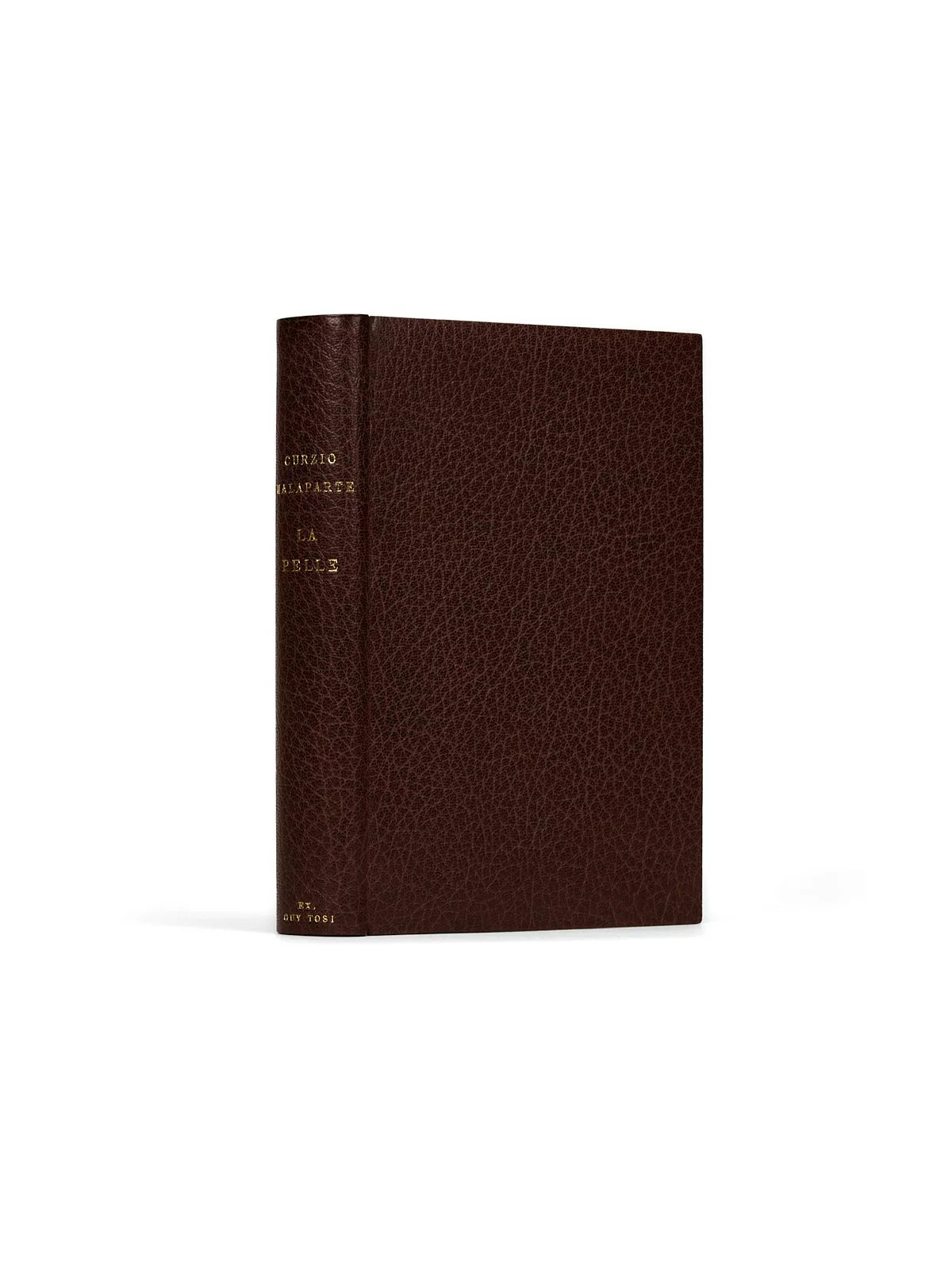
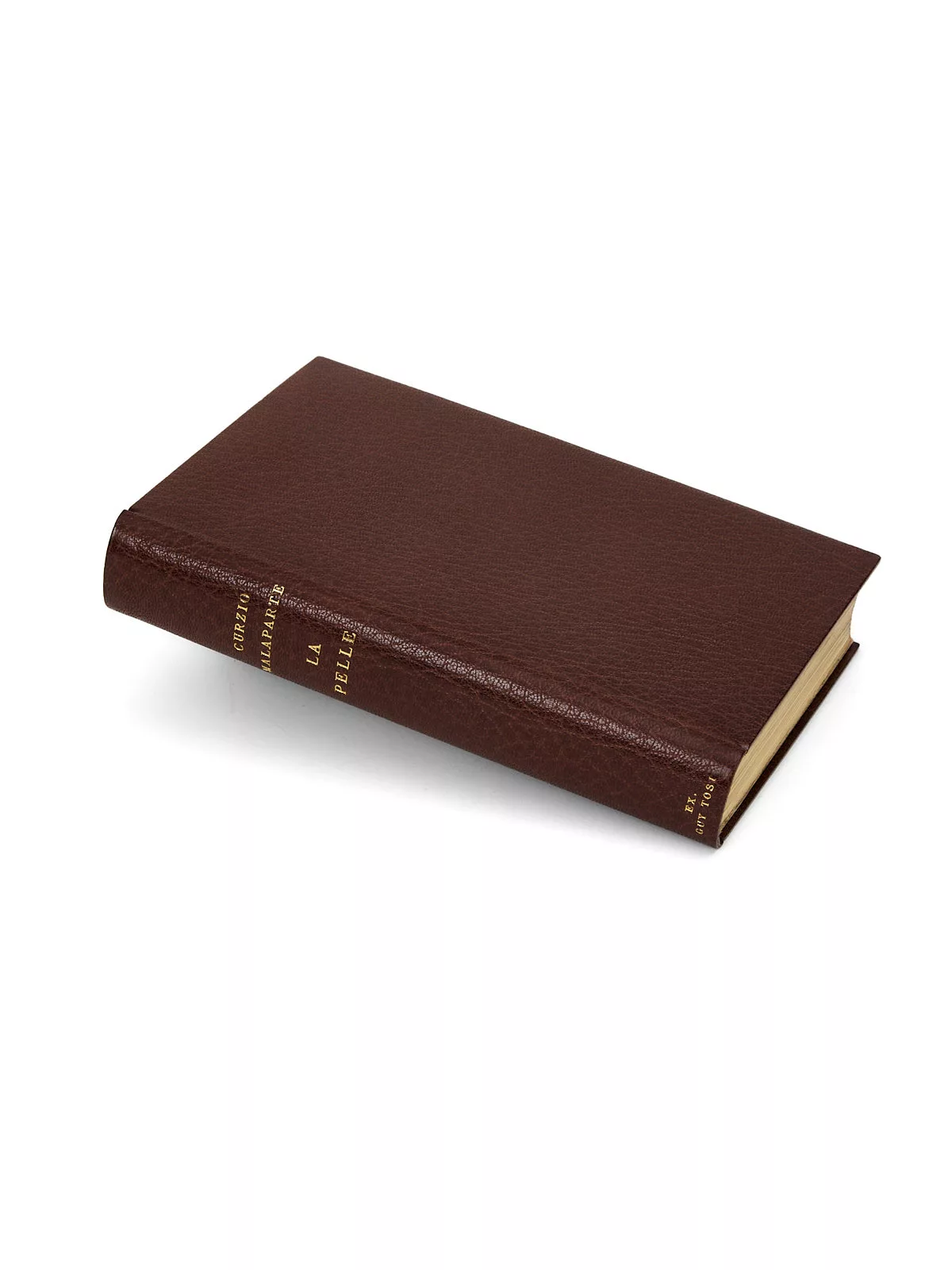
An ideal copy and altogether one of the most significant, beautifully bound by Clara Gevaert.