

Rêves d’encre
Sole printing of 650 copies (no. 364).
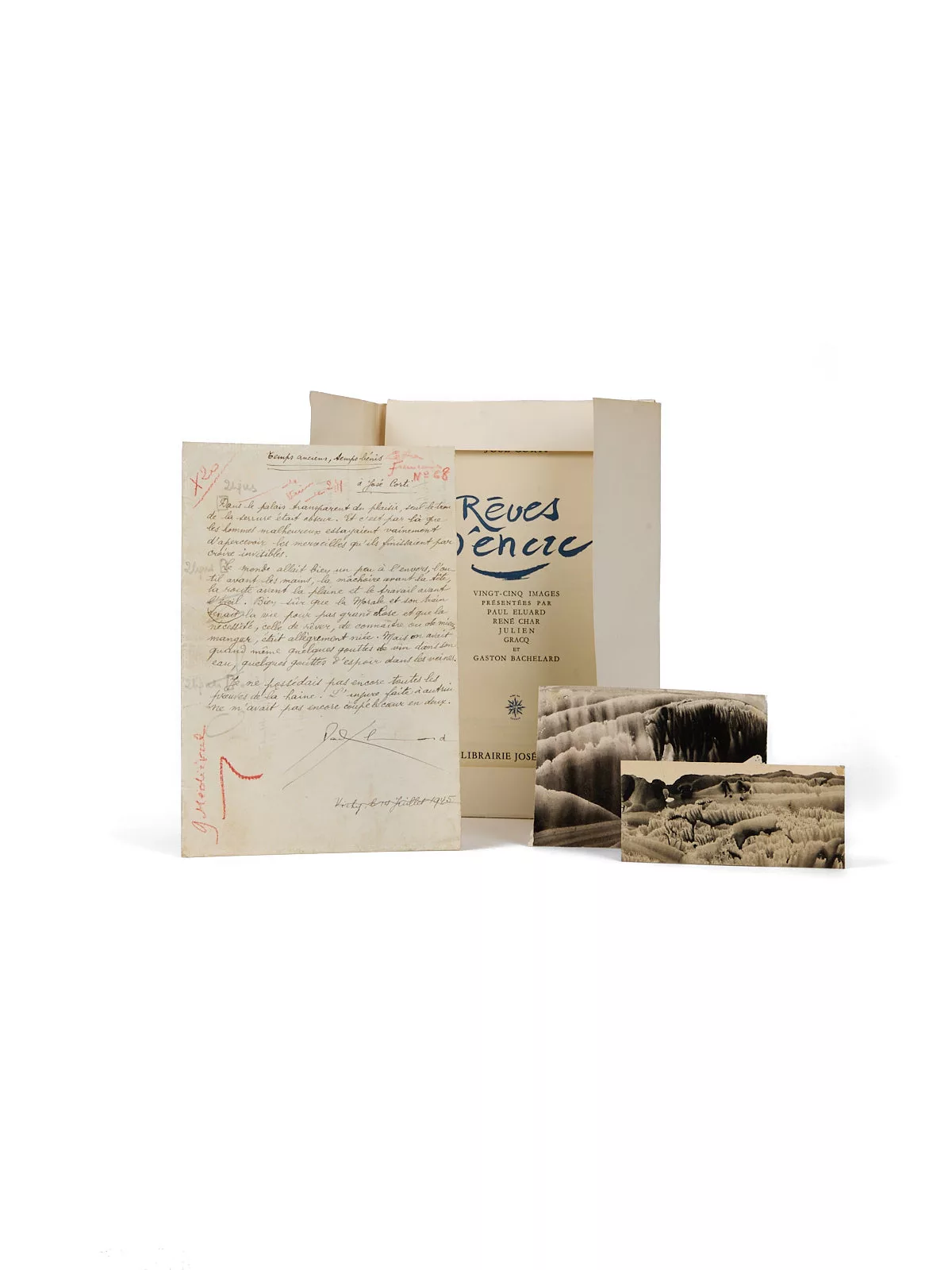
Accompanied by the manuscript of Éluard's poem and two original inks by José Corti.
A rare collection in which the publisher-bookseller himself becomes the artist, Rêves d’encre brings together twenty-four abstract compositions drawn in ink by José Corti and reproduced in phototype, with a twenty-fifth adorning the titled portfolio wrapper. The deluxe copies — a rare issue limited to fifty — each include an original drawing, usually a variant not chosen for the final illustration.
Corti, whose catalogue was a model of exacting taste, championed the Surrealists early on and made Julien Gracq’s books the beating heart of his firm. He worked without gimmicks, guided only by unerring judgment, embodied in a maxim entirely his own: “Better to die bankrupt with the Fleurs du Mal on one’s grave than to leave behind a fortune made from mediocre or unworthy literature.” One should also remember — and indeed place at the forefront — the shadow of Dominique, his son, deported and shot at nineteen, whose memory Corti evokes in his Souvenirs désordonnés: the recollection of a father struck by the loss of his son in the war’s final days.
An artist’s book and a discreet manifesto, Rêves d’encre is thus more than a portfolio: it is a self-portrait of the publisher. The volume contains sixteen pages of text in total, comprising four short, unpublished texts that Corti commissioned from those who were, at that time, unmistakably his four closest friends in letters and in heart: Gaston Bachelard, René Char, Paul Éluard and Julien Gracq.
Bachelard opens the volume with a characteristic text, “Une rêverie de la matière,” in which ink is seen as the very substance of reverie, and the “awakenings of images” as the engines of material imagination — echoing his work of the decade, L’Eau et les rêves (1942) and La Terre et les rêveries de la volonté (1948).
Char contributes a short prose-poem fragment, “La Lune rouge et le géranium noir,” in the line of Le Marteau sans maître (1934), of which he was about to publish a new edition, again with Corti.
Éluard, the friend and poet for whom Corti had smuggled out Poésie et vérité 1942, remains true to himself, offering a celebrated, limpid and lyrical poem, “Temps anciens, temps bénis,” directly echoing his editorial and militant activity during the war and at the Liberation. He dedicated the poem to Corti and closed it with these words: “On avait quand même quelques gouttes de vin dans son eau, quelques gouttes d’espoir dans les veines. Je ne possédais pas encore toutes les preuves de la haine. L’injure faite à autrui ne m’avait pas encore coupé le cœur en deux. Paul Éluard. Vichy, le 14 juillet 1945.” After its publication in Rêves d’encre, Éluard included the poem in the expanded edition of Au rendez-vous allemand (1946), issued together with Poésie et vérité 1942, gathering all the poems published during and just after the war. The present copy is enriched with the princeps manuscript of the poem — 1 page on 1 leaf (150 x 220 mm), on the verso of headed paper.
The poem first appeared in issue no. 68 of Les Lettres françaises, published on 11 August 1945, a month after it was written. This is the very version used for that periodical publication, as confirmed by the pencil note and typographical markings matching the printed text. The date of composition, “14 juillet 1945,” struck through by Éluard, was not retained in that publication, but does appear here.
Finally, Julien Gracq, solicited by Corti, contributes a short piece of traveler-reader’s prose, “Éclosion de la Pierre,” a commentary perfectly attuned to Corti’s compositions and anticipating the vivid notices later found in Préférences and Lettrines: “Une goutte d’encre portée sur une eau-mère, avec la préméditation compliquée et patiente de l’œuf, éclot et dévide le mystère de ses organes. À la ressource inépuisable du hasard vient se joindre un sentiment de nécessité mal explicable.” The text anticipates the narratives of Liberté grande, published the following year.
The copy is further enriched with two original compositions by José Corti, not selected for the finished book.
A second edition, published in 1969, added three further compositions, for a total of twenty-eight images.
A very fine copy, delightfully enriched.