

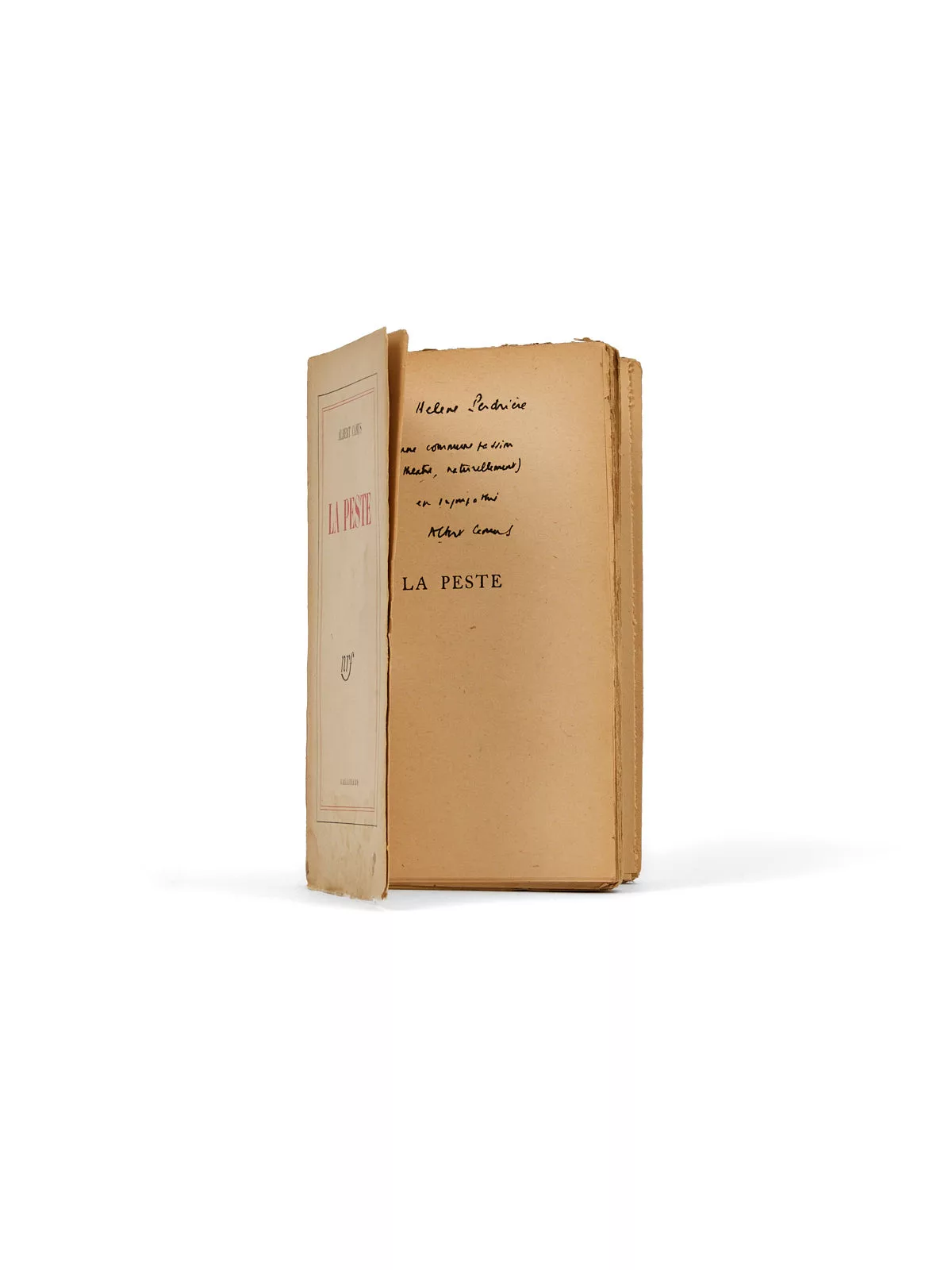
La Peste
“à Hélène Perdrière pour une commune passion (le théâtre, naturellement) en sympathie, Albert Camus.”
The first woman to be admitted to the Comédie-Française, in 1928, and soon a sought-after partner of Pierre Fresnay on the great boulevard stages, Hélène Perdrière returned to the Maison de Molière in the early 1950s (becoming a sociétaire in 1954), while also establishing herself as one of the finest interpreters of Marivaux.
Her career repeatedly crossed Camus’s theatrical world: the Théâtre des Mathurins, run by Marcel Herrand, where Camus had Le Malentendu staged in 1944, and the Festival d’Angers, with which Camus was closely associated and which he directed after Herrand’s death. Perdrière took part in both the Mathurins and Angers ventures.
Given to an actress for whom “theater, naturally” was a vocation, La Peste unfolds precisely the intimate dramaturgy that runs through Camus’s work: a parable of the Occupation as much as an ethical inquiry into solidarity, restraint and men’s determination “to be more than the plague.”
Published at the height of Camus’s most fertile period as a playwright (from Caligula to Les Justes), this major success confirmed the reach of his prose work. The definitive text was finished in December 1946, and Camus set down its final words without joy: “I have the feeling this book is a complete failure, that I sinned through ambition, and this failure is very painful to me. I am keeping it in my drawer, like something rather disgusting.” Camus had no idea it would become a bestseller and a popular classic, the third best-selling title from Éditions Gallimard, after Le Petit Prince and L’Étranger. Translated into dozens of languages, the “Revolt” cycle would weigh heavily in the award of the Nobel Prize in Literature ten years later. “What we learn in a time of pestilence is that there are more things to admire in men than to despise,” he wrote. While showing humanity’s capacity for solidarity and struggle, Camus warns that the lessons of such trials must never be forgotten: “The plague bacillus never dies or disappears entirely.”
Third printing of the year of the first edition (La Peste was published in May), with a printing statement of one thousand.