

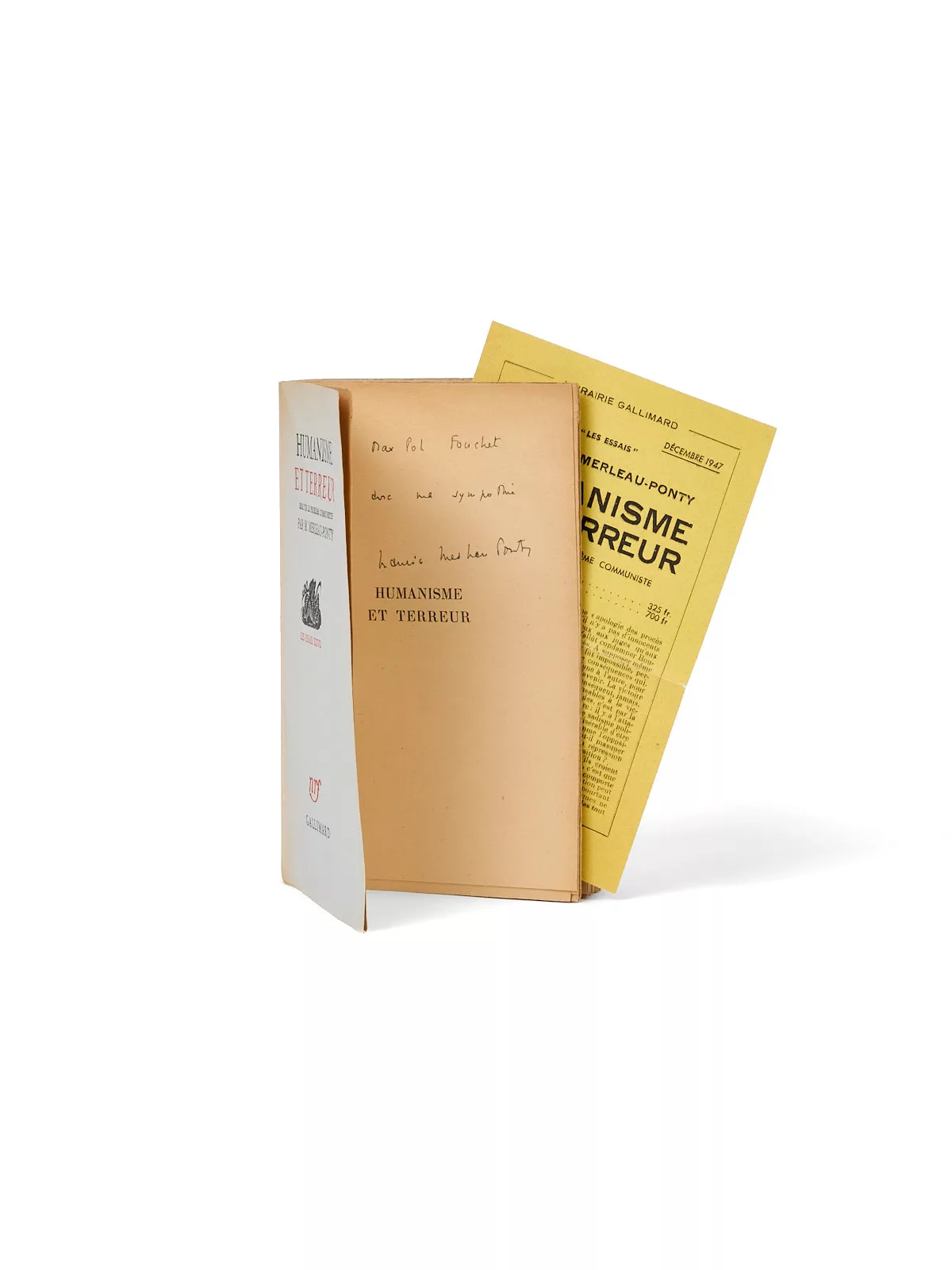
Humanisme et Terreur
Presentation copy inscribed by Merleau-Ponty to Max-Pol Fouchet: “À Max-Pol Fouchet avec ma sympathie, Maurice Merleau-Ponty.”
The volume brings together a series of articles that had appeared the previous year in Les Temps Modernes, whose editorial direction Merleau-Ponty had overseen since its founding in 1945, signing his editorials “TM.”
What remains essential when we reread this text seventy years after its publication? Knowing what followed, one can trace here the first stages of the path that would lead Merleau-Ponty to denounce the Gulag camps, ultimately abandon the Marxist horizon of thought, and definitively break with Sartre in 1953.
From the preface onward, he sums up his book in these terms: “Is communism equal to its human intentions? That is the real question” — the question of revolutionary violence and its Stalinist drift, granting, in the end, that innocents might be killed in the name of revolution, but only on condition that some genuine steps toward greater freedom and the humanization of history are ultimately achieved. Put crudely: if one cannot make an omelette without breaking eggs, there must at least be the beginning of an omelette to justify the breaking. None of this has aged. Nor has Merleau-Ponty’s constant concern to judge only according to circumstances and context, never from fixed principles. “Humanisme et Terreur is therefore not merely a history lesson, an archival document, or a postwar testimony. It is a great lesson in applied political philosophy, whose method, in a time of growing ideological confrontation, can and must be remembered.” (Roger Pol-Droit, in Le Monde, July 2008, on the centenary of the philosopher’s birth; he died in 1961).