

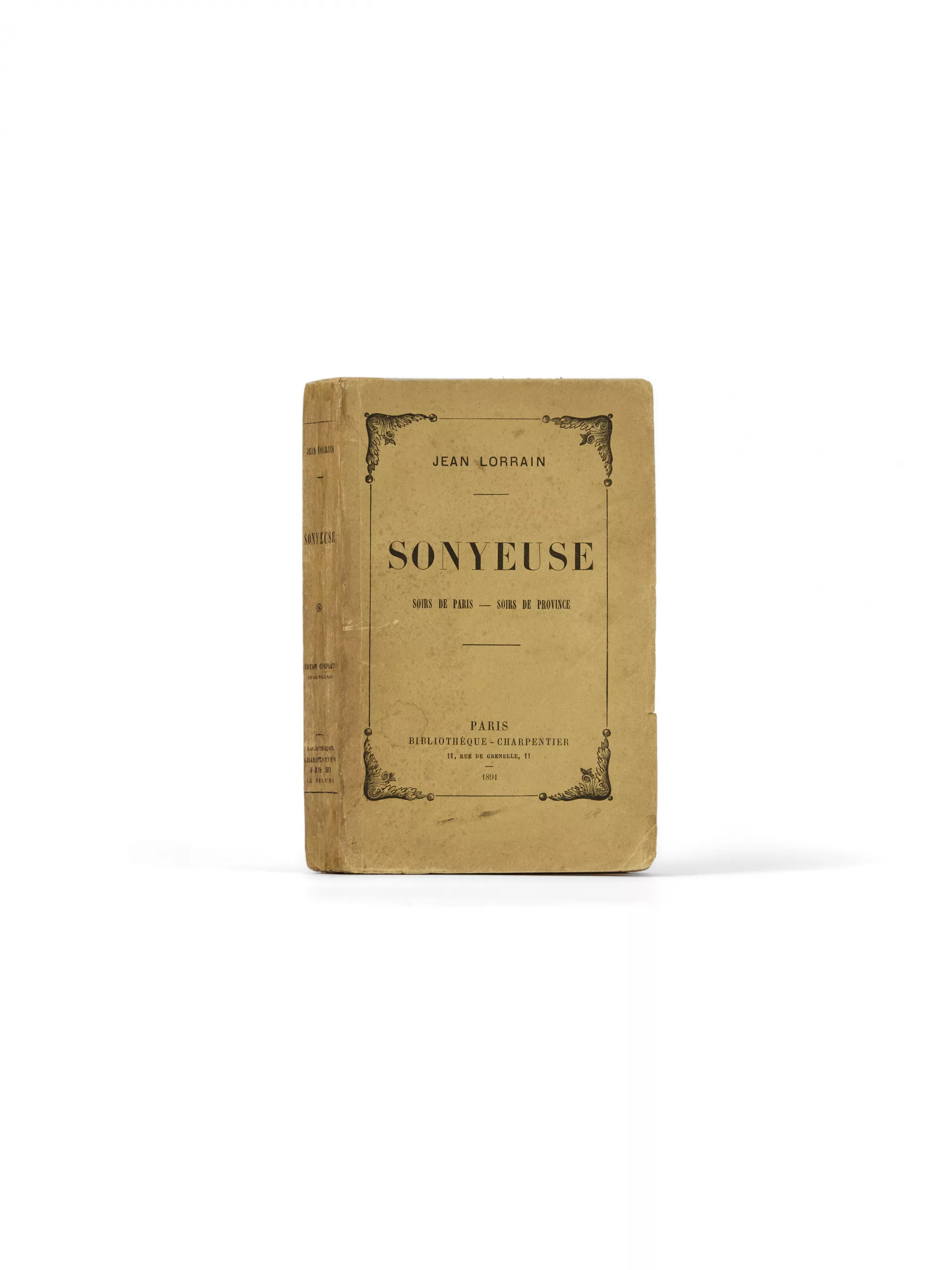
Sonyeuse
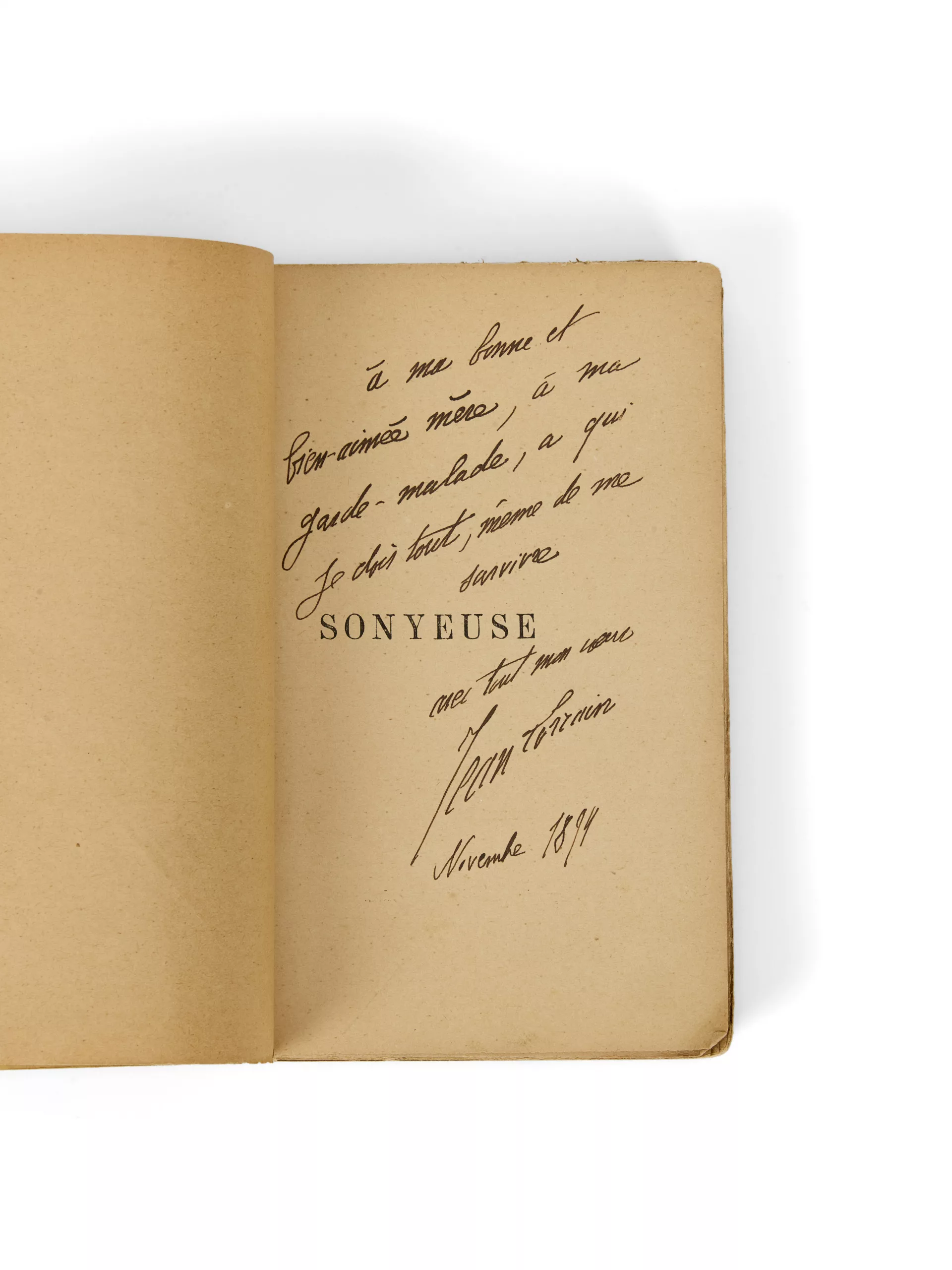
Presentation copy inscribed by Jean Lorrain to his mother: “à ma bonne mère, à ma garde-malade, à qui je dois tout, même de survivre, avec tout mon cœur, Jean Lorrain, novembre 1891.”
Published ten years after Le Sang des dieux, Sonyeuse confirmed Lorrain’s reputation. The volume opens with an almost novelistic narrative (76 p.) that gives the book its title, followed by a series of paired stories — “Soirs de province” (Dans un boudoir, La Chambre close, Romance d’automne! Love’s Labour Lost) and “Soirs de Paris” (L’Inconnue, L’Égrégore, Le Ménage Nauretale, L’Amant des poitrinaires, Conte d’une nuit d’hiver, Dans l’espace, Oraison funèbre, Guide moral Conty) — in which Lorrain’s decadent manner and gift for atmosphere assert themselves, moving between provincial grayness and deserted streets.
This copy, inscribed to Pauline Duval — one of only four recorded presentation copies — illuminates the heart of Lorrain’s biography. In 1880 the young Paul Duval moved to Paris (45, rue d’Auteuil), on the condition set by his father that he adopt a pen name, “Jean Lorrain.” In 1891, the very year of Sonyeuse, his mother came to live with him, a discreet presence revered by the circle at Auteuil. Uzanne described her as an “adorable, impassive, indulgent mother, smiling, with the charm and distinction of a great lady from the age of powder and amiable philosophy, [who] was attentive and solicitous toward the friends […] invited by her dear great boy” (Jean Lorrain, l’artiste, l’ami, Les Amis d’Édouard, no. 14, 1913). After the writer’s death in 1906, she took the name Duval-Lorrain, reconciling the son with the man of letters.
A fine correspondence between Jean Lorrain and his mother was published by Georges Normandy in 1925, gathering their many letters from 1864 to 1906.