

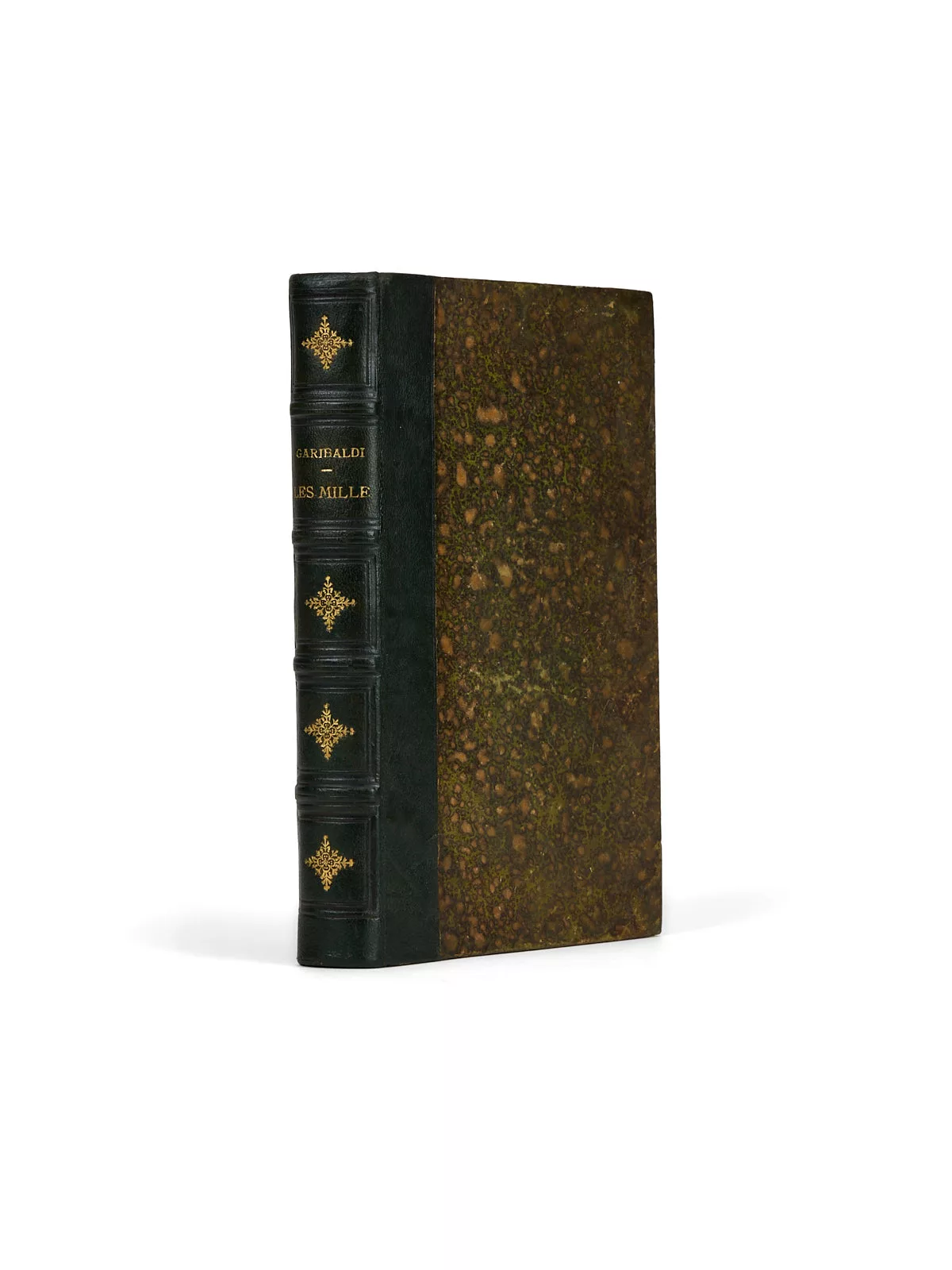
Les Mille
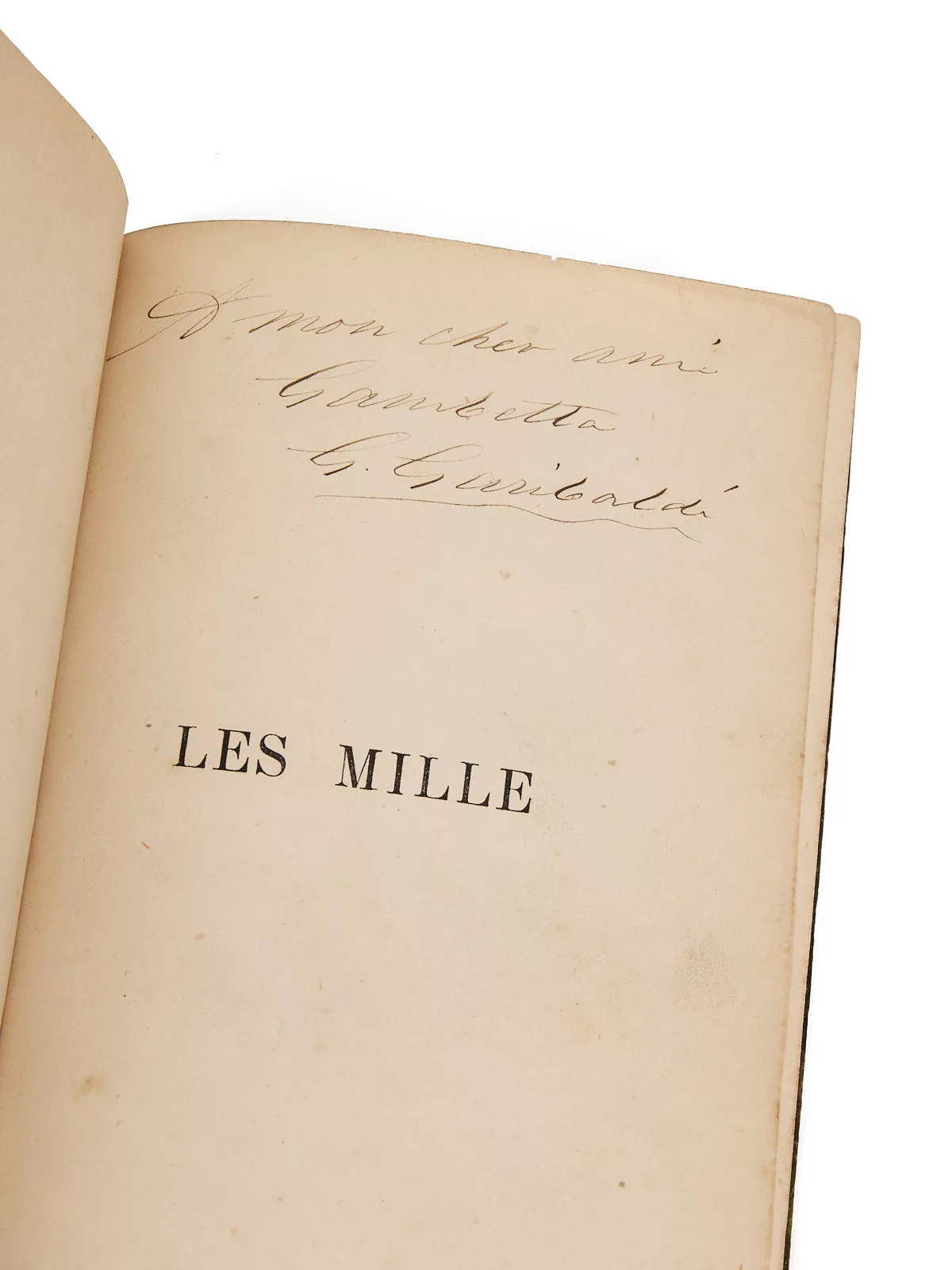
Signed presentation inscription: “à mon cher ami Gambetta, G. Garibaldi.”
An exceptional copy of the first edition of I Mille, inscribed by Garibaldi — a native of Nice — to his friend Léon Gambetta, an emblematic figure of the young French Republic. Les Mille recounts the 1860 expedition led by Garibaldi, when a corps of volunteers landed in southern Italy to conquer the Kingdom of the Two Sicilies, then ruled by the Bourbons. The text was published in Paris in 1875 by Charles Silvain, a printer-bookseller committed to progressive causes, at a pivotal moment: the Republic had only just been consolidated in France, after the ordeal of 1870 and the bloody repression of the Commune.
A central figure of the Italian Risorgimento, having personally led and fought in a great many of the military campaigns that brought about the unification of Italy, Garibaldi was known as the “Hero of Two Worlds” for his military exploits in both South America and Europe. During the Franco-Prussian War of 1870–1871, the National Defense committees, at Gambetta’s instigation, called on Garibaldi, who placed his sword at France’s service: on 25 and 26 November, with his two sons, Ricciotti and Menotti, at the head of 10,000 French riflemen of the Army of the Vosges, he won a resounding victory at Dijon against the Prussians, capturing the flag of the 61st Pomeranian Regiment.
In February 1871, while Bordeaux served as the provisional capital of France and the National Assembly sat at the Grand Théâtre, Garibaldi was elected on the Union Republicaine lists as deputy for Côte-d’Or, Paris, Algiers and Nice. In Paris he came fourth, behind Louis Blanc, Gambetta and Victor Hugo, but because his Italian nationality invalidated the election, and facing accusations from the new monarchist majority in the Chamber that he had not truly fought, he declined his mandates even before presenting himself to the National Assembly. He nonetheless attended once, to defend the cause of the men he had commanded, sitting alongside Gambetta, deputy for the Seine and the Bas-Rhin, the orator of Tours, the resistant of 1870 and the instigator of the parliamentary Republic: a connection that reveals their shared ideals and seals a unique transalpine political bond.
A wonderful and singularly fitting political provenance. No other copy inscribed by Garibaldi to a major French statesman is known.