

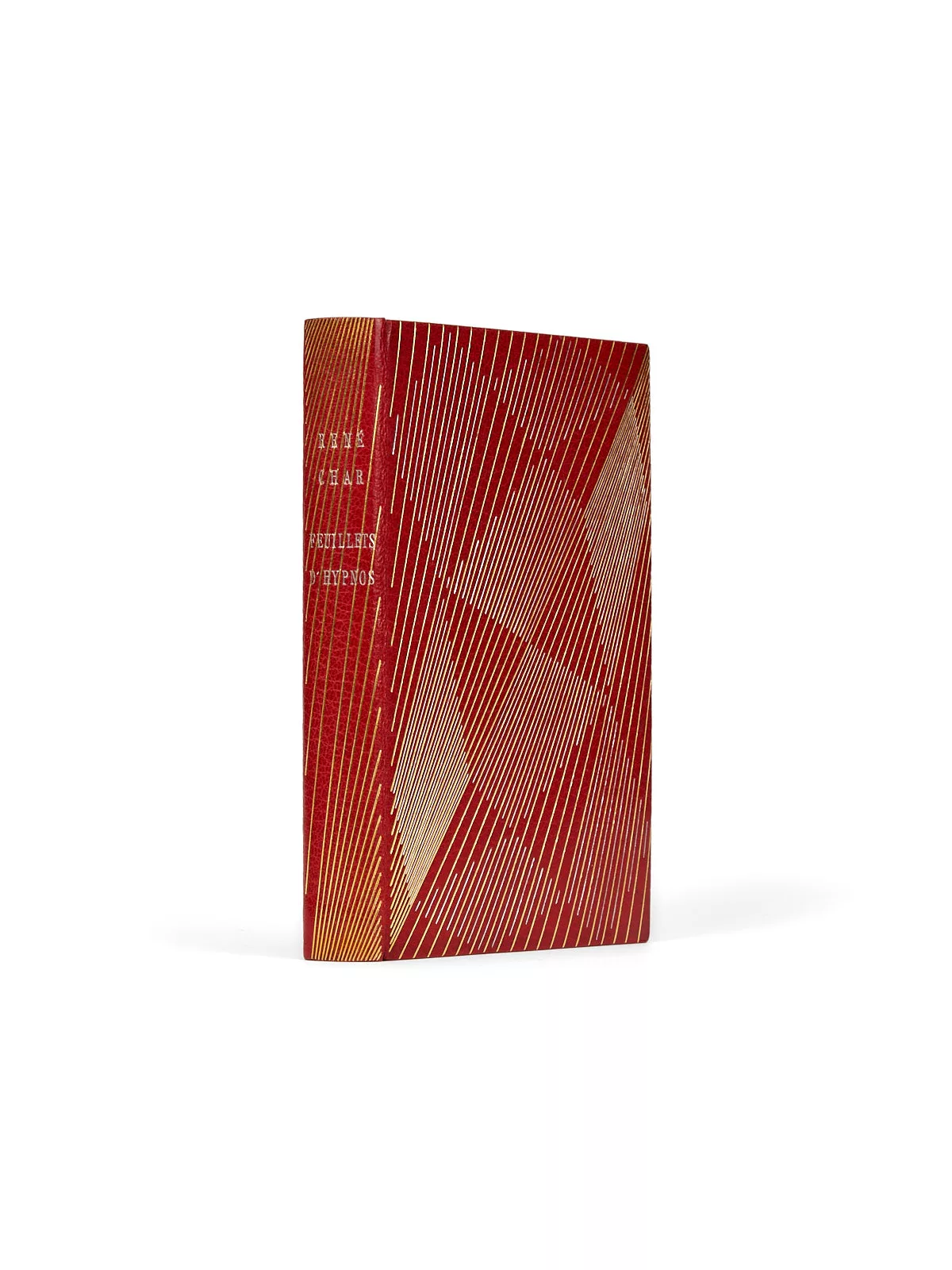
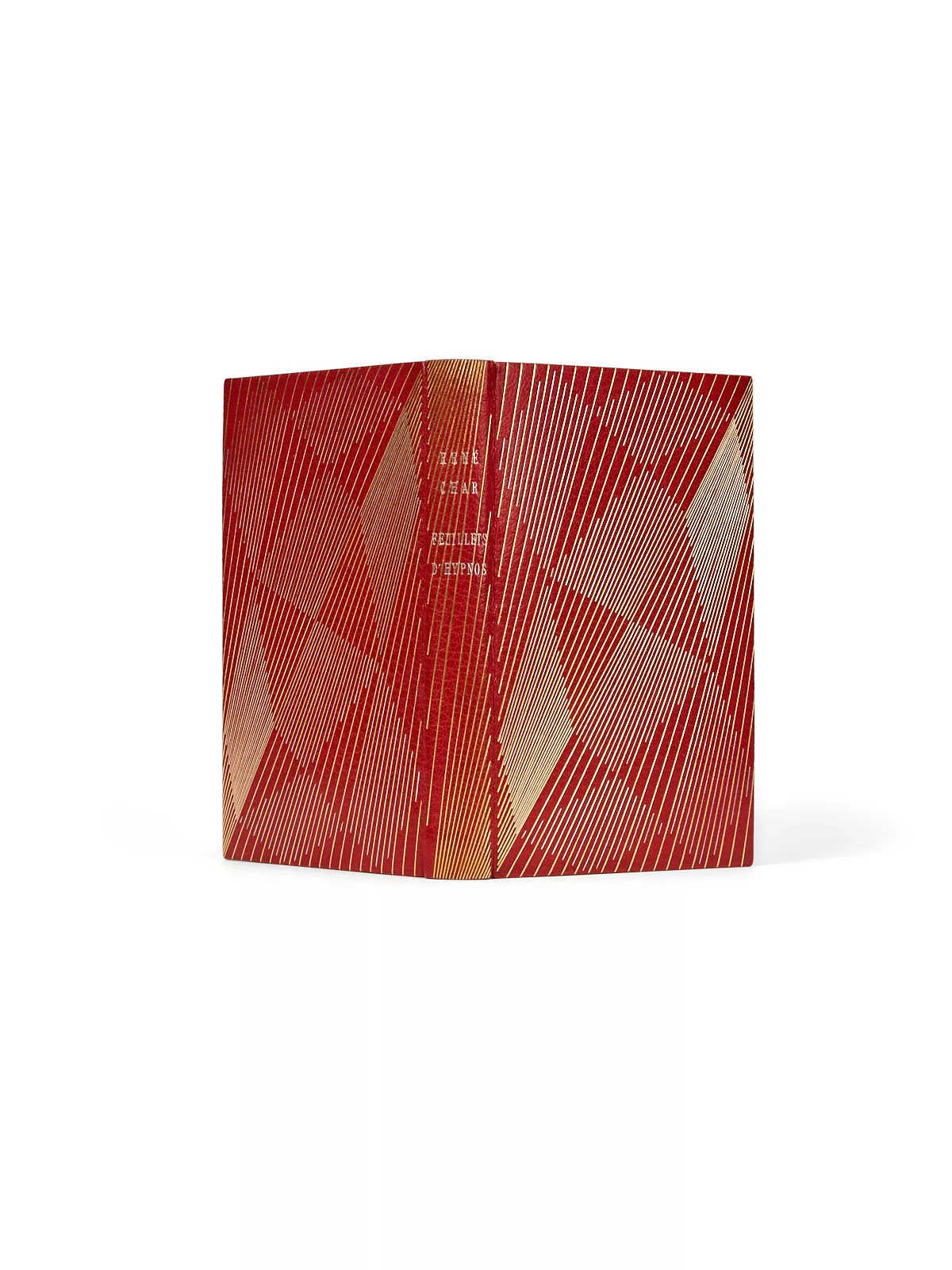
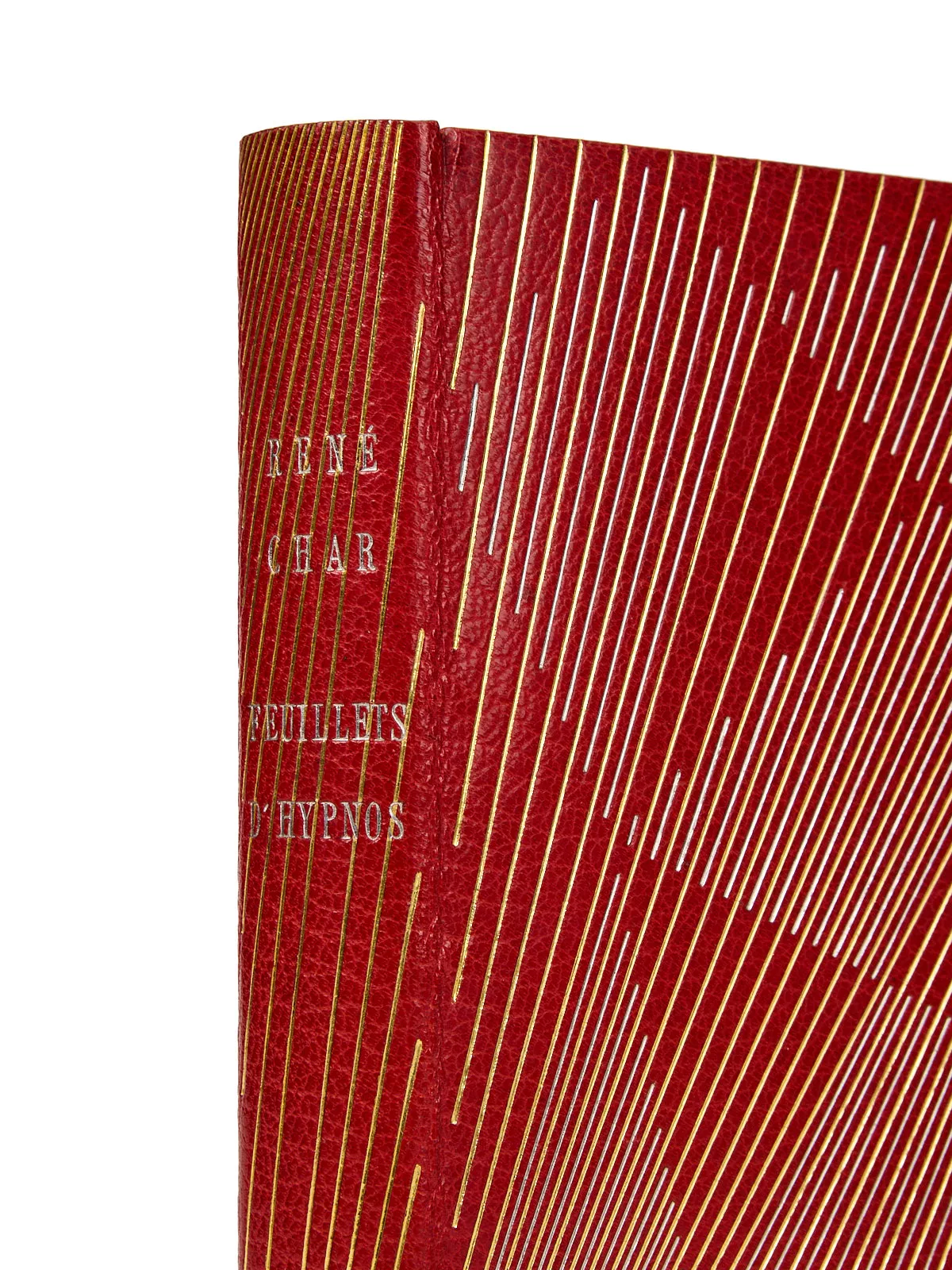
Feuillets d’Hypnos
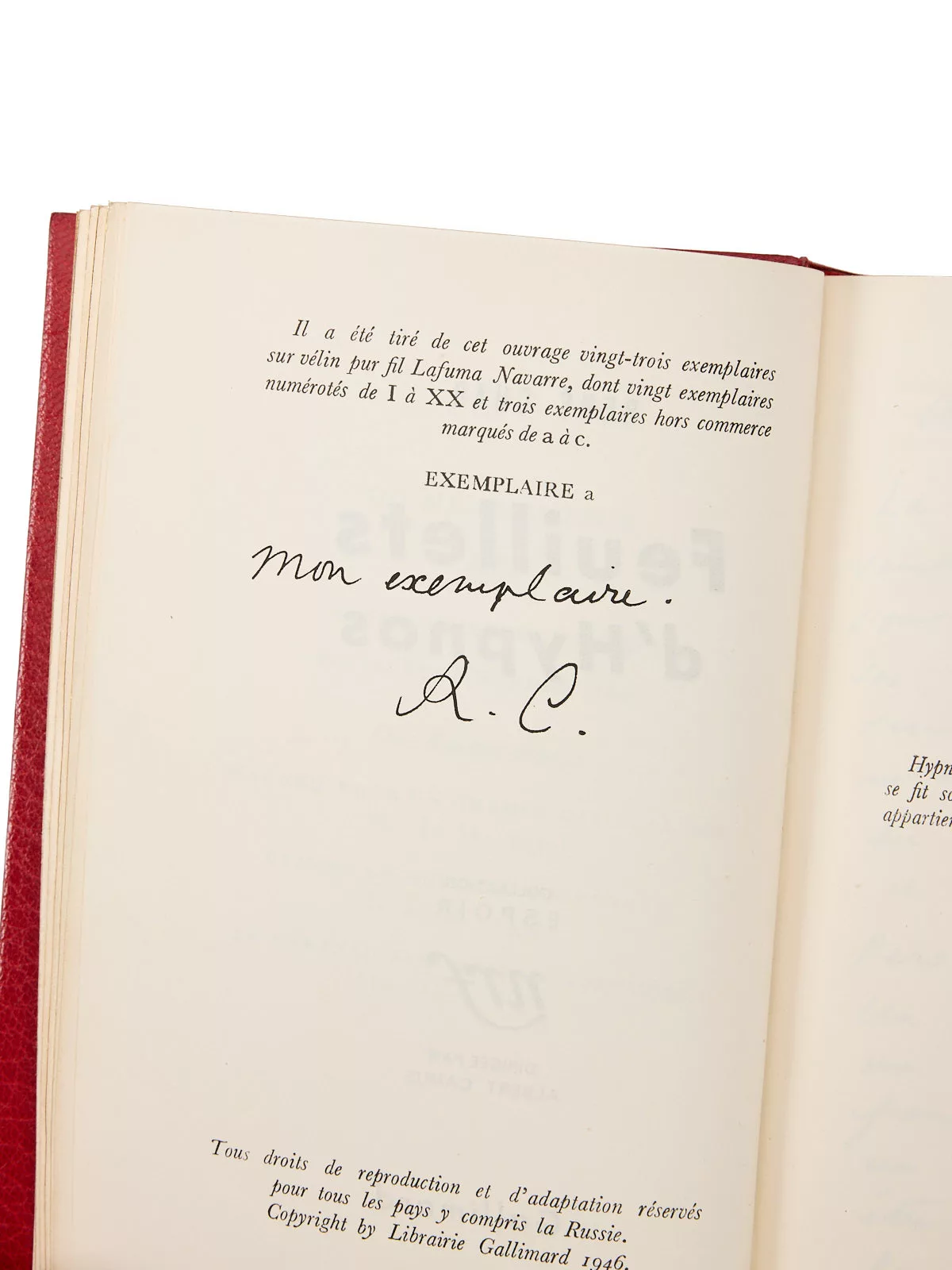
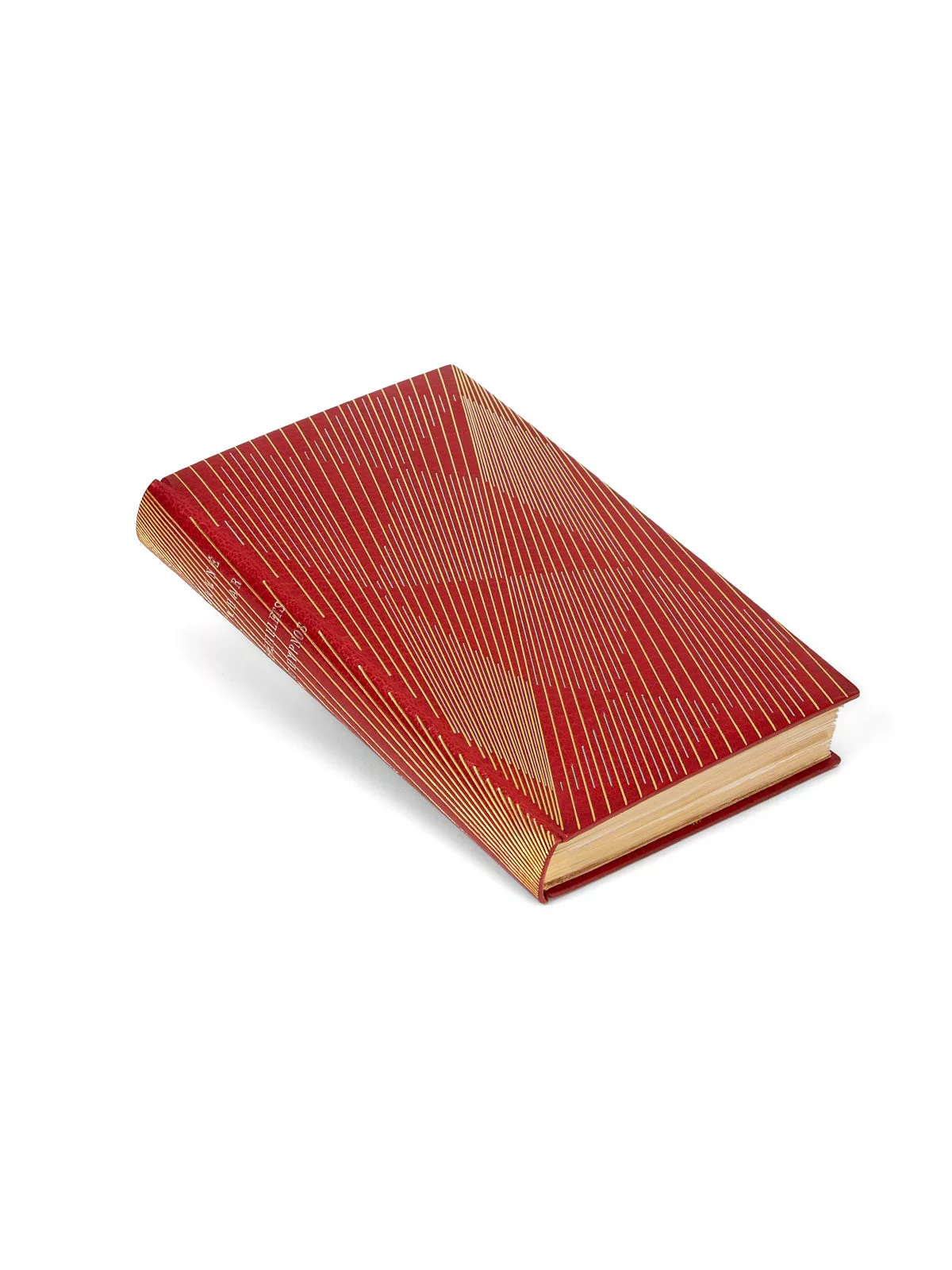
One of 23 copies on vélin pur fil Lafuma-Navarre, this copy hors commerce, lettered “a” and justified by René Char: “Mon exemplaire. R.C.”
Les Feuillets d’Hypnos were written between 1943 and 1944 at Céreste, when René Char, under the name “capitaine Alexandre,” directed the Landings-Parachute-Drops Section of the Resistance in the Basses-Alpes. The name Hypnos — the Greek god of sleep, brother of Thanatos — designates in Char the one who keeps watch through the clandestine night. The book’s entire fragmentary aesthetic proceeds directly from this maquis life: “I write briefly. I can hardly be away for long.”
Originally the Feuillets were not a book but a war notebook — notes, orders, thoughts and poetic flashes set down in the midst of clandestine operations. Called to Algiers by the Allied staff to prepare the landing in Provence, Char buried his manuscript notebook in the wall of a half-ruined house in July 1944. Recovered after the Liberation, this file became the raw material of the future book.
Albert Camus chose the text to inaugurate the “Espoir” series he directed at Gallimard. Les Feuillets d’Hypnos answered deeply to his moral and historical meditation, which he would formulate a few years later in L’Homme révolté. The publication marked the beginning of the great friendship between Char and Camus; when the Feuillets were taken up in Fureur et Mystère in 1948, Char dedicated the whole to Camus.
As early as July 1945, Char wrote to Gilbert Lély: “Je me suis mis violemment au travail. Cela s’appelle : Carnet d’Hypnos (Hypnos est un nom d’homme) 1943-1944. J’ai été assez heureux pour retrouver récemment le journal que je tenais à Céreste, enfoui à mon départ pour Alger dans un trou de mur. C’est ce journal que je vais publier […]. Je mets de l’ordre dedans, j’abrège ou je développe suivant les cas.”
From this first state came a primitive typescript of 72 fragments, then a second, deeply reworked version, completed in August 1945 and destined for the printer. Now preserved at the Bibliothèque littéraire Jacques Doucet, it bears this crucial note by Char: he had destroyed, “for reasons easy to understand,” the notebook of originals, keeping only a single leaf as a witness.
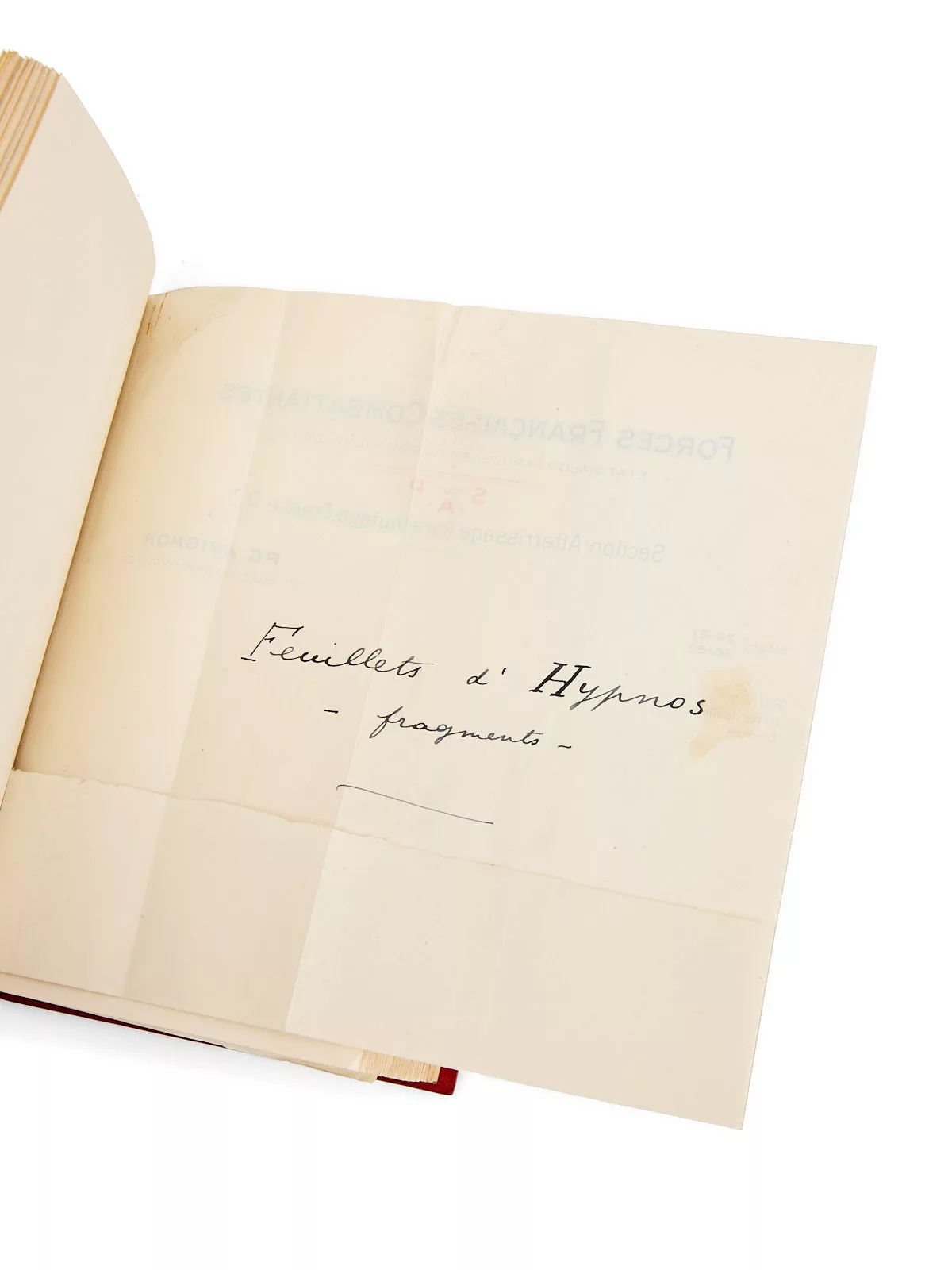
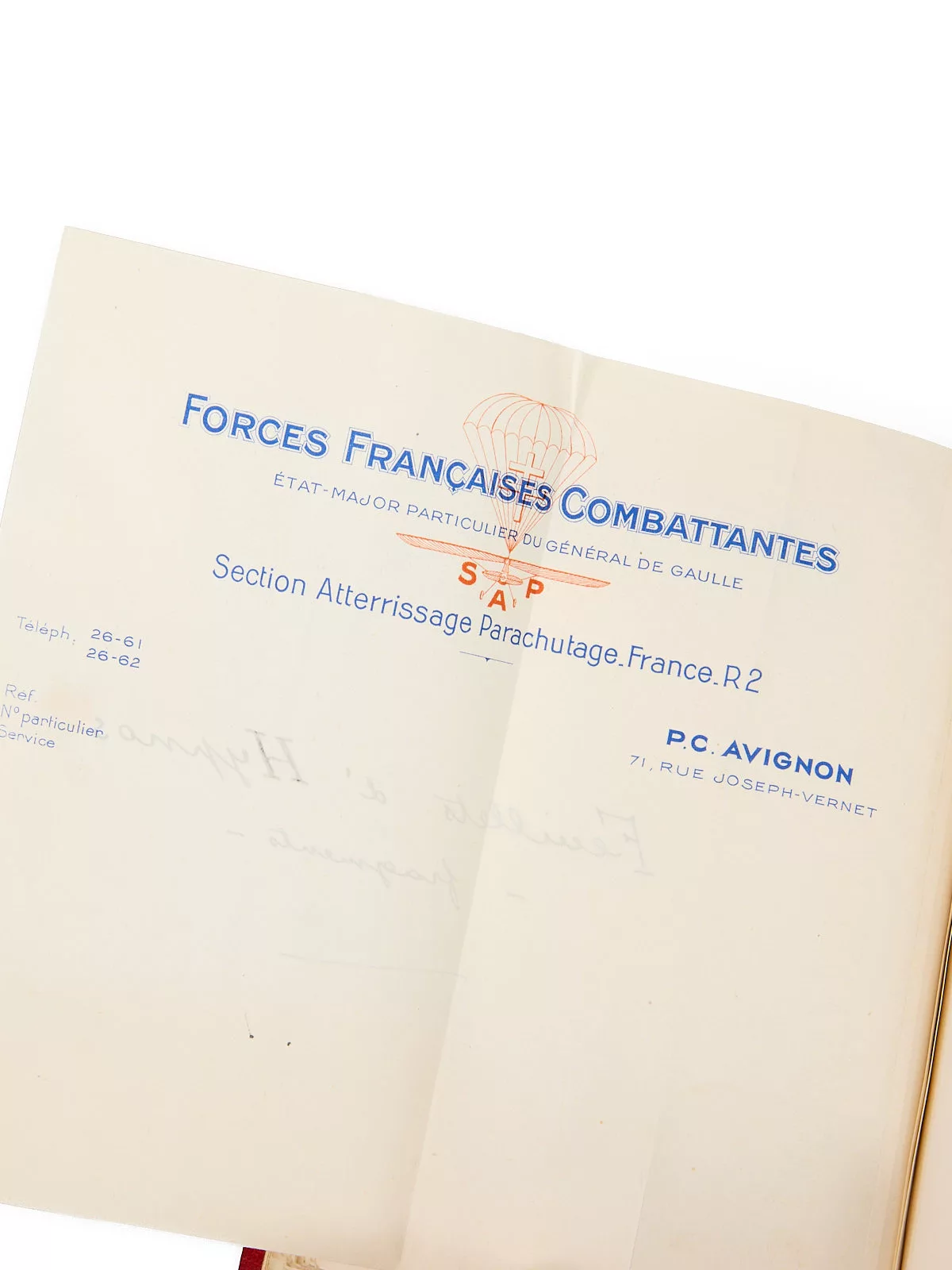
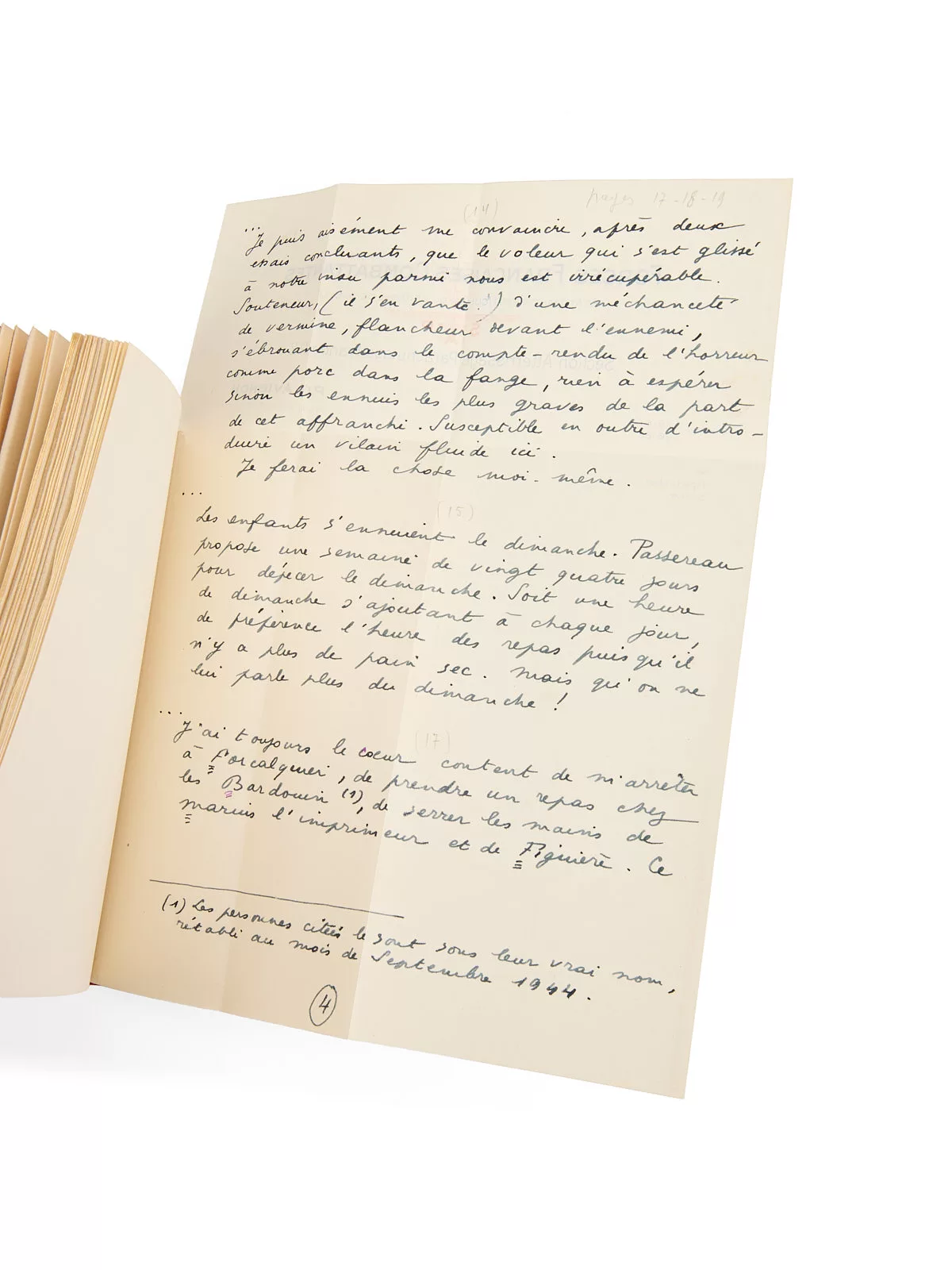
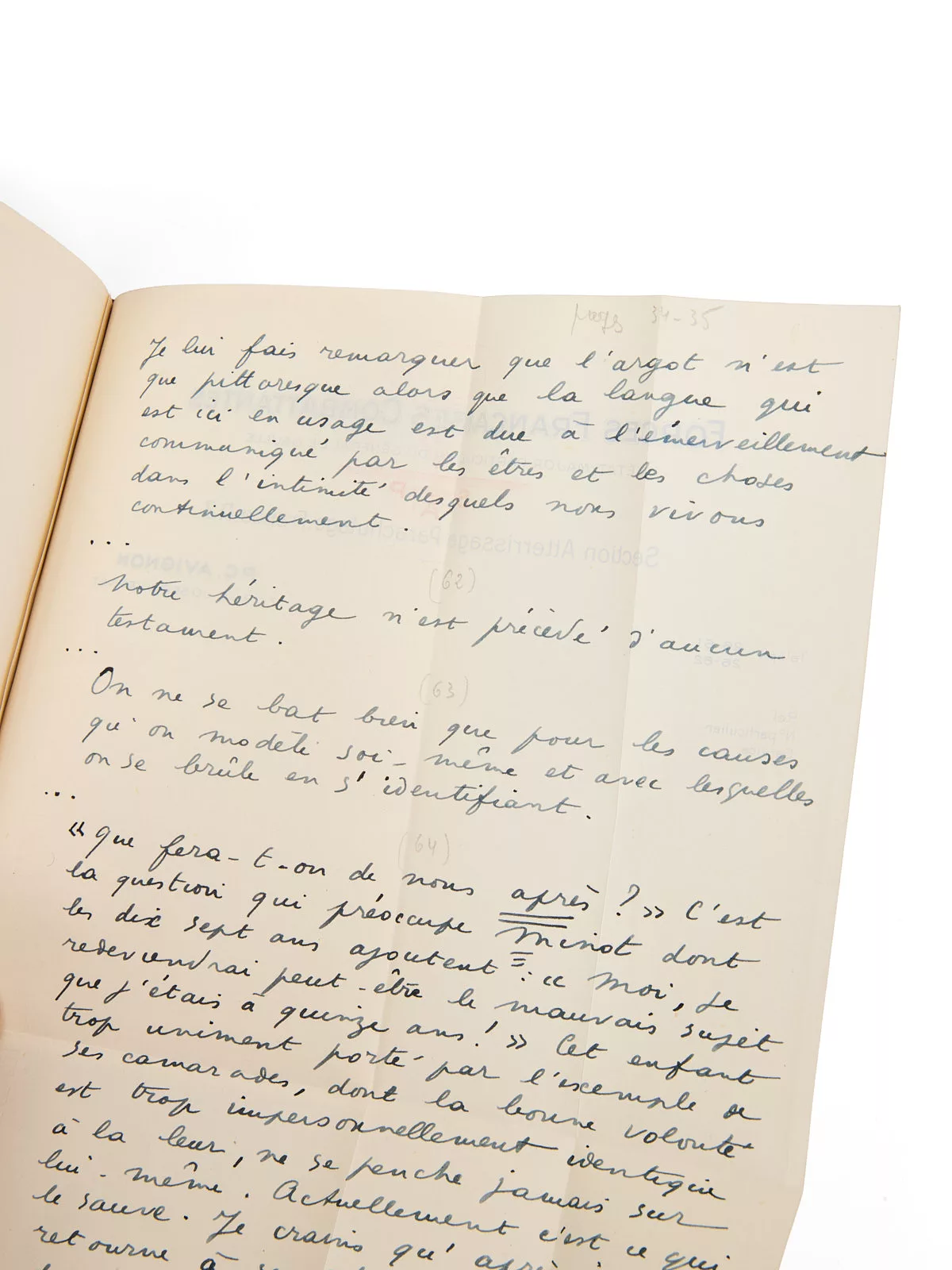
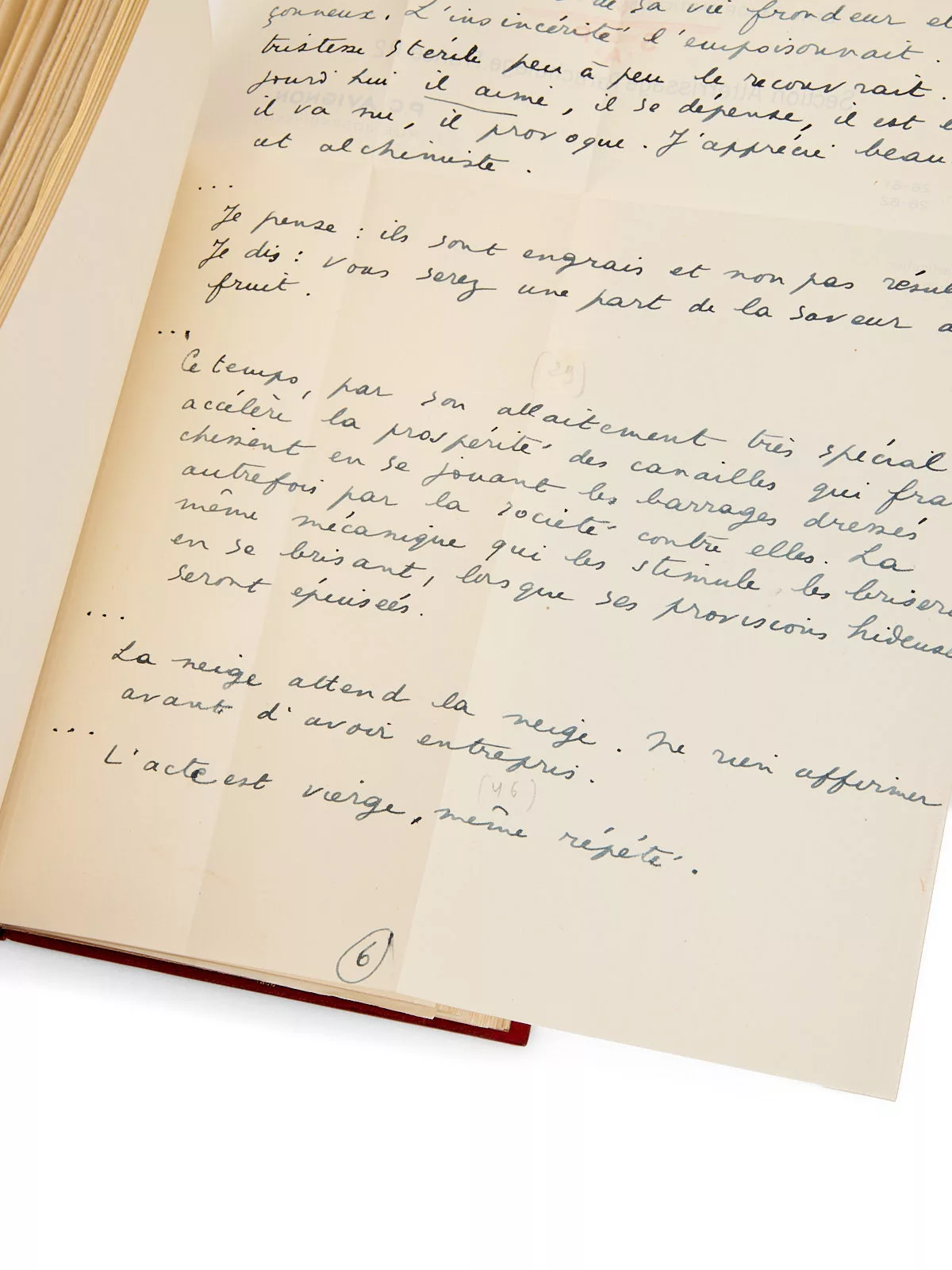
This copy, by contrast, changes what was known of the working manuscripts used for the book’s publication: it preserves the most important known manuscript ensemble of the Feuillets d’Hypnos — twenty-six autograph leaves comprising ninety-two thoughts or fragments. Twenty-two leaves are written on the verso of letterhead of the Forces Françaises Combattantes (Section Atterrissage Parachutage, P.C. Avignon), one on the verso of letterhead of the Comité de la Libération Nationale (Mouvements unis de résistance), and the last three on wove paper, with the autograph note “(1943-1944) // René Char” on the final leaf.
Among these 92 fragments, three are unpublished and two partially so. The partially unpublished fragments are: [35] “Je pense : ils sont engrais et non pas résultat. Je dis : Vous serez une part de la saveur du fruit.”; [44] “La neige attend la neige. Ne rien affirmer avant d’avoir entrepris.” The unpublished fragments are: “Chacun de nos actes est une direction.”; “Ici la gratuité est inhumaine.”; “On ne saurait dire qu’une femme nue soit jolie mais une femme dévêtue est belle.”
Several fragments appear here in a state earlier than or different from the Gallimard edition, developing some passages, condensing others, repeatedly altering the punctuation and inner rhythm. These allow comparison with the Zyngerman copy (cf. the catalogue René Char, BnF, 1990, no. 105), which must be earlier since it contains only 72 fragments and only 9 autograph leaves; a comparison with the reproduced page shows that the autograph additions and corrections made to the typescript have been incorporated into the present manuscript.
Although the manuscript is very carefully written, certain signs — such as the triple underlining of capitals — suggest that it is not a presentation or dedication manuscript but rather René Char’s own personal set, an intermediate fair copy of an earlier state, intended to be typed subsequently for publication.
The importance of this file is considerable: until now the principal known manuscripts consisted mainly of annotated typescripts or copies enriched after publication. Here, on the contrary, the text appears closest to its clandestine birth — following the two reference typescripts (Doucet and Zyngerman), in the exact span of time after the writing of the collection and before its publication. The first leaf serves as title, “Feuillets d’Hypnos – fragments,” followed by the manuscript of the prefatory note (“Ces notes n’empruntent rien à l’amour de soi…”) in its preparatory state, bearing the layout markings that would be those of the published text.
Two other copies, also on deluxe paper, are similarly enriched: that of Henri Parisot (no. XVI), with the manuscripts of several pieces destined for the reviews to which he contributed, Max-Pol Fouchet’s Fontaine (no. 45, October 1945) and Fontigène (no. 28, November 1945); and that of Gilbert Lély (no. IV), which contains 18 fragments that perfectly complement the present copy and is also enriched with the letter of 17 July 1945 cited above. Both were likewise executed by Pierre-Lucien Martin, the first in 1951, the second in 1953; the latter served as the exact model for composing the present copy in 1958, doubtless for Edmée Maus — in fact the most complete and precious of the three by the number and quality of the elements joined to it. The first two were part of the Pierre Leroy collection (Sotheby’s, 2002, nos. 138 and 139, reproduced).
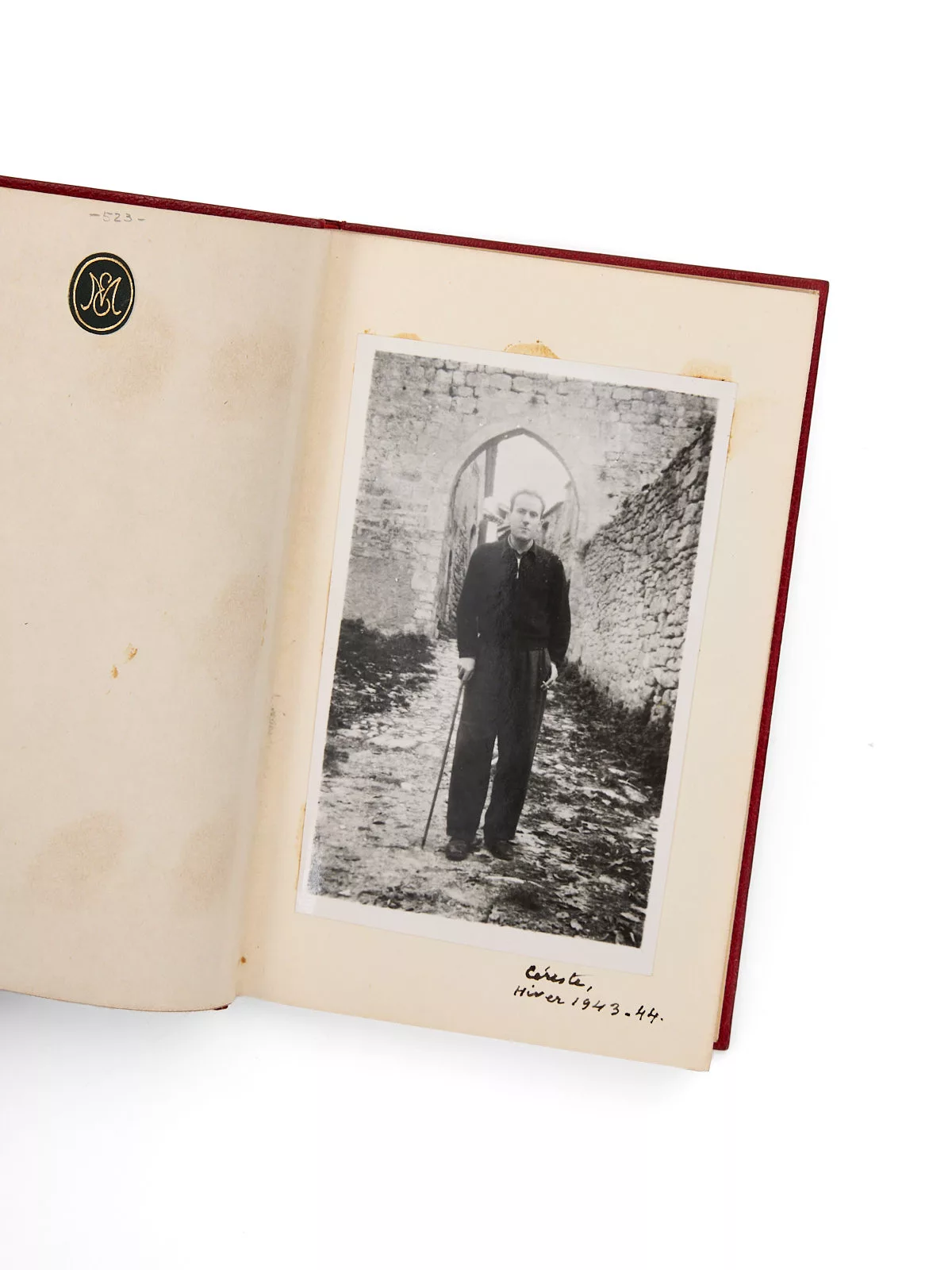
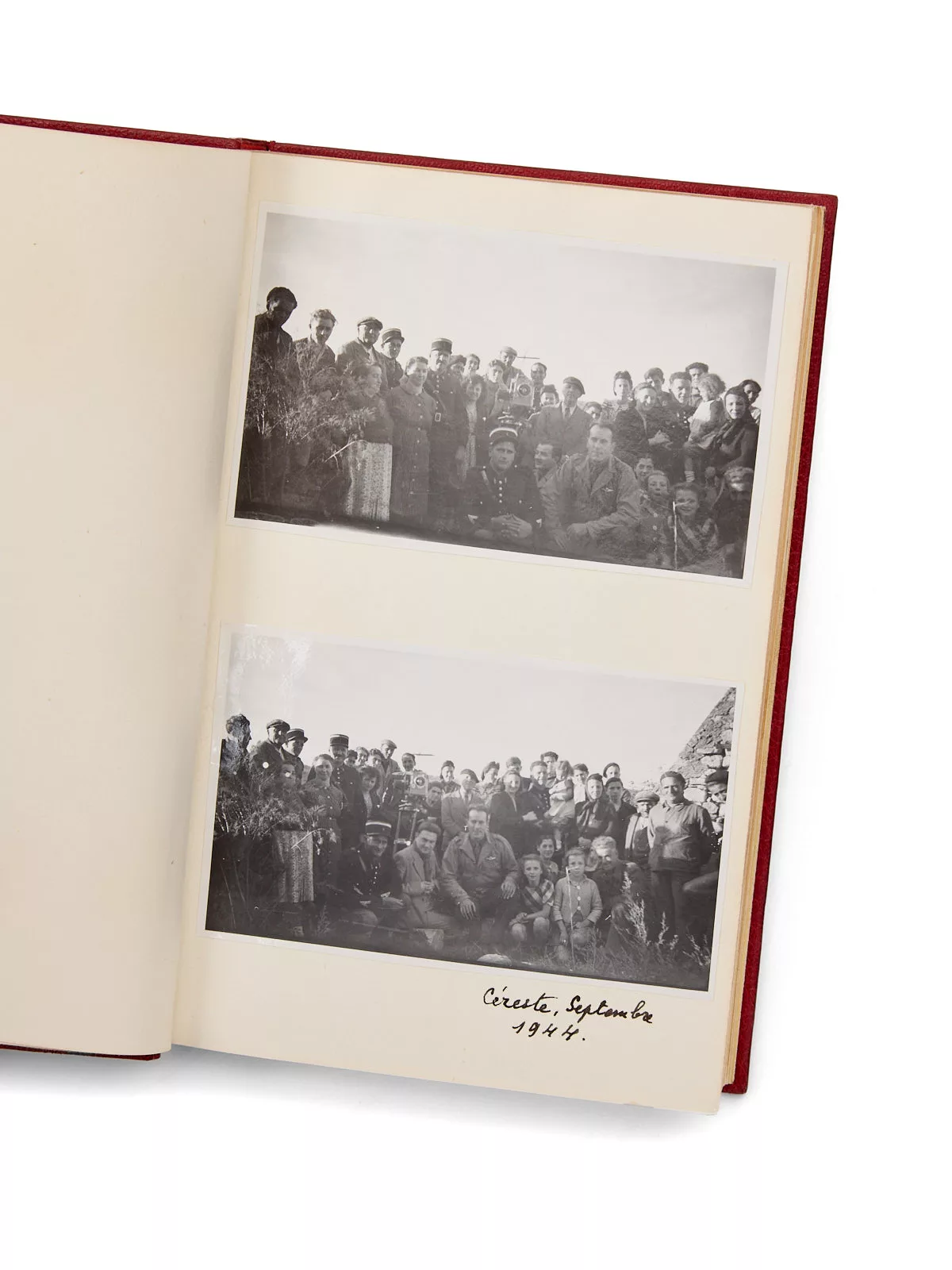
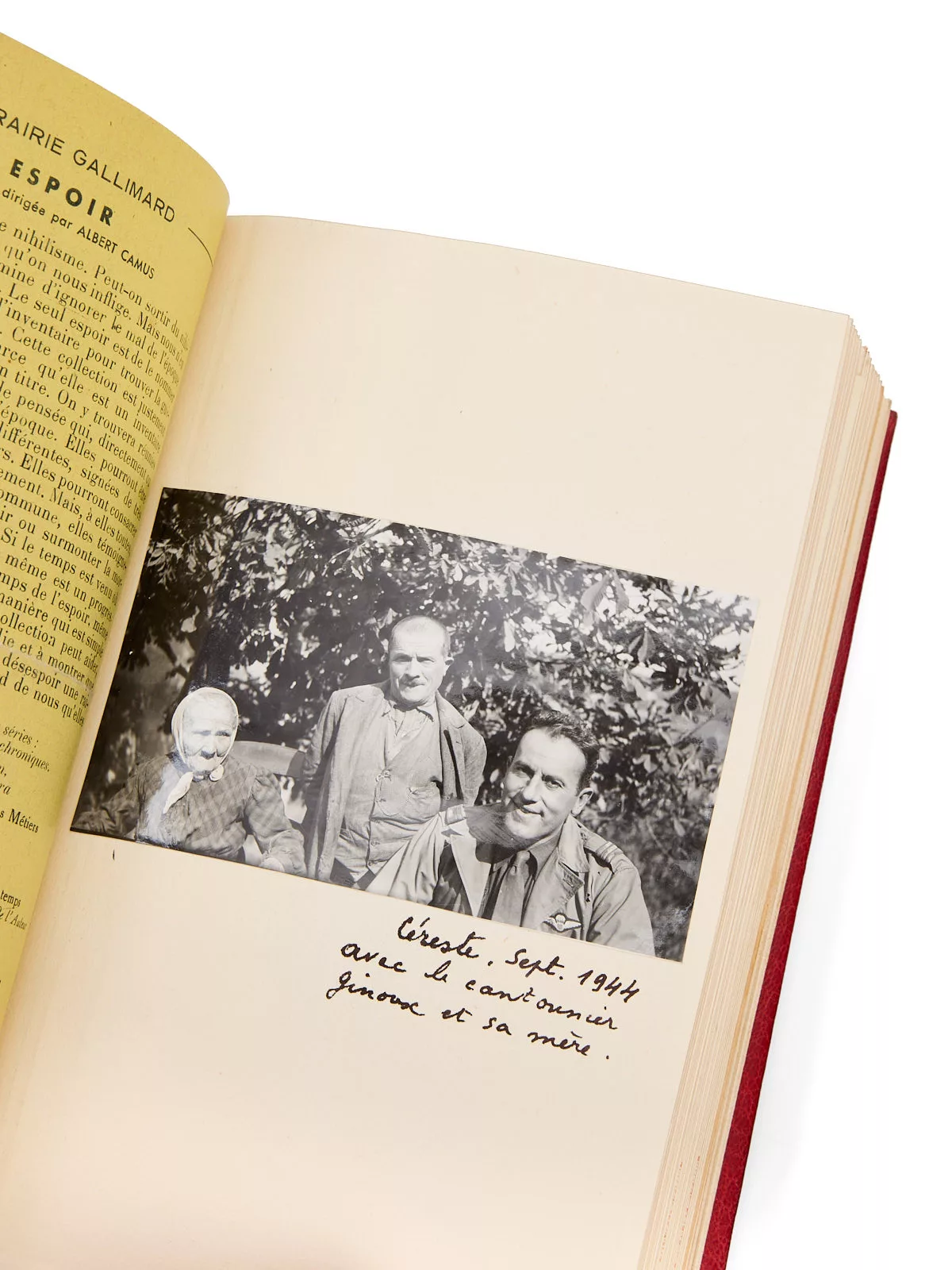
Where the Parisot copy contained none and the Lély copy only one, Char added here original photographs of the first order, often reproduced elsewhere. All were taken at Céreste and captioned in his hand on the mounting leaf: “Céreste Hiver 1943-1944,” “Céreste septembre 1944” and “Céreste sept. 1944 avec le cantonnier Ginoux et sa mère” — the last two bearing on the verso, in Char’s hand, “Céreste, à mon retour d’Alger,” in uniform. These two were taken by Irisson, Char’s photographer friend, in September 1944, for a documentary film on the SAP and the Céreste maquis that never came to fruition.
The first shows René Char in an American M-41 Field Jacket bearing captain’s stripes and an RAF parachutist’s cloth insignia, with the Ginoux — the village roadman and his mother, whom Char, “fearing a search, one day asked […] to hide codes and other important documents under her petticoats” (René Char, Bibliothèque nationale, p. 76). The other, taken the same day at Céreste, shows him in the same uniform among a group of villagers and a few gendarmes. The girl in a checked dress in the front row is Mireille Sidoine, the eleven-year-old daughter of Marcelle Sidoine-Pons, the “vixen” of poem 222 of the Feuillets d’Hypnos — the woman to whom Char would give a manuscript copy and to whom he wrote on 18 September 1947 that he had told a bookseller [Jean Hugues] she wished to sell the Feuillets d’Hypnos she owned, and that he consented (BnF, p. 209). These leaves seem to be those used to make up the Lély and Maus copies, twins in composition and binding, Char keeping for his own copy a majority of the salient manuscripts and these first-rate photographic elements. Some are reproduced in the Char catalogue, BnF (no. 100); of the one with the Ginoux, two other prints are known: one given to Adrienne Monnier in 1949 (Pierre Leroy collection, 2002, no. 171; then sale Boisgirard, Paris, 1998, no. 66), and another to Max-Pol Fouchet. Further prints exist, Irisson having pulled several more from 1945 in larger formats (100 x 170 and 120 x 180 mm).
There is also a postcard addressed to René Char by André [Ravaute]: a translator from English (notably the poems of Wallace Stevens), painter and illustrator, a native of the Vaucluse, who would later exchange with the poet a long correspondence of more than 200 letters written between 1946 and 1984 (Compiègne Enchères, 23 June 2018), still unpublished — only a few extracts were published by Laurent Greilsamer in L’Éclair au front. His testimony in the Cahier de L’Herne devoted to Char is important: at twenty, having read the newly published Seuls demeurent, he went to Les Névons, the family house at L’Isle-sur-Sorgue where Char, alias capitaine Alexandre, had settled after the maquis. He describes the corner study: on the wall a reproduction of Georges de La Tour’s Le Prisonnier; on the mantel a photograph of Arthur Rimbaud at sixteen; on the table a flat round blue box that had held detonators and that Char had turned into a tobacco tin, for he then rolled his cigarettes; a Colt in a leather holster hung by the door; and on the table a file marked in red pencil “S.A.P.R 2,” which he later learned was a copy of the Feuillets d’Hypnos. Char kept a postcard reproducing the sculpted portrait of Hypnos, with these words: “Au British Museum j’ai trouvé le portrait d’Hypnos. Affectueusement André.”
The copy is finally enriched with a long autograph inscription signed to Dr. Zara: “Le mont du Lubéron semble dormir, et plus souvent souffrir derrière ses cicatrices encore visibles lorsque je m’approche de lui en 1963. « Bonne nuit, Hypnos ! » Personne n’a parlé. Un enfant du passé, un enfant resté enfant est là derrière un troupeau, peut-être éternel comme la clarté des étoiles.”
Provenance: René Char; Edmée Maus (bookplate); Dr. Zara (inscription and sale, 2026).
A marvelous copy, probably the most precious of the 23 deluxe copies.