

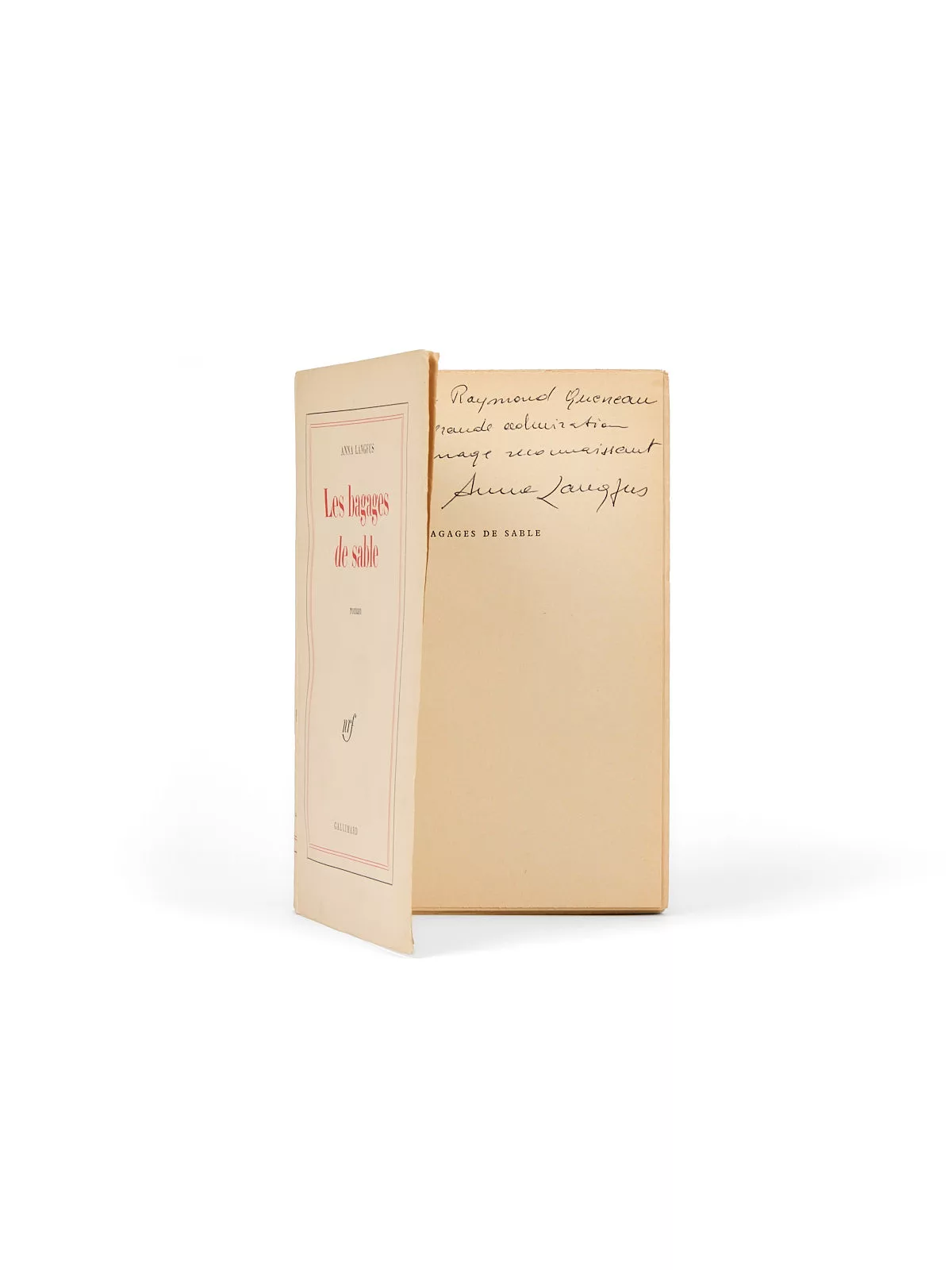
Les Bagages de sable
One of the press copies, stamped as such.
Signed presentation inscription: “À monsieur Raymond Queneau avec une grande admiration, en hommage reconnaissant, Anna Langfus.”
Prix Goncourt, 1962. Born in Poland in 1920 and a survivor of the Lublin ghetto, Anna Langfus took refuge in France after the war and made her work a restrained yet unflinching testimony to the concentration-camp experience and its aftermath. Les Bagages de sable is her second novel, following Le Sel et le Soufre (Prix Charles Veillon, 1960). Her parents, who had remained in the Warsaw ghetto, disappeared in 1943.
The novel follows the wandering of a young camp survivor, haunted by the memory of his murdered parents and unable to rebuild his life after the war. In a taut style, free of pathos yet dramatically intense, Langfus depicts the impossibility of returning to normal life, survivors’ guilt, and the crushing weight of the dead upon the present.
The fourth woman to receive the Prix Goncourt (after Elsa Triolet in 1944, Béatrix Beck in 1952 and Simone de Beauvoir in 1954), Anna Langfus marked the history of the prize by introducing a distinctly female and Jewish voice into the literature of memory. Her work, admired by Jorge Semprún and Primo Levi, ranks among the foremost survivor narratives published in France in the 1960s.
A rare autograph presentation copy: the one given to Queneau, a member of the Goncourt jury — a token of gratitude from a novelist who died too soon (she passed away in 1966, at only forty-six, while working on a fourth novel), leaving behind a brief but brilliant body of work that remains an essential landmark in the literature of the Shoah and its aftermath.