

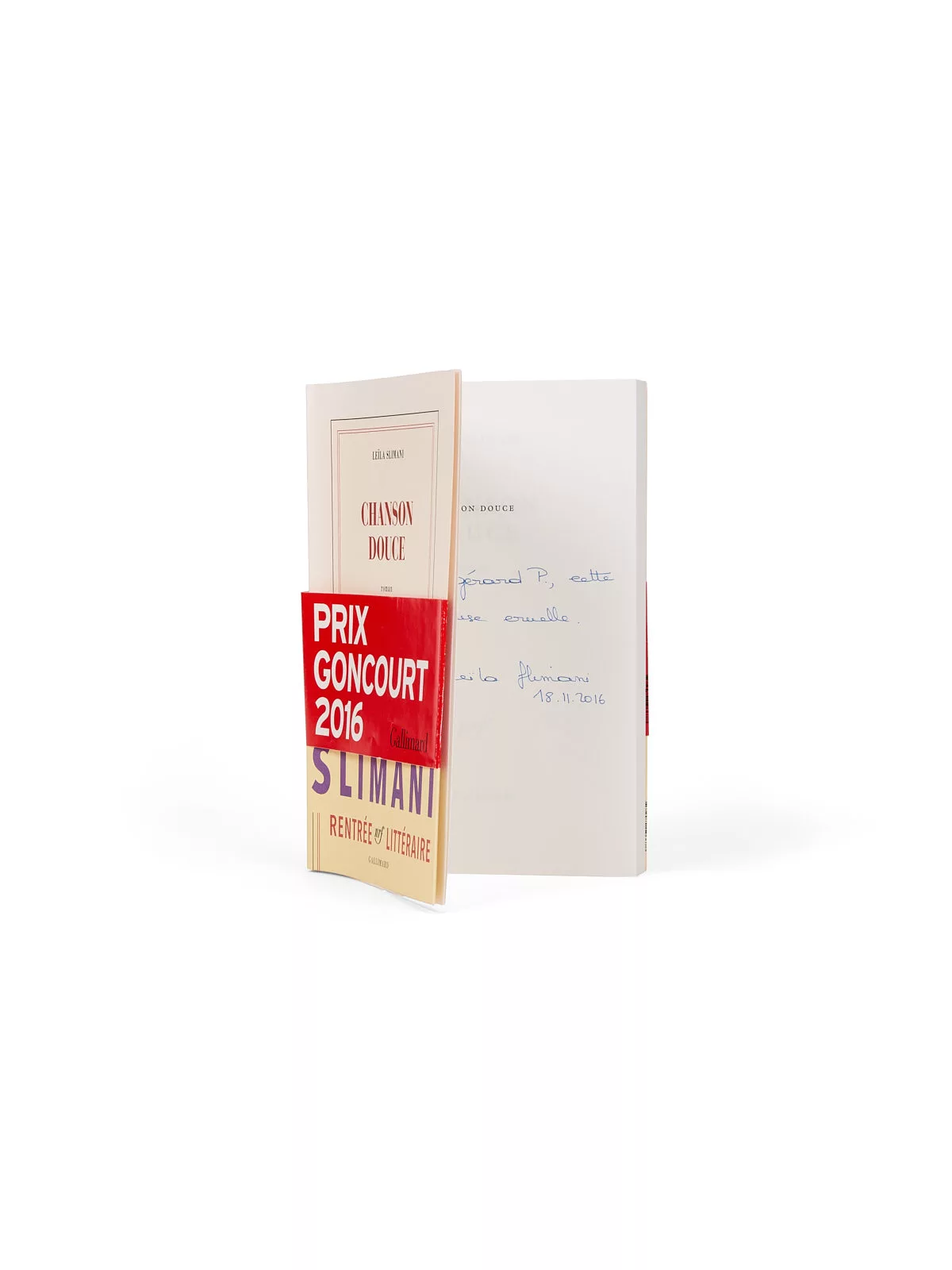
Chanson douce
Signed presentation inscription: “À Gérard P[ouguet], Cette berceuse cruelle, Leïla Slimani, 18.11.2016.”
From its opening sentence — “Le bébé est mort” (“The baby is dead”) — Chanson douce (Lullaby) seizes the reader and never releases its grip. Far from a lullaby, Leïla Slimani patiently traces backward the events leading to a double infanticide, inspired by a 2012 New York case, following the trajectory of a “perfect” nanny, Louise, driven to the edge by isolation, precariousness and humiliation.
Written in a dry, clinical and precise style, this is the second novel by a writer born in 1981 in Rabat, a graduate of the khâgne and Sciences Po, confirming the talent already noted in Dans le jardin de l’ogre. Leïla Slimani became the twelfth woman to win the Prix Goncourt in one hundred and thirteen years, and the second from the Maghreb after the author of La Nuit sacrée.
The prize was awarded to her on the first ballot, adding a new laurel to Gallimard’s harvest — the house that has always produced the largest contingent of laureates of France’s foremost literary prize, and which had won it “only” three times since 2001.
Publisher’s band and Goncourt band laid in.