

À l’ombre des jeunes filles en fleurs
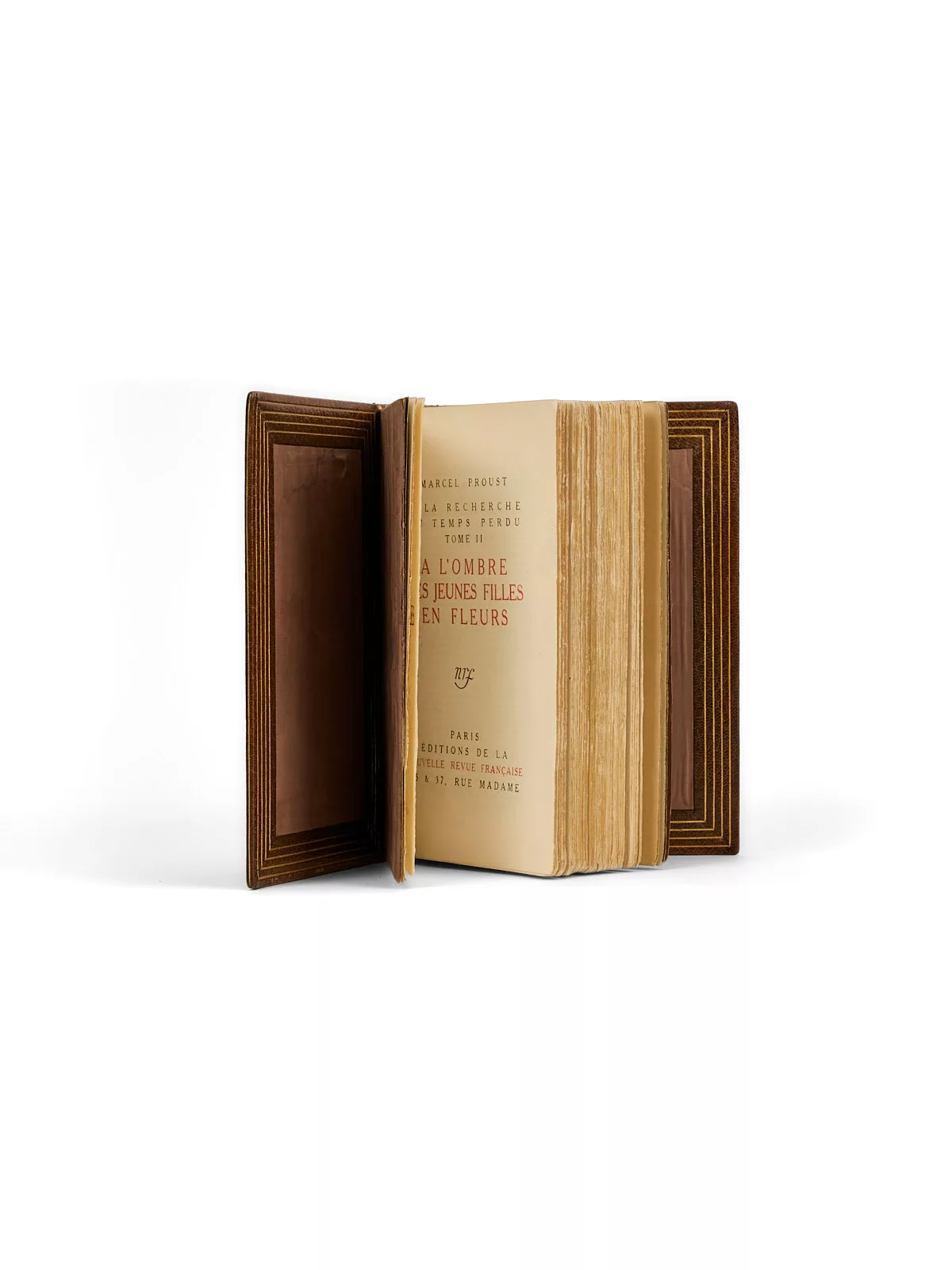
Copy of the first printing, first issue, without edition statement.
The deluxe-paper copies were only printed six months later, in the summer of 1919 (128 réimposé copies).
Since 1916, Gaston Gallimard had officially become Marcel Proust’s new publisher. As early as October 1917, he intended to print the forthcoming volumes of the Recherche du temps perdu, taking the opportunity to buy back from Bernard Grasset the roughly six hundred remaining copies of the stock of Du côté de chez Swann. These copies were put back on sale under new NRF wrappers in the winter of 1917.
A new “house” typesetting was then planned, with a few amendments required by the subsequent development of the work, whose printing was constantly delayed by Proust’s incessant corrections. These delays postponed the publication of the second volume of the series, À l’ombre des jeunes filles en fleurs, which was finally ready in the autumn of 1918. The Imprimerie La Semeuse in Étampes produced a first ordinary printing of 500 copies without any edition statement, followed by six further runs of 450 copies each, bearing statements from “second” to “seventh edition,” all sharing the same printing date of November 28, 1918. In total, 3,242 copies came off the presses, while the publisher announced 70 réimposé copies to be printed separately on Lafuma de Voiron pur fil paper: but these were never printed.
It would take nearly six months before the book went on sale — the time needed to finish the edition of Swann, finally ready in early June. The book could then be put on sale, but still without the announced deluxe copies. The planned 70 copies evolved into a new standard, the famous “in-quarto Tellière” format: 128 réimposé copies of these two volumes were printed at the start of the summer.
Less than six months later, on 10 December 1919, Marcel Proust was awarded the seventeenth Prix Goncourt for À l’ombre des jeunes filles en fleurs — the first Prix Goncourt for Gaston Gallimard’s house. In the wake of this success, volumes were reprinted starting on 16 December 1919, this time in two volumes, with an “eighth edition” statement for copies of the first issue.
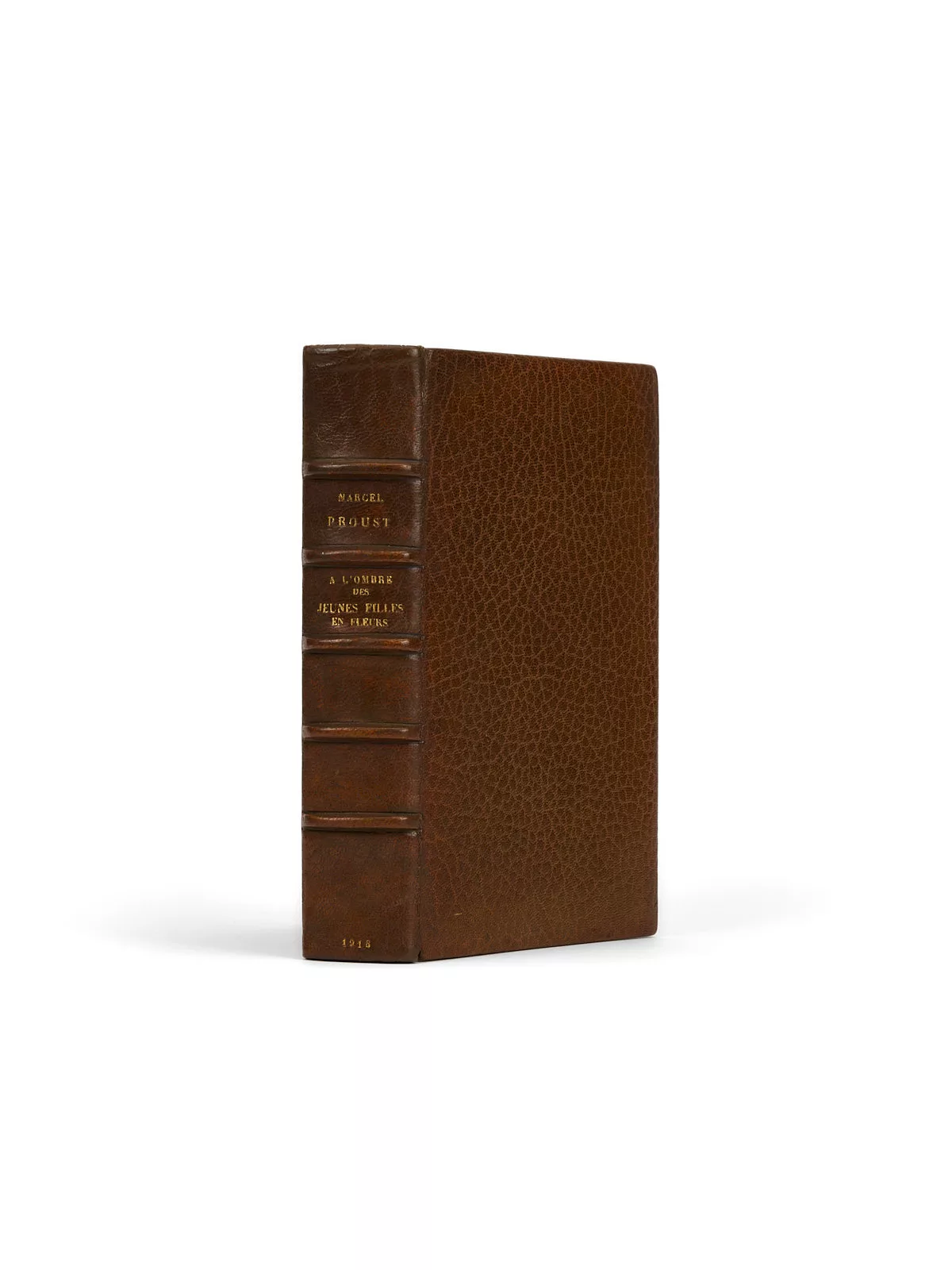
A very fine copy of the first Gallimard Goncourt, here in a contemporary binding, of good provenance: Guy Seligmann was the son of Jean Seligmann and great-nephew of Jacques Seligmann, both major Parisian antique dealers of the first half of the twentieth century. It is likely that this copy came from one or the other of these collections.
From the library of Guy Seligmann (bookplate).