

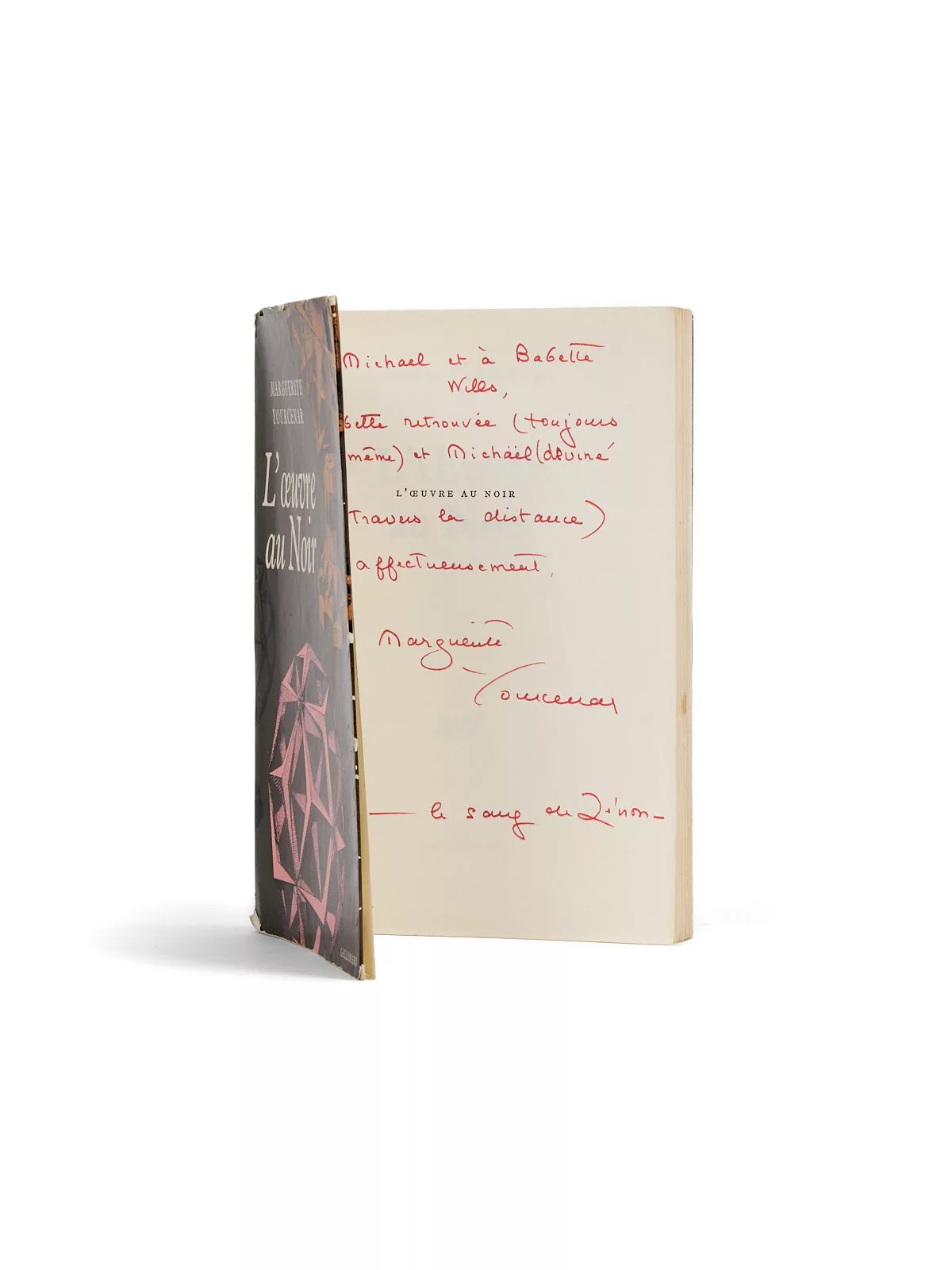
L’OEuvre au noir
A long-gestated novel, begun as early as 1956 and preceded by several magazine pre-publications between 1964 and 1965, L’Œuvre au noir marks one of the summits of Marguerite Yourcenar’s work. The novel follows Zénon, a physician, philosopher, alchemist and free thinker in sixteenth-century Flanders, confronted with religious violence, the illusions of knowledge and the experience of a suffering body.
Awarded the Prix Femina unanimously and on the first ballot, L’Œuvre au noir achieved great public success from the year of its publication. In his review for Le Monde, José Cabanis emphasized the novel’s highly original way of renewing the historical novel, through a “rigorous scientific spirit” and a rare ability to convey, through the Renaissance setting, deep analogies with contemporary anxieties.
The inscription hints at a long-standing relationship: although it cannot be established, document against document, that Marguerite Yourcenar and Babette knew each other before the war, the wording suggests old ties. The hypothesis is far from implausible: Babette Wills, then Elisabeth Ullman, lived in the artistic Paris of the 1930s alongside the painter Paul Ullman, before the war forced the couple to leave for the United States in 1940, where they settled in Connecticut. Yourcenar, who had also moved to America as the conflict approached, lived those same years in Connecticut with Grace Frick, before later settling permanently in Maine. Widowed when Paul Ullman was killed in France in 1944 while on a mission for the Office of Strategic Services, Elisabeth married Michaël Wills in 1945; after this second marriage she settled in California, in the house Willy Nilly, at Portola Valley, which became an important meeting place for writers and intellectuals on the West Coast. Yourcenar maintained a regular correspondence with her fellow dual national — both women held French-American dual nationality.