

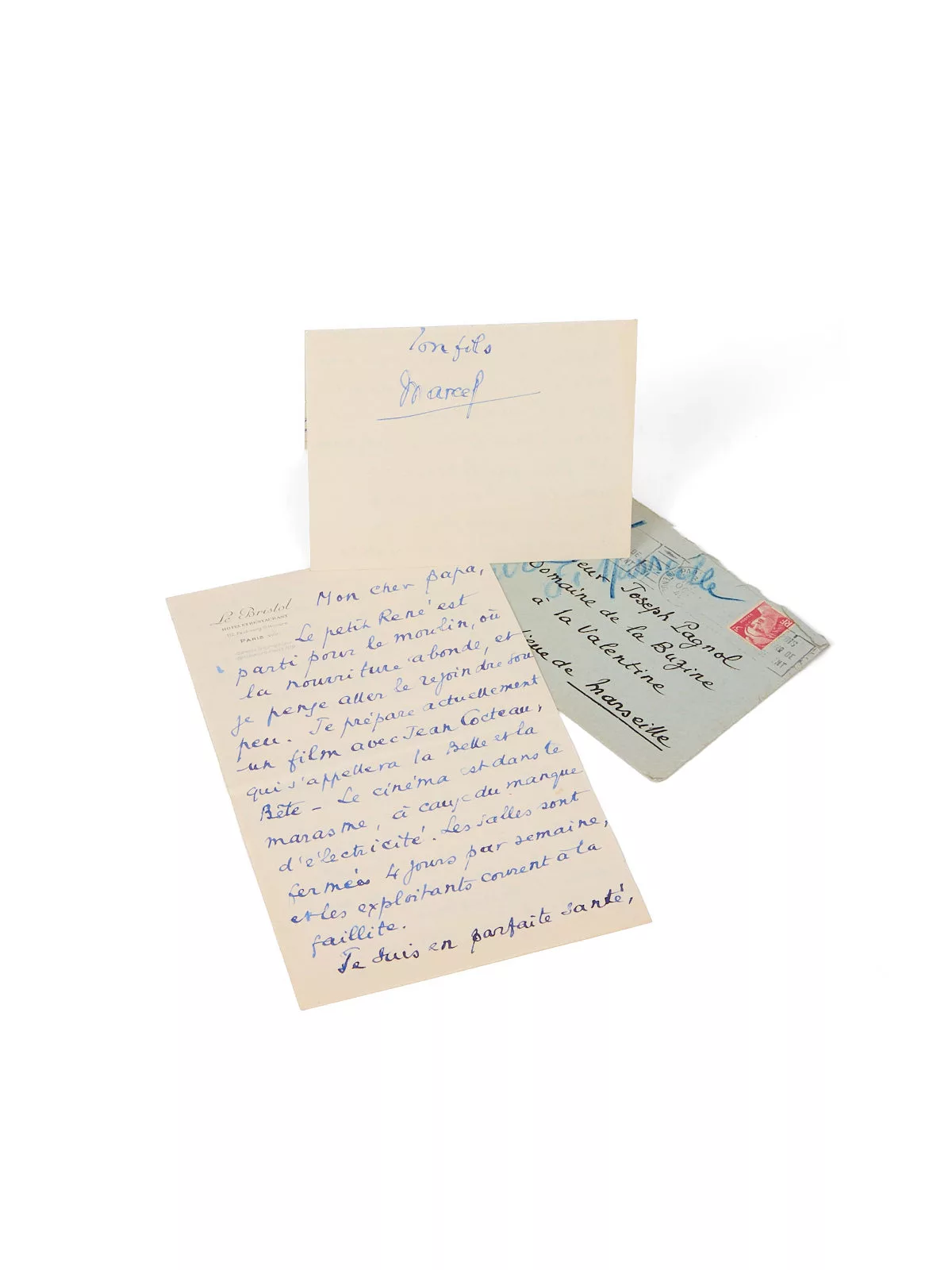
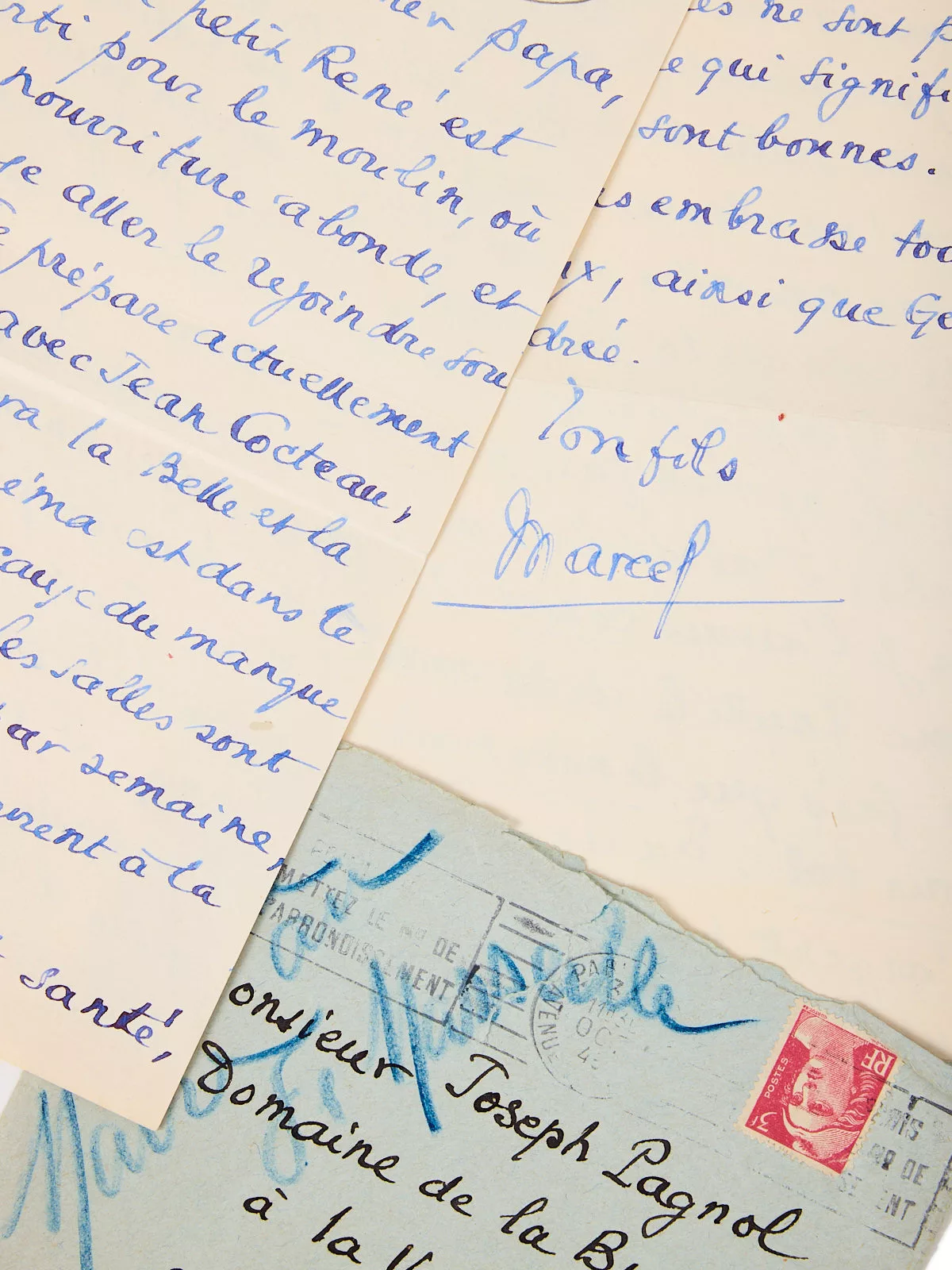
Lettre à son père
In occupied Paris, Jean Cocteau set out to bring Mme Leprince de Beaumont’s tale La Belle et la Bête (Beauty and the Beast) to the screen.
In his diary of those years, the author of Potomak noted that his world and that of the author of Marius, Fanny and César “could not mix.” And yet Pagnol, who admired Cocteau, was a discreet but decisive presence behind the venture: he persuaded Gaumont and then the producer André Paulvé to back the project, and helped secure the casting of the leading actress, Josette Day, his own companion, whom he had nonetheless just left. The two met at a dinner arranged at Lili de Rothschild’s: the actress arrived with curled hair, made up and elaborately styled, the very opposite of what Cocteau had in mind. The film’s costume and set designer, Christian Bérard, took her to the washroom, put her head under the tap, soaked her hair and pinned it into a bun, then brought her back to the table exclaiming: “Here she is, Beauty!”
The result was a marvel, and the film became legendary. Cocteau himself, in his Journal d’un film, described the difficulties of shooting in a Paris ravaged by shortages and rationing, but also the joy of its completion. The film was made in the immediate postwar period (27 August 1945 to 11 January 1946) — the scenes at Belle’s house were shot at the Manoir de Rochecorbon in Indre-et-Loire, near Tours — and won the Prix Louis Delluc 1946, the sole annual award for French cinema.