


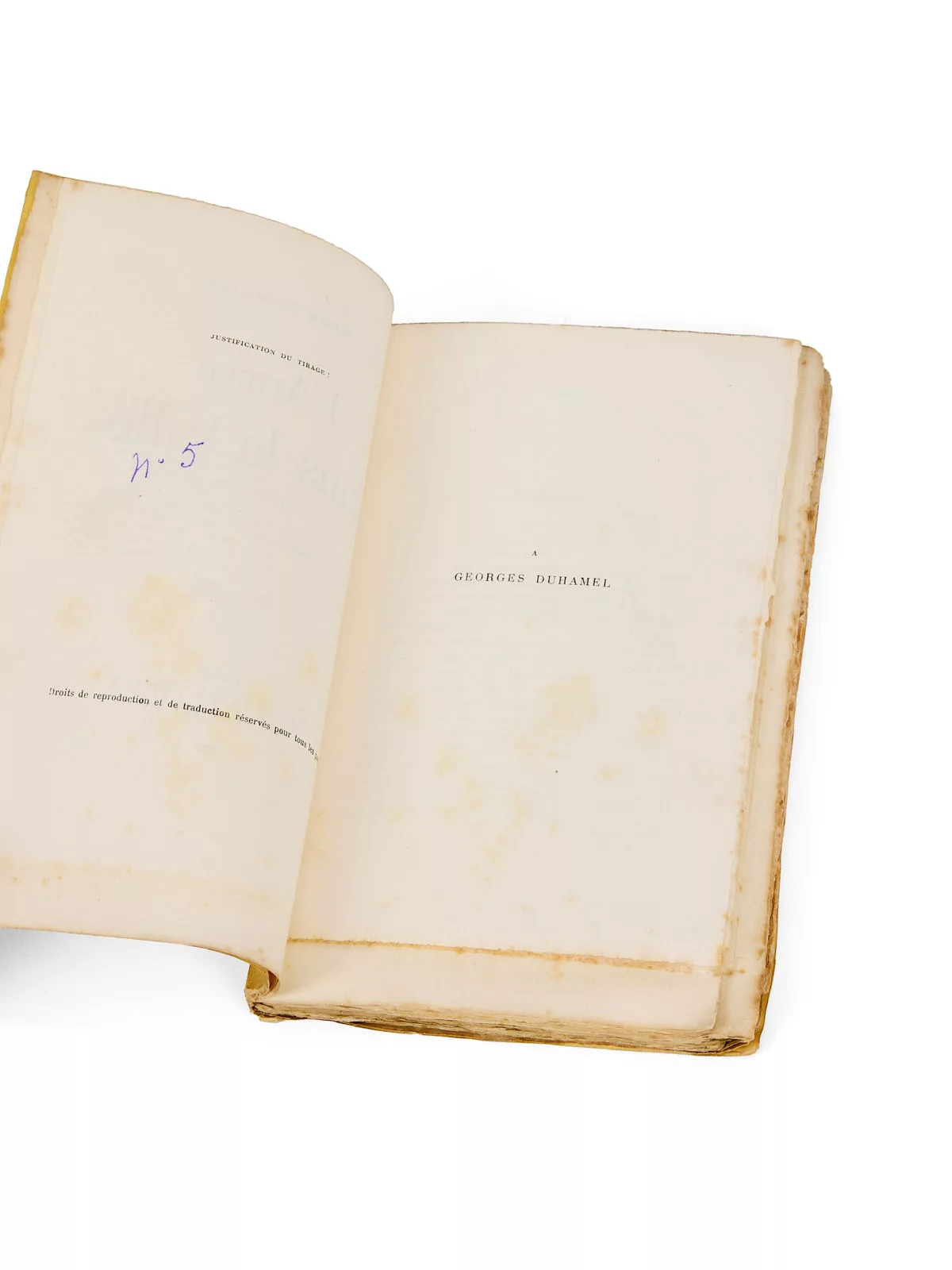
L’Armée dans la ville
One of 10 [unannounced] copies on Hollande paper, the only paper used (no. 5).
Inscribed and signed: “à René Arcos, Jules Romains.”
Foxing to the deckle edges.
Jules Romains is no longer read today as widely as he once was, even though he was among the most significant French writers of his time: a triumphant playwright of the interwar period, a future Academician laden with honors and distinctions, he long occupied an eminent place in French literary life. Of this immense fame, it is probably his plays that have best withstood the passage of time, Knock foremost among them. But before this theatrical fortune came the years of youth, a period of still-tentative but energetic and ambitious invention, when Romains sought to give literary form to his doctrine of “unanimism,” which he shared with Georges Duhamel.
A precocious writer, he published as early as 1906 Le Bourg régénéré, subtitled Conte de la vie unanime, in which he attempted to convey the collective life of human groups rather than the isolated psychology of individuals — an idea that also runs through his early work for the theater. The year 1911 proved decisive in this respect: it saw the publication of Mort de quelqu’un, a “brilliantly ordinary tale, imbued with an imperishable humanity,” in the words of the critic René Arcos — the novel was also highly praised by Stefan Zweig, among others — followed by his first play, staged at the Odéon: L’Armée dans la ville.
It was therefore only natural that he should present this same René Arcos, a few months after his laudatory review, with this deluxe copy of what then stood as the first manifestation of a dramatic career about to take flight.
The reception, however, was far from unanimous. The NRF, in particular, harshly attacked the play after its performance, mocking the “Appeal to Youth” that Romains had published on the occasion and challenging the work’s claims to classicism, national relevance and innovation alike. This did not, however, prevent Gaston Gallimard from signing Jules Romains to his house: all of his future plays would be published there.