

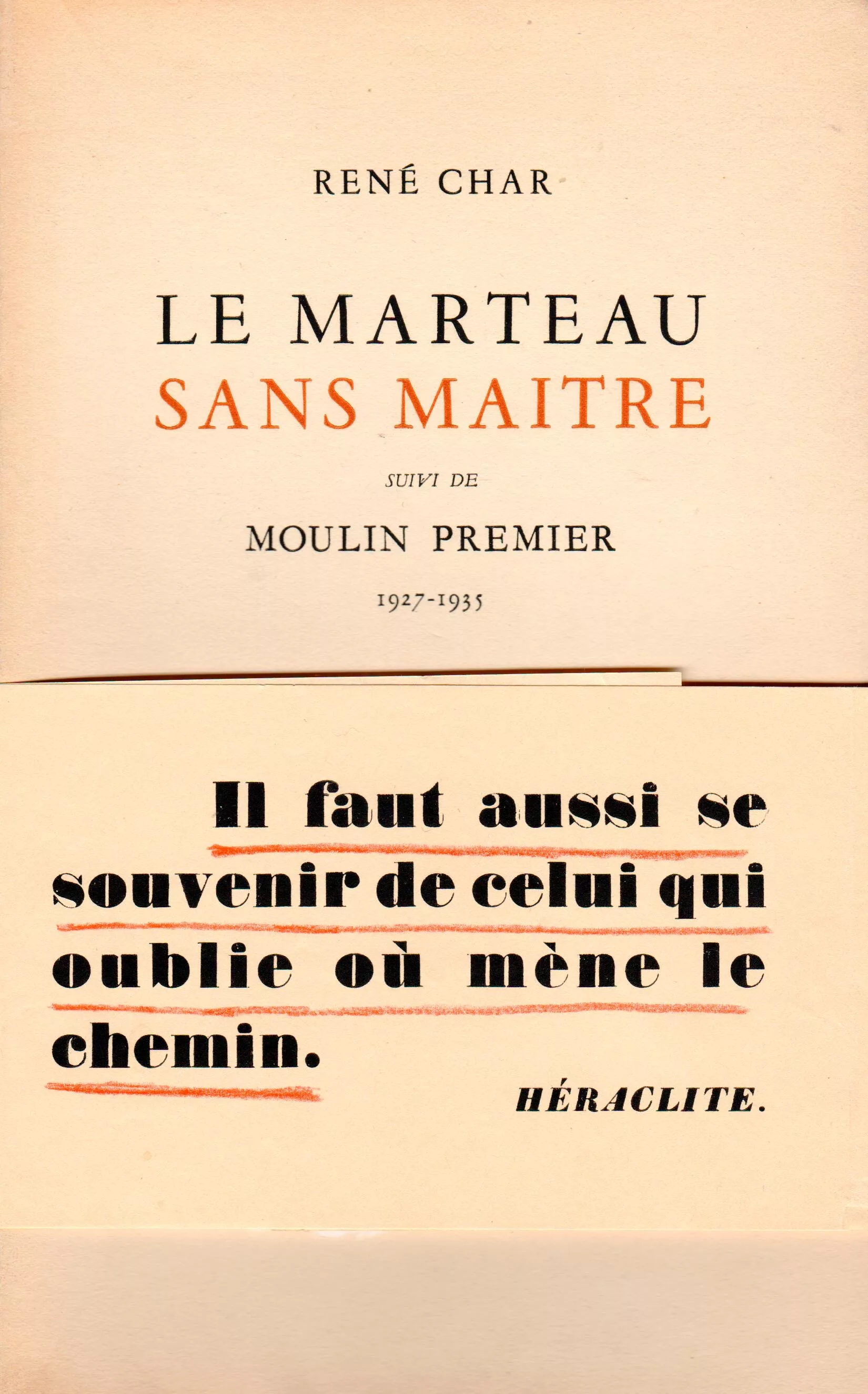
One of 50 copies on vélin du Marais, this copy no. 36.
Picasso, who had greatly admired the first edition of this text (published in 1934 with a drypoint by Kandinsky), took the opportunity of this second edition to produce an etching for this collection, deeply marked by Surrealism. The etching presents a face in which Cubism and Surrealism blend and complement one another perfectly (Cramer, no. 42). It appears only in the 25 deluxe copies on Arches paper.
This postwar edition is nonetheless of interest for its content: Char revised several poems, seeking to celebrate — just as he had published Seuls demeurent and was preparing the edition of Feuillets d’Hypnos — his “years of companionship” with his Surrealist friends, foremost among them Éluard and Breton.
A few days after publication, René Char was demobilized. The war was over, and it was time to honor the Resistance: as early as October, extracts from Feuillets d’Hypnos appeared in the review Fontaine, read by Camus, who asked to publish the book in his Espoir series. For Char, this marked the beginning of another path, distinct from the 1930s, though he always retained an undimmed passion for that earlier period. For this edition, he added a preliminary leaf:
“Vers quelle mer enragée, ignorée même des poètes, pouvait bien s’en aller, aux environs de 1930, ce fleuve mal aperçu qui coulait dans des terres où les accords de la fertilité déjà se mouraient, où l’allégorie de l’horreur commençait à se concrétiser, ce fleuve radiant et énigmatique baptisé Marteau sans maître? Vers l’hallucinante expérience de l’homme noué au Mal, de l’homme massacré et pourtant victorieux. La clef du Marteau sans maître tourne dans la réalité pressentie des années 1937-1944. Le premier rayon qu’elle délivre hésite entre l’imprécation du supplice et le magnifique amour.”
A copy from René Char’s own library, which has preserved the publisher’s band bearing the quotation from Heraclitus, underlined by Char in red colored pencil.