

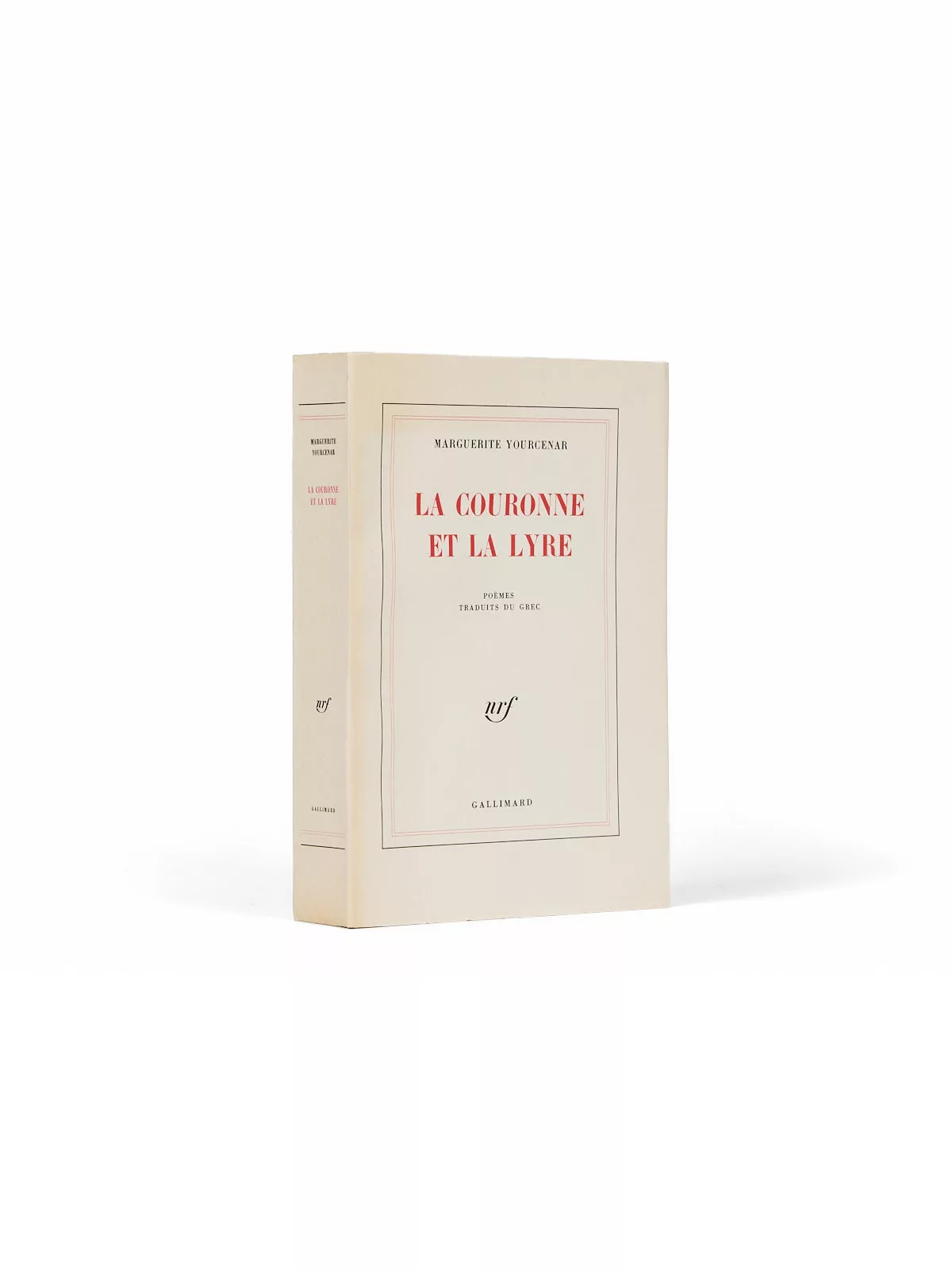
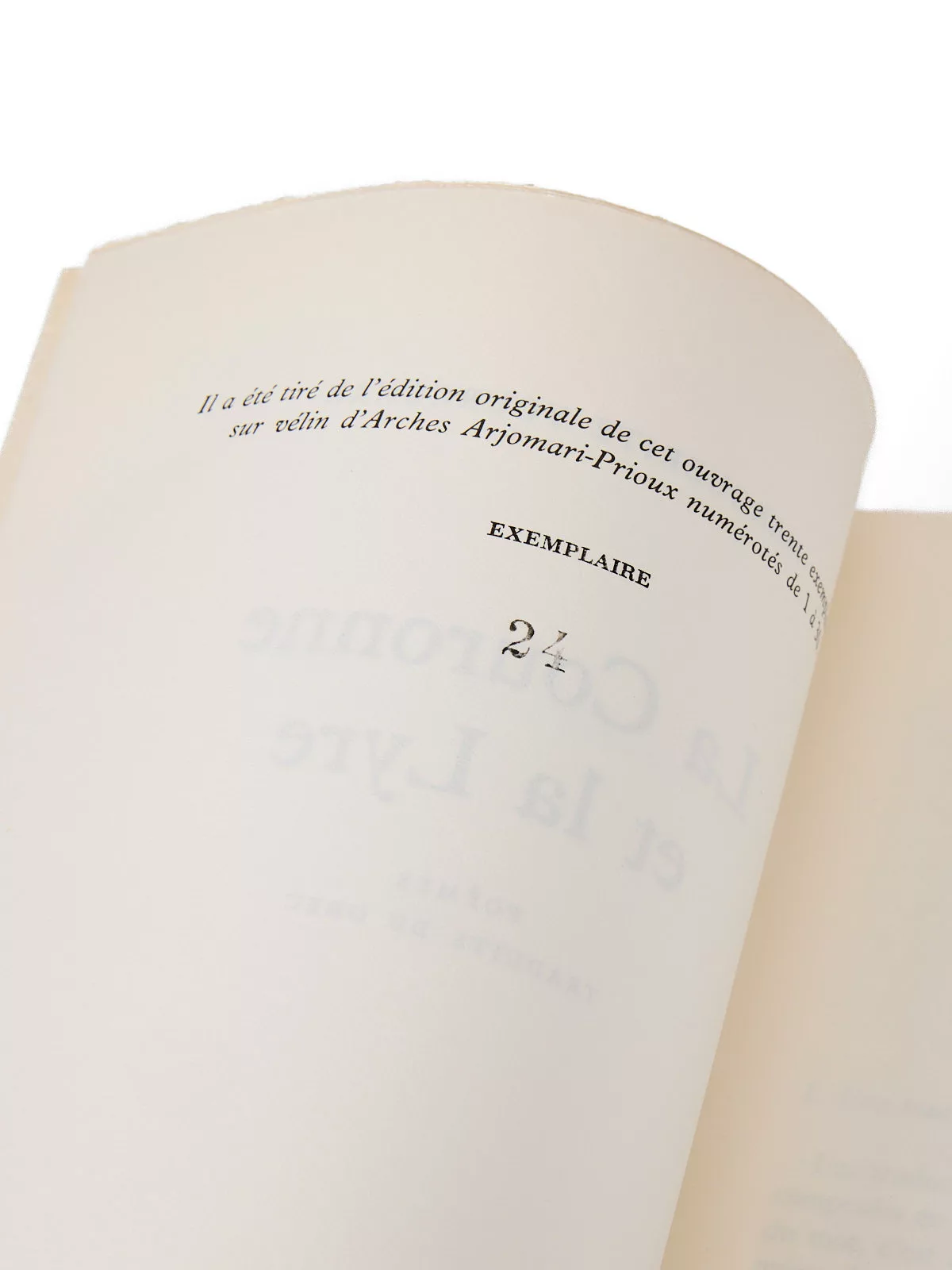
One of 30 deluxe copies on vélin d'Arches (no. 24).
La Couronne et la Lyre is one of the great late books of Marguerite Yourcenar, and one of those in which her relationship to Greece is most directly expressed. It is not a simple anthology, but a personal selection, presentation and translation of the ancient Greek poets — a subject that had occupied her since her earliest years, since as early as 1932 she had published Pindare with Grasset, a biography of the Theban poet and an essay on his work, already revealing the depth of her attraction to the Greek world. This fidelity would continue to run through her work, from Électre ou la chute des masques to Mémoires d’Hadrien.
With La Couronne et la Lyre, Yourcenar sought to recover, as far as possible, the “echo of Greek song,” the movement and the musical constraint of the poem, and Pindar naturally occupies a special place in the collection. Between the 1932 Pindare and the translations gathered in La Couronne et la Lyre, nearly half a century had passed — a period of distillation, almost a reckoning, and Yourcenar reread Greece with all the experience of a writer’s lifetime.
Published in 1979, a year before her election to the Académie française, La Couronne et la Lyre was not unrelated to the recognition of her peers, masters of language. The time would come, the following year, to welcome a mistress among them.