

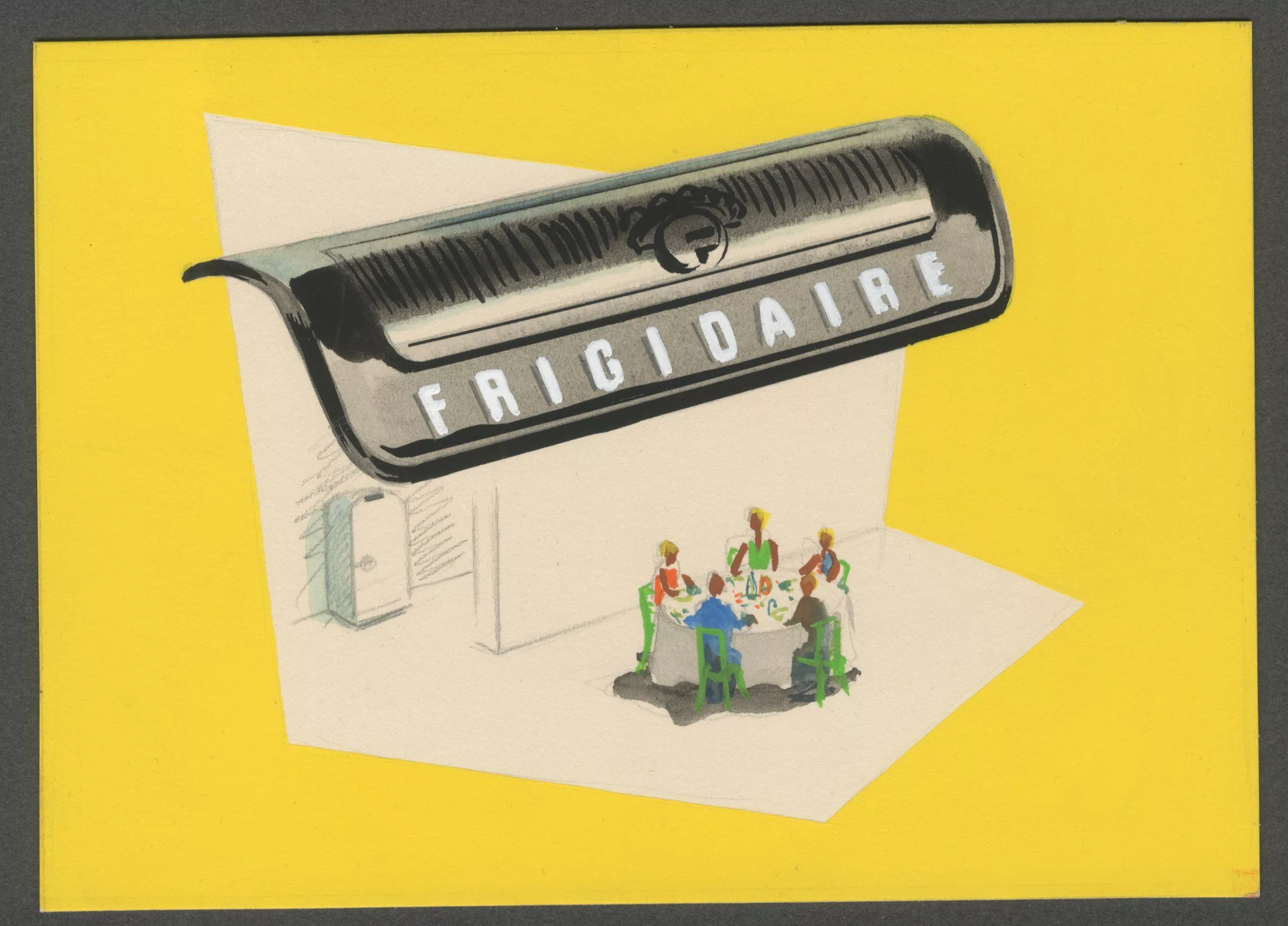
A subsidiary of General Motors, Frigidaire established itself as early as the interwar period as one of the leading brands of “domestic refrigeration.” In France, its name quickly became a byword for the refrigerator itself. At the height of the postwar economic boom, household equipment underwent explosive growth: refrigerators, washing machines and vacuum cleaners became the new emblems of modern comfort, reshaping domestic habits and advertising alike. Brands poured investment into the Salon des arts ménagers, held at the Grand Palais, which reached its peak attendance in the late 1950s, with vast illuminated stands displaying a profusion of products that Boris Vian would mock — and popularize — in his famous song La Complainte du progrès, subtitled “les Arts ménagers.” Recorded in 1955, the song popularized the name Gudule and, more importantly, described a new mode of seduction: instead of winning over one’s beloved with words of love, it was now more effective, in keeping with the times, to offer her a list of household products — from the salad-spinner to the deodorizing fan, by way of electric blankets and the waffle iron.
Philips seized the opportunity and sent Boris Vian himself to promote the brand at the Salon des arts ménagers, held from 23 February to 18 March 1956. For a month, Vian, dressed as a sandwich-board man, wandered the fair among pressure cookers, stoves and washing machines, with Gudule playing in the background. The only two brands named in the song, Frigidaire and Dunlopillo, both had stands there. Whether Vian ever went so far as to hum his own song in front of them remains unknown.
That year, attendance reached its all-time high of 1.5 million visitors. From 1961, having outgrown its premises, the fair moved to the new “futuristic” CNIT building at La Défense, a symbol of a new way of living and moving: the automobile and household appliances became the twin emblems of the emerging consumer society. General de Gaulle himself recognized as much in 1965, declaring that “the housewife wants to have a vacuum cleaner, a Frigidaire, she wants a washing machine, and if possible, a car too. That is progress.”
This design by Jacquelin belongs to the visual rhetoric that celebrated the performance of the sacrosanct appliance, one that — no less — “protects the family.” Advertising codes shifted toward a narrative of safety, health and abundance, embracing the era’s core belief: that household equipment was a promise of well-being for the home.