

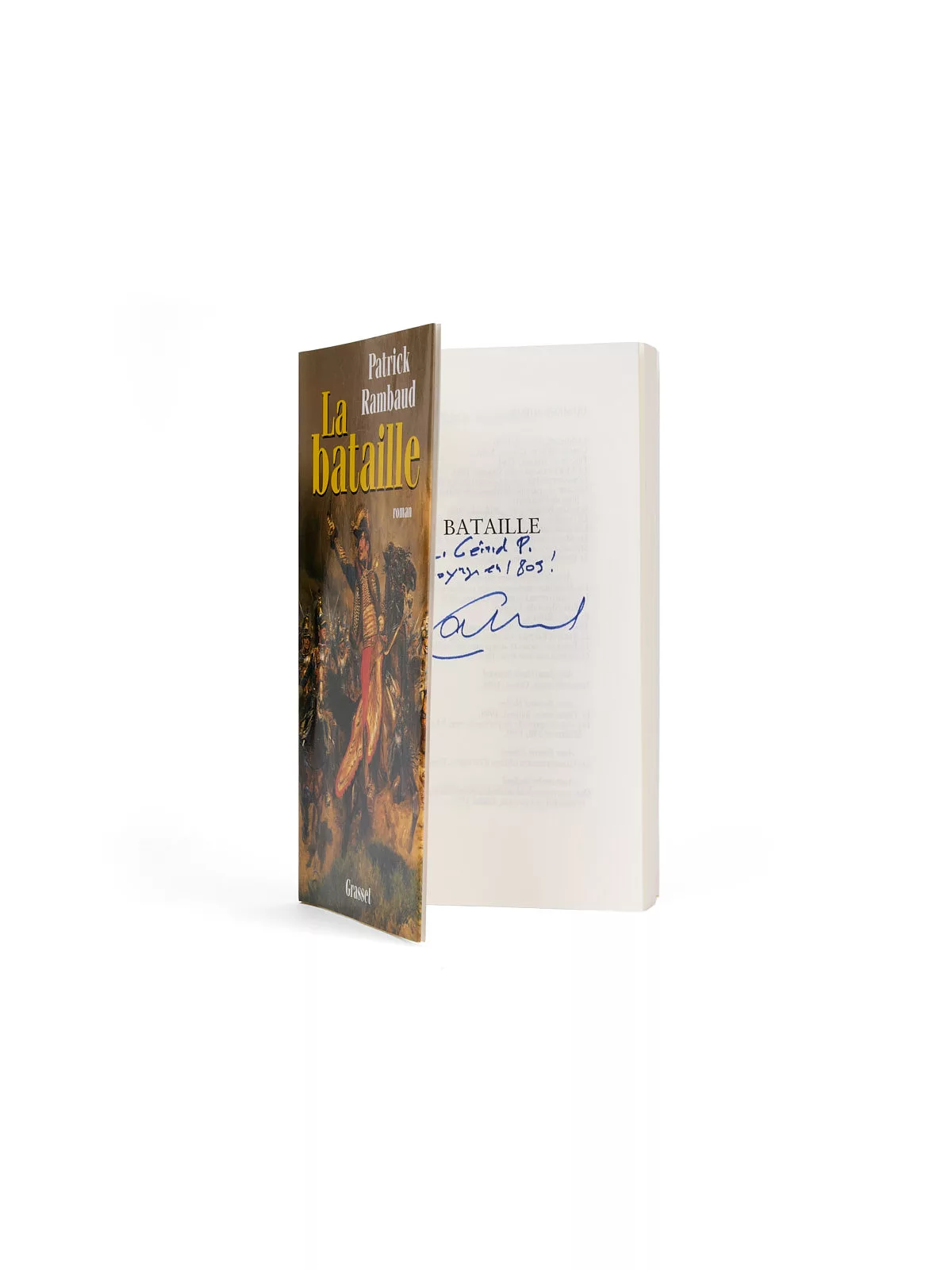
La Bataille
First printing (no deluxe-paper copies).
Signed presentation inscription: “pour Gérard P[ouguet], bon voyage en 1809 ! Patrick Rambaud.”
“There, I set out to initiate you into all the horrors and all the beauties of a battlefield… Cannons, horses, two armies, uniforms; on the first page, the cannon roars, on the last, it falls silent.” Thus Balzac described his planned novel devoted to the Battle of Essling (May 1809), Napoleon’s first major defeat against the Austrians, a slaughter with more than 40,000 dead. Left unfinished, this project was revived a hundred and sixty years later by Patrick Rambaud, who set out to “complete” Balzac: La Bataille immerses the reader in the thirty hours of fighting, between fury and silence, in a realistic fresco in which military history becomes total novel. Critics unanimously praised this literary tour de force, and the Académie Goncourt named Rambaud the winner of the Prix Goncourt in 1997.
Co-founder in 1970 of the monthly Actuel — a laboratory for a generation and an ideal playground for perfecting his art of pastiche — Rambaud’s corrosive humor and stylistic virtuosity became his trademark, moving between historical frescoes and political satire: his Chroniques du règne de Nicolas Ier, then François le Petit and, more recently, Emmanuel le Magnifique, reinvent the Fifth Republic in the guise of a grotesque and delectable monarchy.