

Le Bal du comte d’Orgel
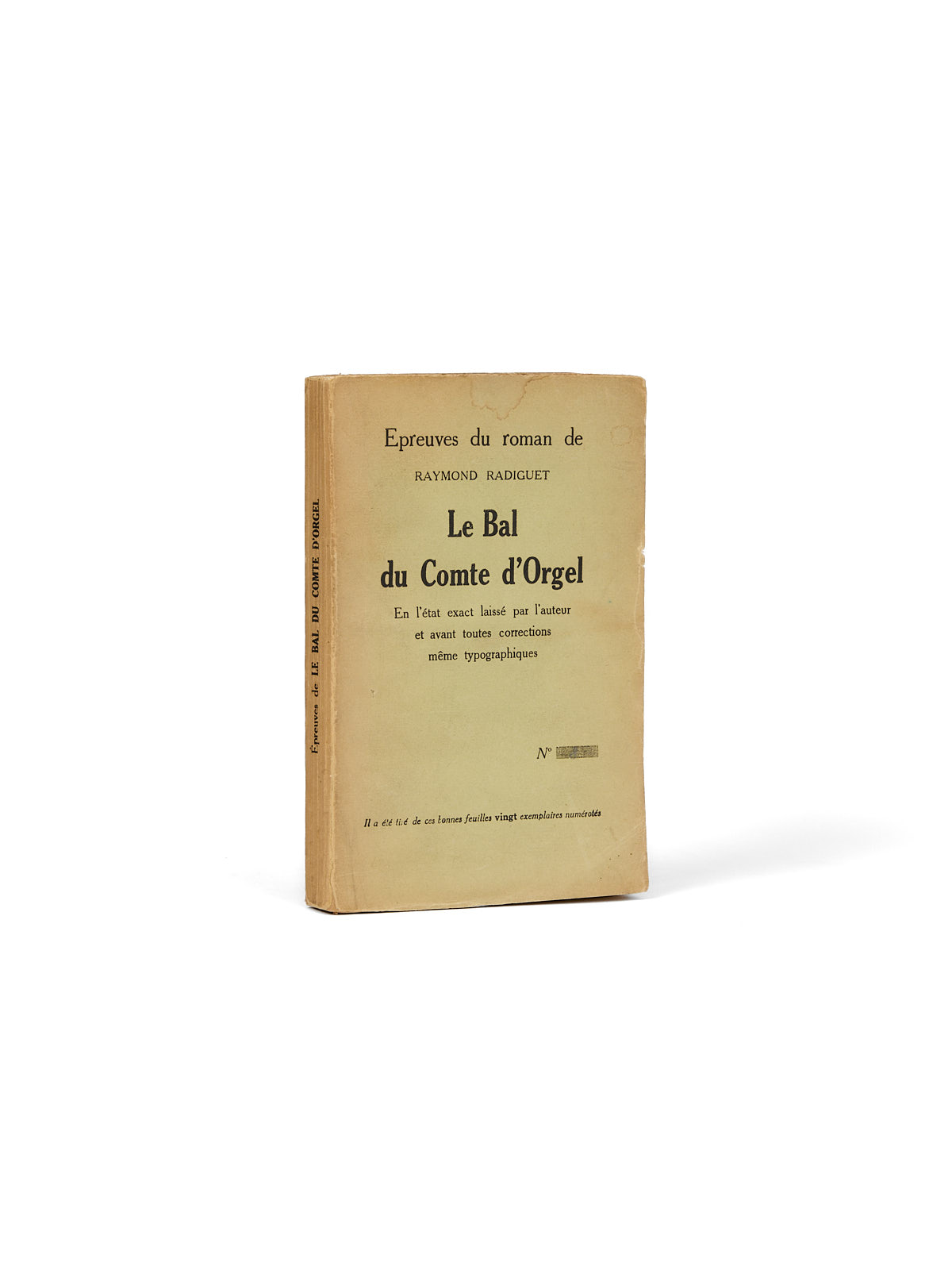
One of the rare 20 proof copies preceding the corrections made to the published text, known as the “Bonnes feuilles” — this copy unnumbered.
Radiguet met Cocteau in 1919, and Cocteau later read the first version of Le Diable au corps to Bernard Grasset in 1922. A long process of revision between master and disciple followed, culminating in the novel’s publication and its immediate, spectacular success. Crowned with the Prix du Nouveau-Monde and buoyed by such a striking literary debut, the young author immediately began a second novel, Le Bal du comte d’Orgel, a version of which was finished by the end of that summer, and for which Grasset promptly had proofs printed. Staying at Piquey, Radiguet dictated a new version to his friend Georges Auric, who had brought his typewriter, introducing further significant corrections — work cut short by his sudden death on 12 December 1923. He was twenty years old.
Bernard Grasset then entrusted Joseph Kessel and Jean Cocteau with establishing the definitive text, which was published posthumously in July 1924.
A pre-press printing was produced and distributed to some 200 privileged recipients in a “Bonnes feuilles” version, giving the definitive text as established by Kessel and Cocteau: “the former intervened with a light hand — typos, agreement errors, etc. — while respecting the text; the latter, carried away by questionable enthusiasm, intervened extensively in the text itself” (Chloé Radiguet and Julien Cendres, Raymond Radiguet, un jeune homme sérieux dans les années folles). These copies bear the statement “il a été tiré de ces bonnes feuilles 200 exemplaires numérotés,” and most carry an inscription by Lemarchand — responsible for corrections at Grasset — or by Grasset himself.
Before this, however, and as a tribute to the deceased novelist, the publisher had 20 copies printed of the text before the third-party corrections, but after Radiguet’s own — that is, the last state of the text corresponding to the author’s own intentions. These unpaginated copies, in a form identical to the corrected “Bonnes feuilles” version, bear instead the following statement beneath the title: “En l’état exact laissé par l’auteur et avant toutes corrections même typographiques. Il a été tiré de ces bonnes feuilles vingt exemplaires numérotés.” Copy no. 1 bore this inscription from Grasset: “En souvenir de notre ami disparu.”
Small marks to the wrappers; paper browned.