

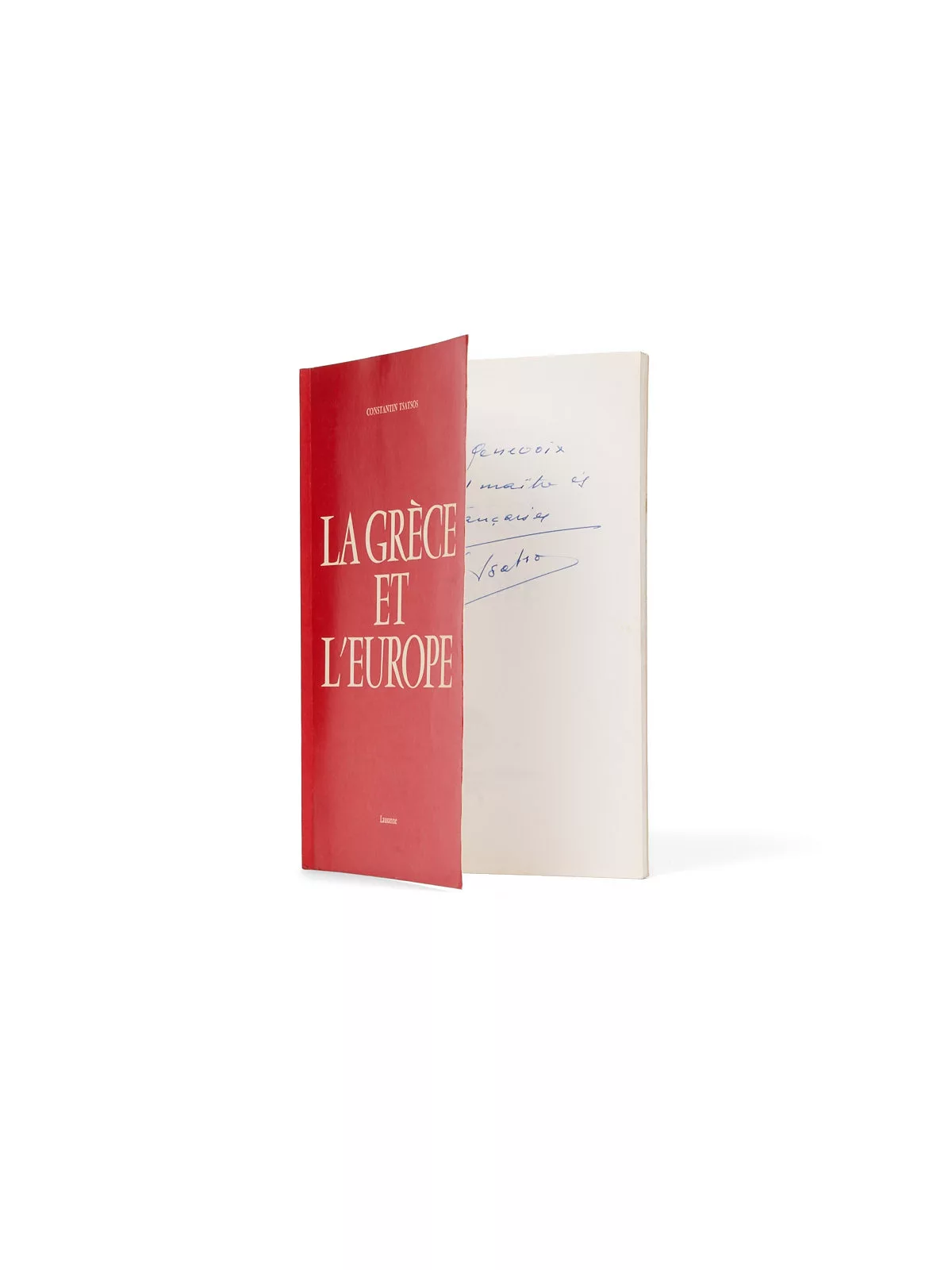
La Grèce et l’Europe
Presentation copy inscribed by the author to Maurice Genevoix: “Pour Maurice Genevoix, le grand maître des Lettres Françaises, Tsatsos.”
In 1977, Constantin Tsatsos, President of the Hellenic Republic and a philosopher by training, published La Grèce et l’Europe in Lausanne. This brief but erudite essay argues for a demanding vision of Europe: not merely an economic construction, but a civilization borne by the Greek idea of the free and rational man, rooted in culture, law and memory. In his words, “the dialogue between Athens and Europe can never cease,” for it is the condition of fidelity to the spirit.
Educated in Germany and a fluent French speaker, Tsatsos always regarded Europe as a cultural space before a political entity. As a European in a meditative mode, anxious to restore to Greek civilization its formative vocation at a time when Europe was seeking its unity, he called for a “dialogue between Athens and Europe [that] can never cease, for it is the dialogue of man with his own dignity.”
The tribute to Genevoix is not merely a matter of protocol: it rests on a genuine affinity. Though “the great master of French Letters” was neither a philosopher nor a diplomat, he embodied in French literature a voice of humanity, of fidelity to the past, and of transmission — qualities Tsatsos could not fail to recognize.
Little known but essential in this respect is Genevoix’s text L’Olympie (published in 1964 in the volume Regards sur le monde antique, issued by UNESCO), which testifies to this inner resonance between the author and Greece. In this short tribute to the light of the Peloponnese and the sacred ruins of Olympia, Genevoix writes with an almost liturgical simplicity of the still presence of ancient grandeur, and the silent respect it inspires in twentieth-century man. He is also the author, in 1924, of Euthymos, vainqueur olympique, a novel retracing the life of the boxer Euthymos of Locri, three-time Olympic victor, whom he raises to the status of a legendary figure of Antiquity.
Greece would join the European Community in 1981, shortly after Tsatsos’s presidency and three years before the death of Genevoix.