

Le Procès-verbal
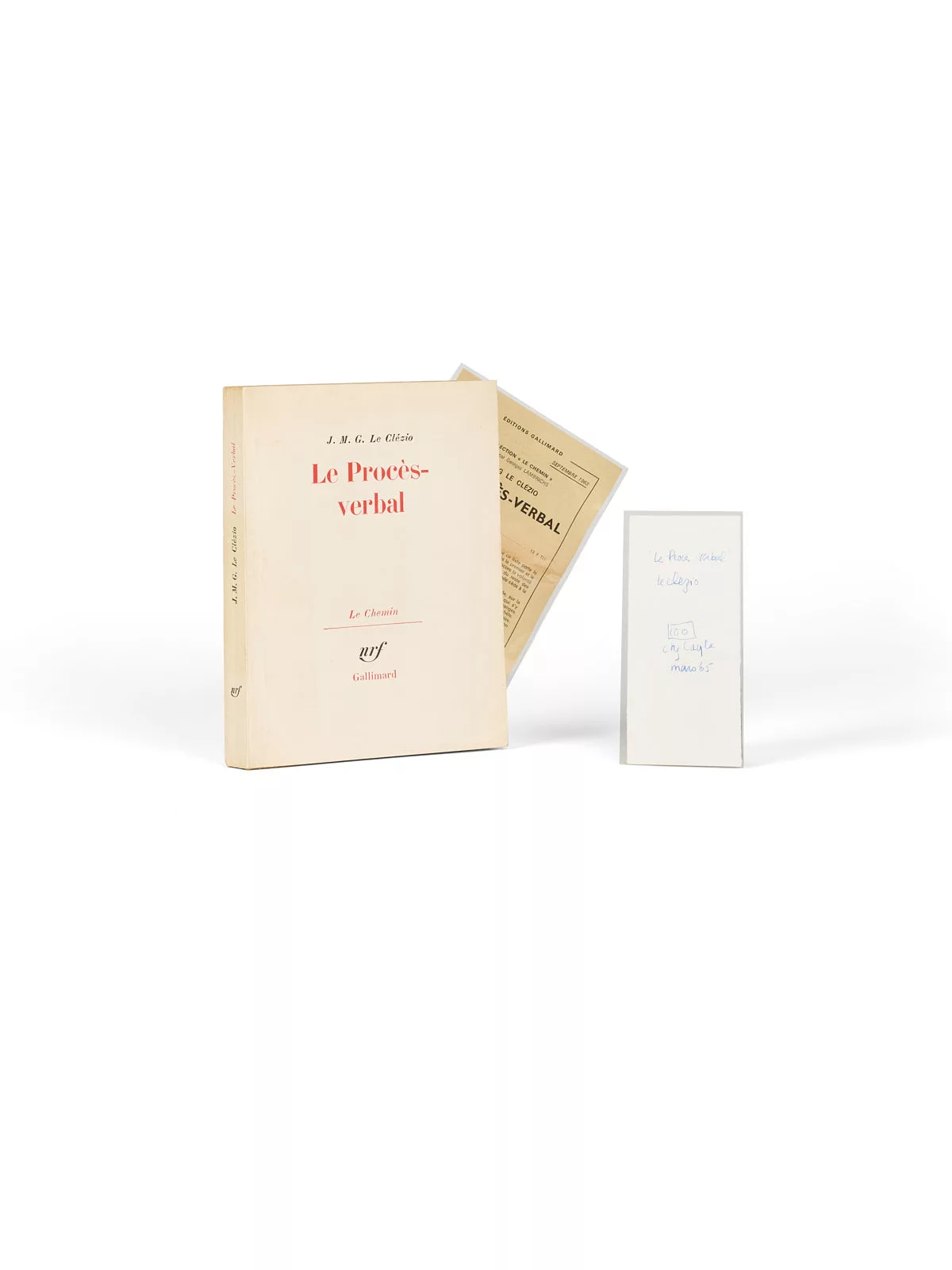
Autograph note by François Mitterrand: “Le Procès-verbal, Le Clézio, 100 [fr.], chez Cayla, mars 65.”
Complete with the publisher's insert.
This first novel — awarded the Prix Renaudot — tells “the story of a man who could not quite tell whether he had come out of the army or out of a psychiatric asylum,” and is, according to its author — then twenty-three years old — the work of an adolescent. Answering journalist Jacques-Pierre Amette of Le Point, Le Clézio explained the context of its composition: “It was a strange time. I began writing this book while the Algerian War was still going on, when boys still faced the threat of being sent to serve their term. One of my friends, a very artistic, very rebellious boy named Vincent, was sent off at the end of 1960 because of his poor grades, and was killed almost immediately in an ambush. Another was smuggling funds for the FLN. Another had come back on leave, his mind wrecked, talking only of bazookas and “special drums” (as napalm was euphemistically called). […] So I wrote Le Procès-verbal in fragments, at the back of a café, mixing in scraps of overheard conversation, images, newspaper clippings. Day by day. The novel was finished after the Évian Accords, when I understood that the threat was over, that we were going to live. It remained a manuscript for a little over a year…”
François Mitterrand acquired the book nearly eighteen months after its publication, from the bookseller Robert Cayla, at 28 rue Saint-Sulpice. Le Clézio had just published his second novel, La Fièvre. Mitterrand bought both volumes on the same day in March 1965, at the same shop: clearly he admired the novelist, who would prove to be the most represented author of the late twentieth century in his library, with eight titles. By 1965, Le Clézio already commanded some standing: the price paid for the pur fil copy of La Fièvre (100 francs) was the same as for this ordinary-paper copy of Le Procès-verbal.