

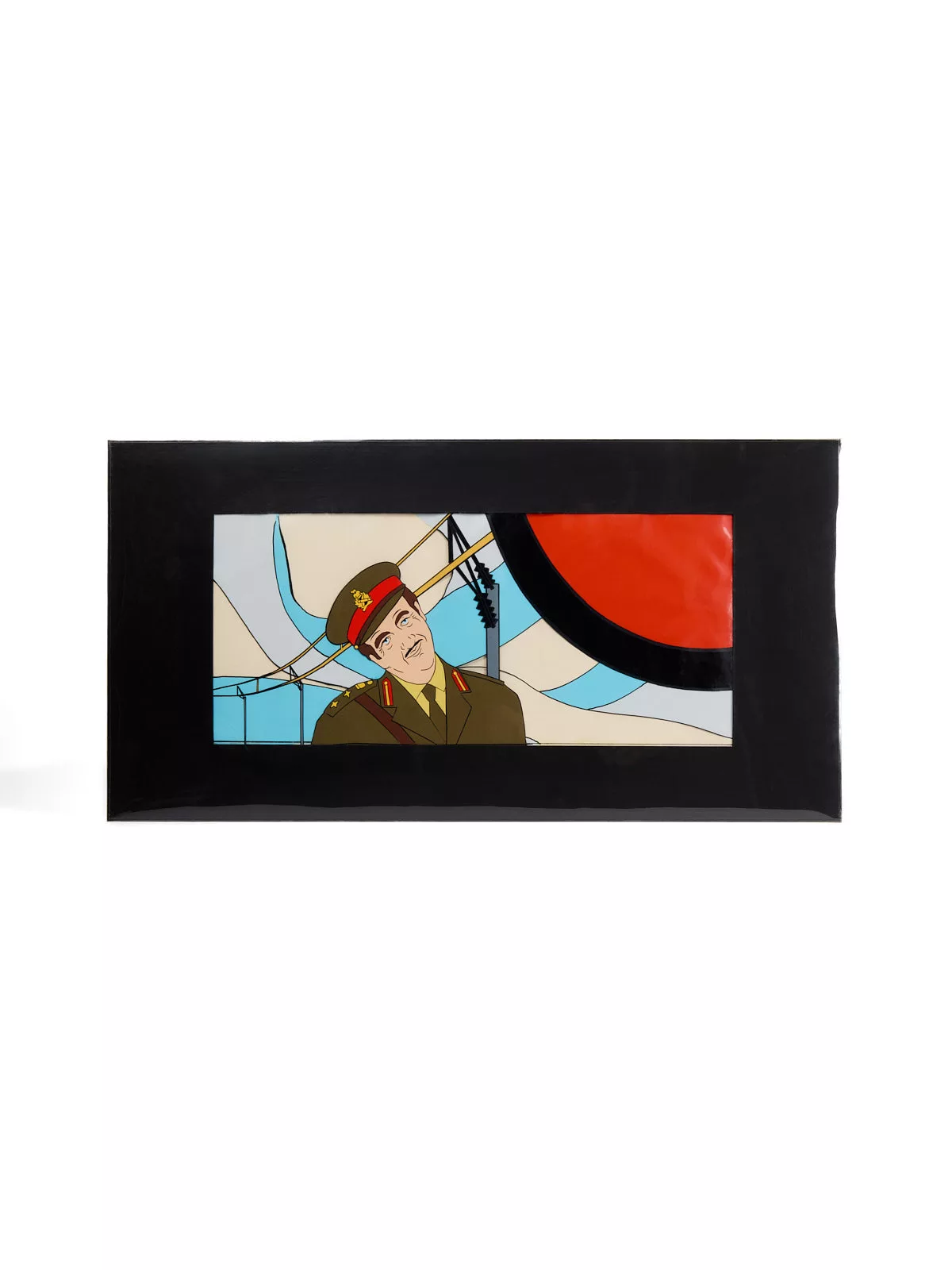
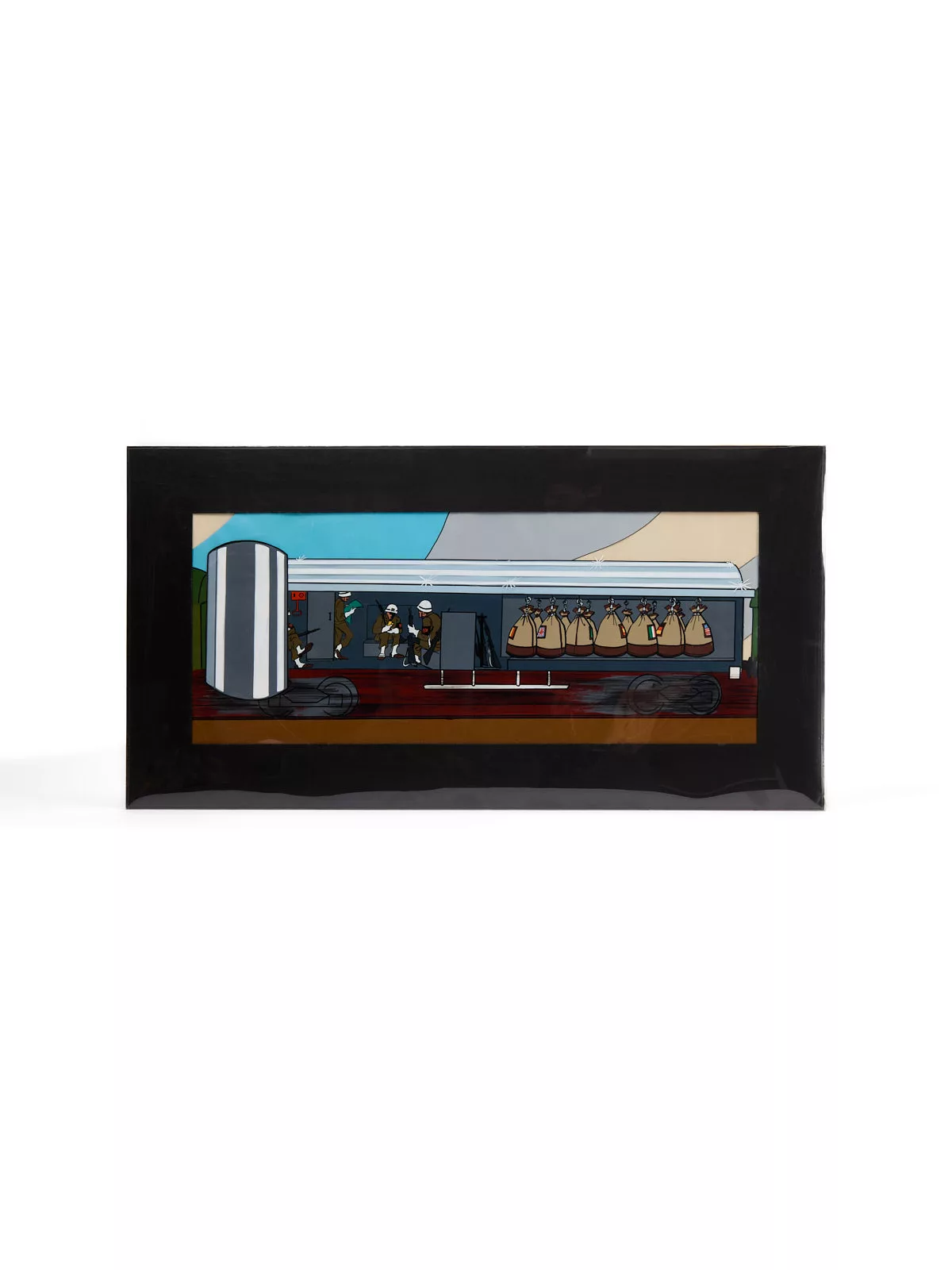
Deux celluloïds originaux du film Le Cerveau
These two celluloids come from the emblematic animated sequence of the film directed by Gérard Oury: a big-budget comedy released in 1969 starring Jean-Paul Belmondo, Bourvil, David Niven and Eli Wallach. The film epitomizes the golden age of ambitious popular French cinema, in an Anglo-Italian-French production open to an international audience. The opening credits, in English (The Brain), already incorporate elements of pop culture and a psychedelic score.
One of the film’s boldest strokes lies in the insertion of an animated short at the heart of the plot: the character of Colonel Matthews, alias “The Brain” (played by David Niven), explains his plan to rob an armored NATO train. Directed by Jean-Charles Meunier for the Films Orzeaux studio, this animated sequence inserted into the film was an entirely new and exceptional device in French cinema of the 1960s; few films had previously dared to include an animated narrative sequence, apart from a few opening credits such as those of Jacques Tati’s films.
The sequence pastiches the conventions of military cartoons, in a spirit at once satirical and pop. Hollywood had occasionally used this device, but in fantasy or comic works: The Pink Panther, in 1963, or Mary Poppins, the following year, are two famous examples; the year before Le Cerveau was filmed, Casino Royale included some animated elements by Richard Williams (the future creator of the animation for Roger Rabbit), who brought a very pop style to the credits of that James Bond film.
In Le Cerveau, the animation does more than amuse: it schematizes the genius of David Niven’s character, depicting his brain in action in credits that are thoroughly pop-culture, thoroughly British, characteristic of the Beatles years. The sequence is genuinely woven into the narrative as part of the character’s plan, and executed as a fully realized animated short in its own right.
The first drawing depicts Colonel Matthews in uniform, with his telltale head-shake, a revealing tic of the character in the film; the second celluloid offers a side cutaway view of the armored wagon carrying the funds, guarded by military police soldiers, with bags stamped with the colors of the great NATO powers (France, United Kingdom, United States, etc.).
Technically, a celluloid consists of one or more sheets of transparent plastic (often acetate), on which the illustrator draws and paints — frame by frame — the characters or moving elements of a scene: the cel is then placed over a fixed, hand-painted background, over which the changing elements can be superimposed to produce the final animation.
The heist involves stopping the wagon (in the film, a Paris–Brussels train) in open countryside — in the middle of the Beauce region, between Toury and Janville. But nothing goes quite as planned…