


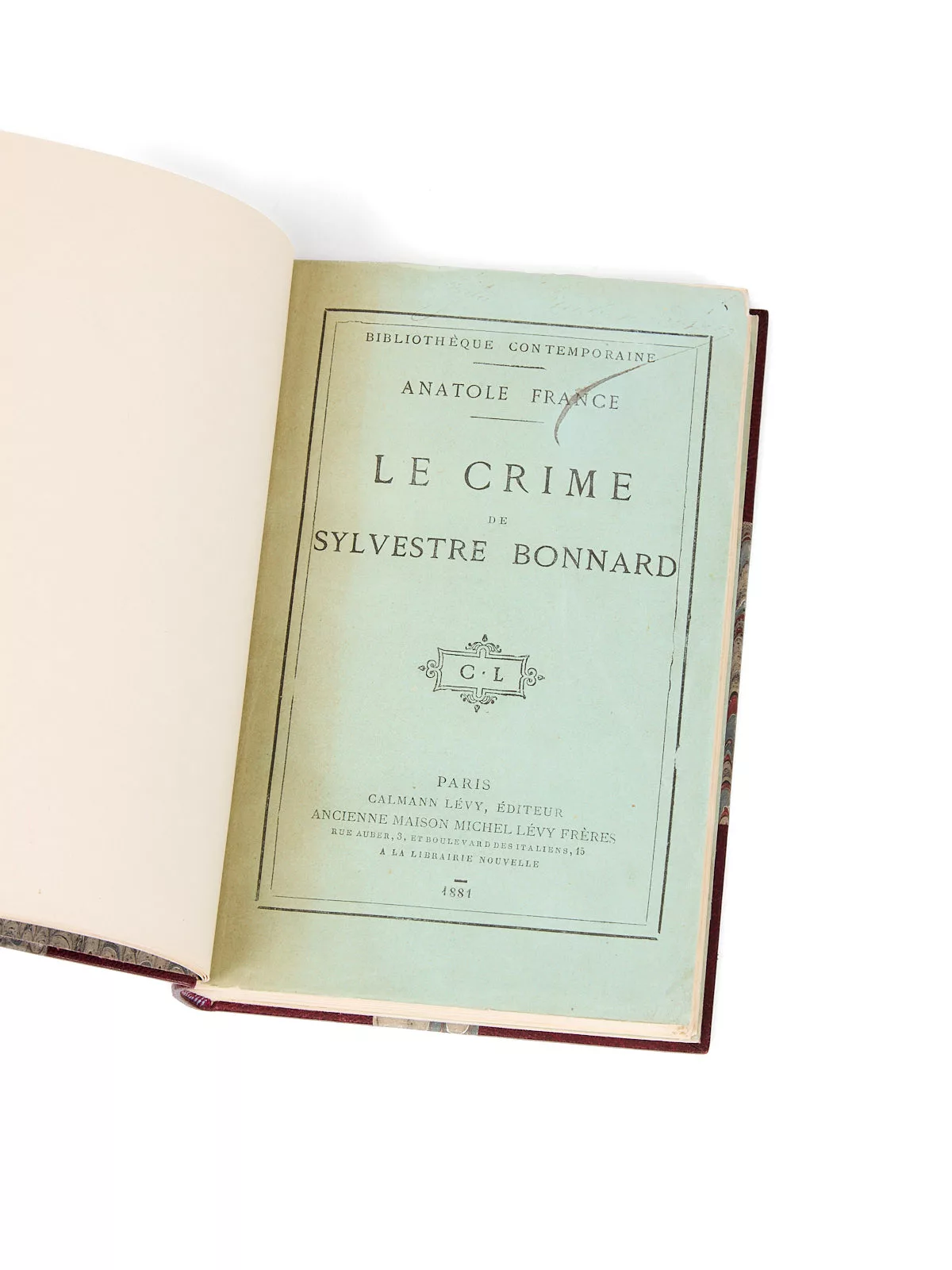
Le Crime de Sylvestre Bonnard
A very fine copy, in the rare erroneous (blue) wrapper: the words “Membre de l'Institut” are absent from it, and it was replaced during binding by the yellow wrapper used by the publisher Calmann Lévy for its best-selling authors (Carteret, I, 278).
“Far superior to his earlier attempts, Le Crime de Sylvestre Bonnard, membre de l’Institut marks a turning point in the writer’s work. Until then he had been searching for his path; from this point on, he had found his manner.” (J. Suffel, Anatole France).
Between December 1879 and January 1881, France published in various journals the texts that would form this novel: La Fée, Une très vieille histoire d’amour, Un stratagème, and Le Crime de Sylvestre Bonnard, the last of which gave the volume its title. The story of an elderly scholar, a member of the Institut and a celebrated medievalist searching for the manuscript of La Légende dorée, his bearing, his gentleness put upon by a domineering servant, and his affection for an unhappy young girl, charmed readers — some spoke of it as a masterpiece. As early as 30 March 1881, France sent his book to the secretary of the Institut, with these words: “If the Academy, which has never spoiled me, should deign to grant this volume some small reward, I know in advance that I would owe you a very particular debt of gratitude.” The Academy did deign to do so, and crowned Le Crime de Sylvestre Bonnard with a prize. “The Academy’s benevolence is all the more understandable in that it could be read as a repudiation of Naturalism. […] The salons, deeply shocked by the Médan group, were enraptured. […] Readers believed they had discovered a new Xavier de Maistre or a new Töpffer, and forgot the disquieting theories of Les Noces corinthiennes.” (Ibid.)
The success was indeed considerable: the publisher had the remaining stock in his warehouse recovered with the house’s yellow wrapper reserved for its best-selling authors. Lemerre alone took offense at this success, which had eluded him, and burdened France with fresh commissions, even ones not provided for in the brand-new contract he had (at last) concluded with him; “from August 1881 onward, he showered his tardy supplier with stamped legal papers, who, frightened by the prospect of a lawsuit, finally set to work.”