

Pluies
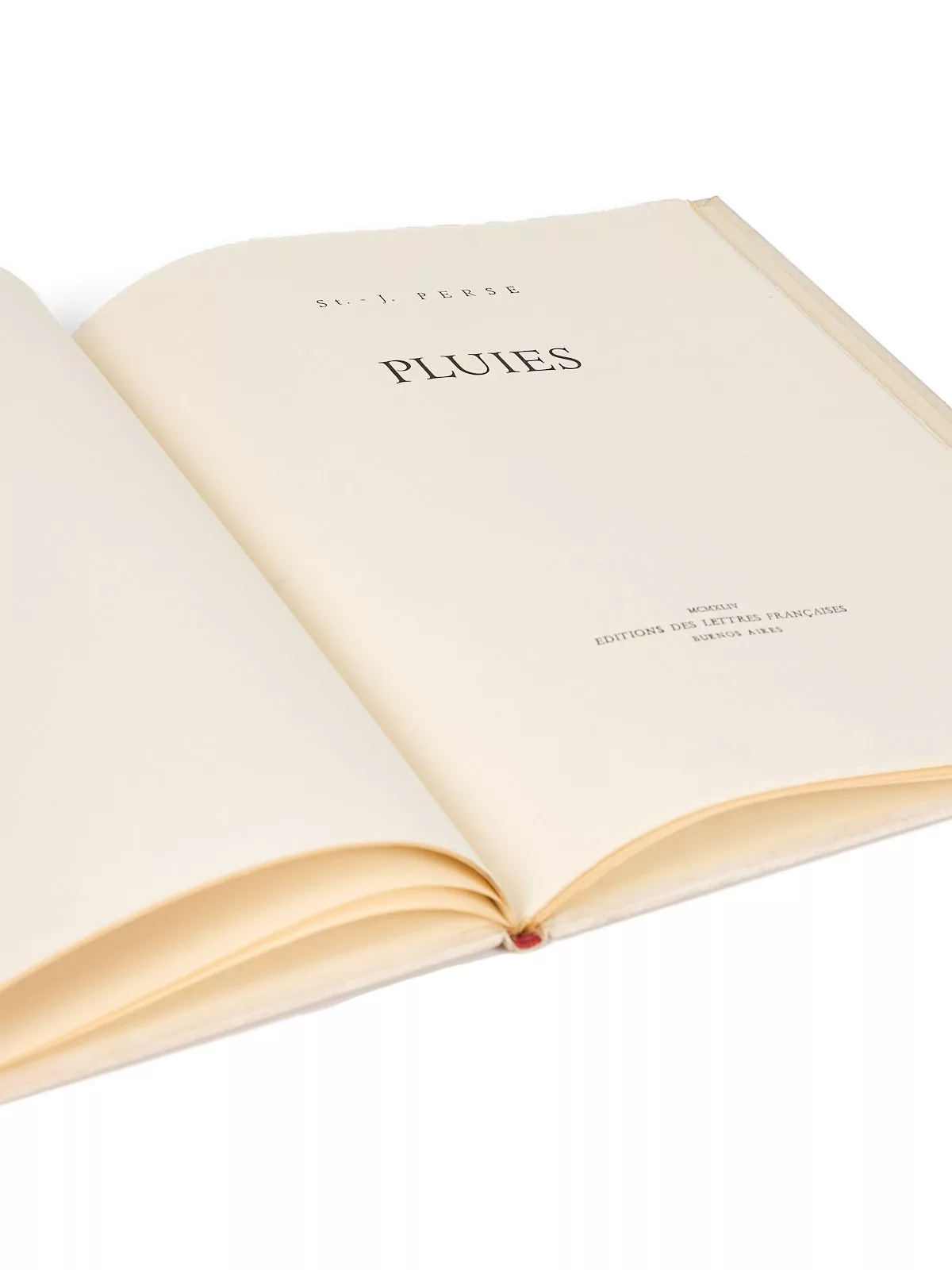
One of 300 copies on Holland-type paper (no. 294).
Pluies was published in Buenos Aires in April 1944, at the height of the war, in an edition as discreet as it was elegant. This poem of exile, in which rain becomes a symbol of fertility, memory and renewal, testifies to the persistence of poetic language in a world in ruins. The text is also political: beneath the abstraction of its imagery lies the unease of a high-ranking diplomat — Alexis Léger — sidelined by the Vichy regime and forced into American exile since 1940.
Henri Hoppenot’s copy, most likely sent by Perse to Bern when Hoppenot had just taken up his post as ambassador in 1945, having been recalled by de Gaulle and then appointed ambassador to Bern. His young embassy secretary at the time was a future friend: Romain Gary.
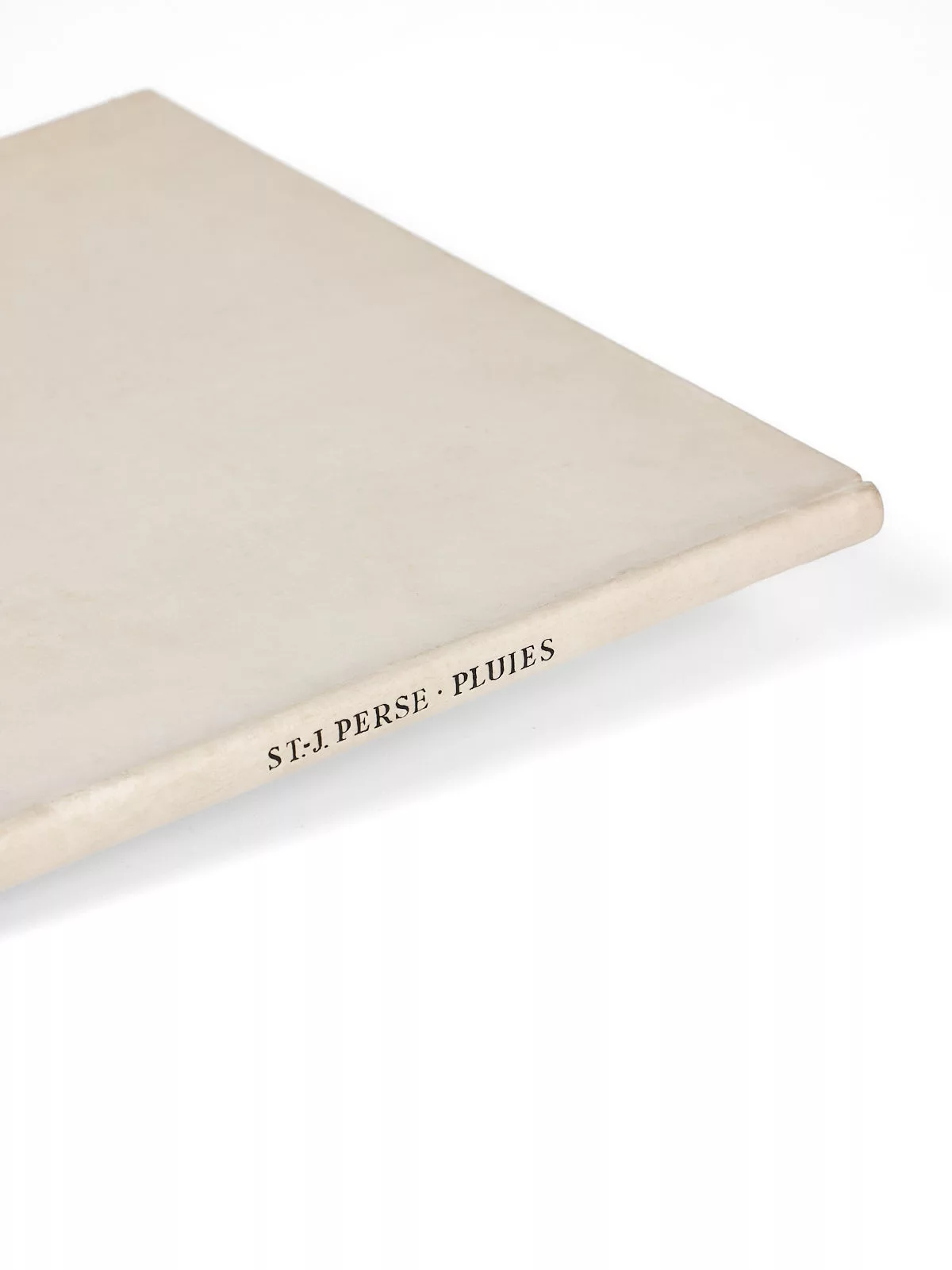
There, he had this copy of Pluies, as well as Vents, bound by a renowned bindery located on the Kramgasse, one of the main commercial streets of the old town: the Schumacher firm, founded in 1840.
Perse and Hoppenot had known each other since August 1914. At that date, Hoppenot joined the Press Bureau of the Ministry of Foreign Affairs.
Alexis Léger, who had passed the entrance examination the previous year, was already in place. When they joined the ministry, the diplomat-writers Giraudoux, Morand and Claudel were already there. For more than sixty years, Alexis Léger and Henri Hoppenot moved in the same circles, drifted apart according to their postings, came together again at the Quai d’Orsay, and met once more on the American continent. Léger’s first — and only — foreign posting was in China, before a brilliant career in the central administration: after the publication of Anabase in 1924 under the pseudonym Saint-John Perse, he set aside his literary career to devote himself entirely to diplomacy. Appointed head of the private office of Minister Aristide Briand in 1925, he became one of the highest-ranking officials at the Quai d’Orsay. He managed to keep his position after Briand’s death in 1932 and replaced Philippe Berthelot as Secretary-General of the Ministry of Foreign Affairs from 1933 to 1940 — the highest-ranking official after the minister himself. Alexis Léger did much to advance Hoppenot’s career: “He helped me several times in my career, whenever he could” (Ina, Archives du XXe siècle, interview with Henri Hoppenot, 1971) — notably his appointment to China in 1933. In memory of this period, Hoppenot had a rarity printed in 1937: a report on a mission by Alexis Léger, printed on the Lazarist press in Peking in ten copies: the Relation respectueuse addressed by the secretary Lei Hi-Ngai [Alexis Léger] to his excellency Minister Kang Te [Alexandre Conti, French minister in Peking]. This was just before the two men were reunited in Paris, at the Quai d’Orsay, between 1937 and 1940.
Disavowed in 1940, Alexis Léger was removed from office on 18 May 1940 by Paul Reynaud and went into exile in the United States. Hoppenot, for his part, paid for his closeness to Léger: he was denied several postings in Europe and was sent to Uruguay instead. He resigned from that post in 1942, when the STO (forced labor draft) was introduced and a new statute concerning Jews was promulgated.