


[Picasso]
The friendship between Paul Éluard and Pablo Picasso was profound. Although they had known each other since 1916, it was in 1935 — as Picasso’s relationship with André Breton was fraying — that their friendship deepened, remaining unshaken thereafter.
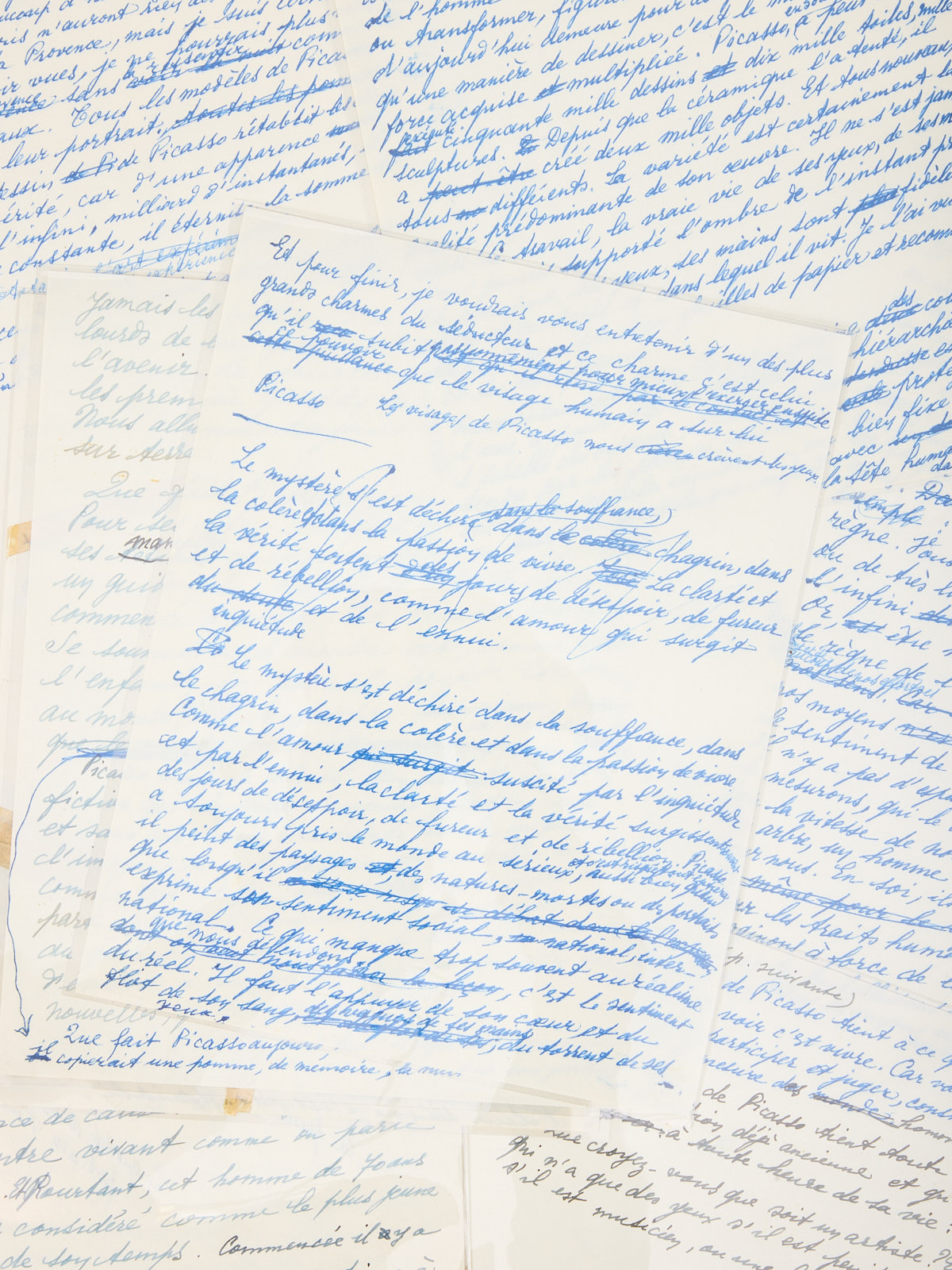
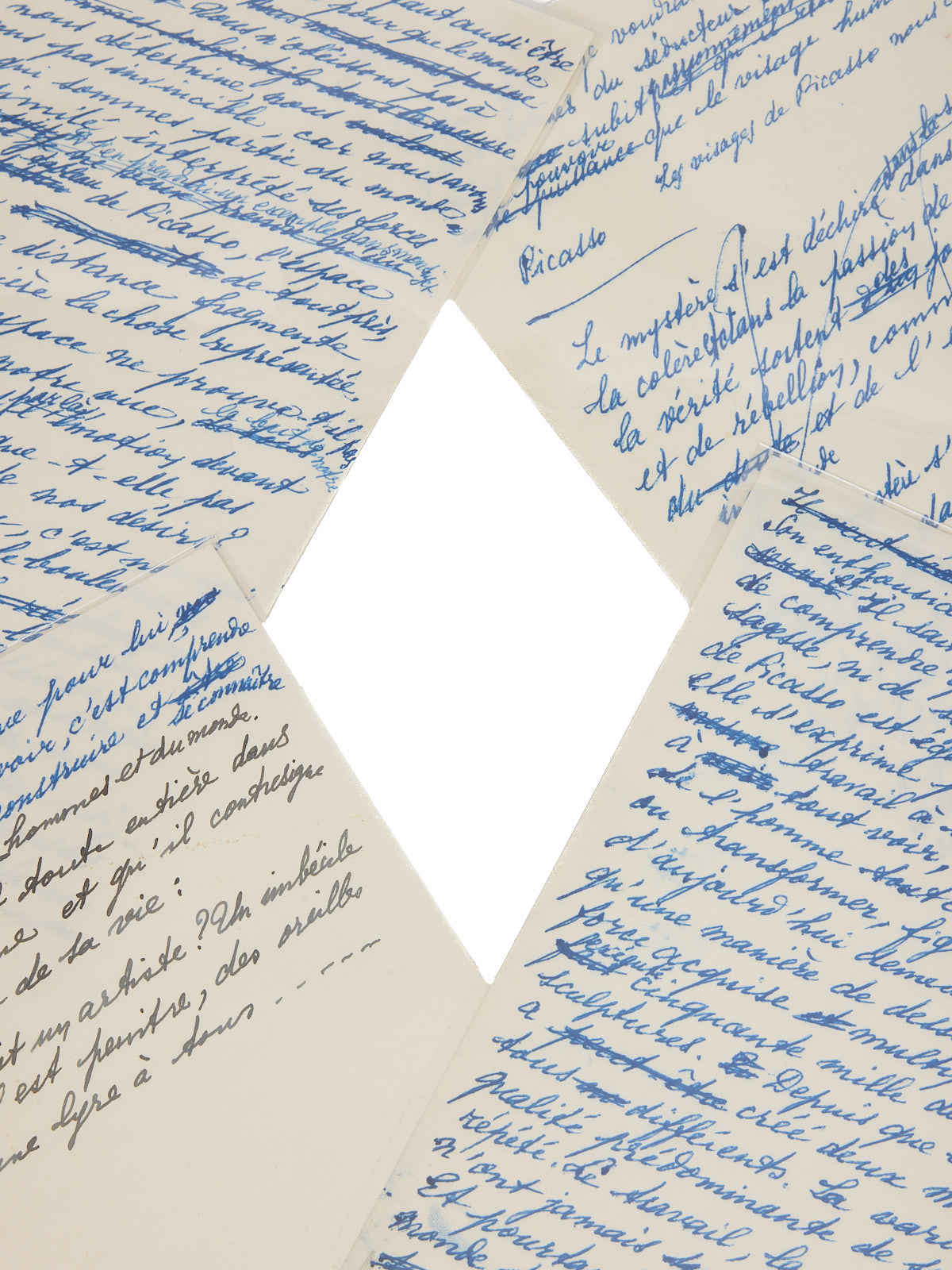
Fifteen years later, on 18 October 1951, Paul Éluard delivered a lecture in London in honor of his great friend, who was to celebrate his seventieth birthday a week later, on 25 October: “I can easily imagine that the one hundred and seventy-one-thousandth article and the one thousand two hundredth book on Picasso have just been published, that we have reached his millionth photograph, and that his name has become a common word […]. No living painter has ever been spoken of the way Picasso is spoken of. And yet this man of seventy may be considered the youngest artist of his time. Begun more than half a century ago, his work continues to be the most vital in the world; it continues to surprise, to outrage, and, happily too, to arouse admiration and enthusiasm. […] The truth on which Picasso relies is his own youth. […] And today, we are not commemorating Picasso, we are inaugurating him. His strength will be great, his genius will flourish. Tomorrow will not fulfill yesterday’s promise, but the promise of the day after. This perpetual child, this new Faust and new Don Juan, means to seduce, to mesmerize […]. What is Picasso doing today? A goat. For its ribs, he used branches; for its udders, two cooking pots; for its horns, a bicycle handlebar. And the goat comes to life. And Picasso is born.”
The fraternal bond between the painter and the poet, which Éluard called “sublime” in an inscription to Picasso, ended only with the poet’s death on 18 November 1952: exactly one year and one month, to the day, after this lecture.
The manuscript, in midnight-blue ink or blue ballpoint pen, contains numerous and substantial deletions and corrections. A fragment of it was published, under the title “Le plus jeune artiste du monde,” on the front page of the 25 October 1951 issue of Les Lettres françaises, also devoted to the Catalan painter, featuring a photograph by Man Ray surmounted, in capital letters, by a large “PICASSO A 70 ANS.” A double-page spread was devoted to the painter. The full text of the lecture is unpublished.
This was to be Éluard’s last text devoted to his friend: the two men had just completed the edition of Le Visage de la paix, a collection of 29 poems illustrated with a lithograph by Picasso. As early as 1944, Éluard had devoted a first tribute to him, published by Éditions des Trois Collines in Geneva: À Pablo Picasso, for the series “Les Grands peintres et leurs amis.” The poet had then gathered all the texts he had written about his friend, beginning with the lecture “Je parle de ce qui est bien”: “In January 1936, in Barcelona, at the exhibition organized by ADLAN [Amics de l’Art Nou] in homage to Picasso (who had not been exhibited in Spain since 1900), Éluard acted as the painter’s traveling ambassador; he gave a lecture in that city, which was broadcast on the radio, before going on to spread the word in Madrid” (Emmanuel Guigon, director of the Museu Picasso in Barcelona, in the preface to the catalogue Picasso – Éluard, 2020). The artist was then going through a serious crisis: separated from Olga, he had stopped painting and had begun writing poems. Between the two men, everything converged: a shared taste for poetry and a shared vision of artistic creation. Their friendship, lasting sixteen years until the poet’s death, would give rise to joint works, the first being Les Yeux fertiles, published in 1936, in which the drawings of one answer the poems of the other.
A remarkable tribute from the poet to his painter friend.
Formerly in the collection of Jacques Millot (Paris, Bibliothèque du Professeur Millot, Ader, 15 June 1991, no. 66).