

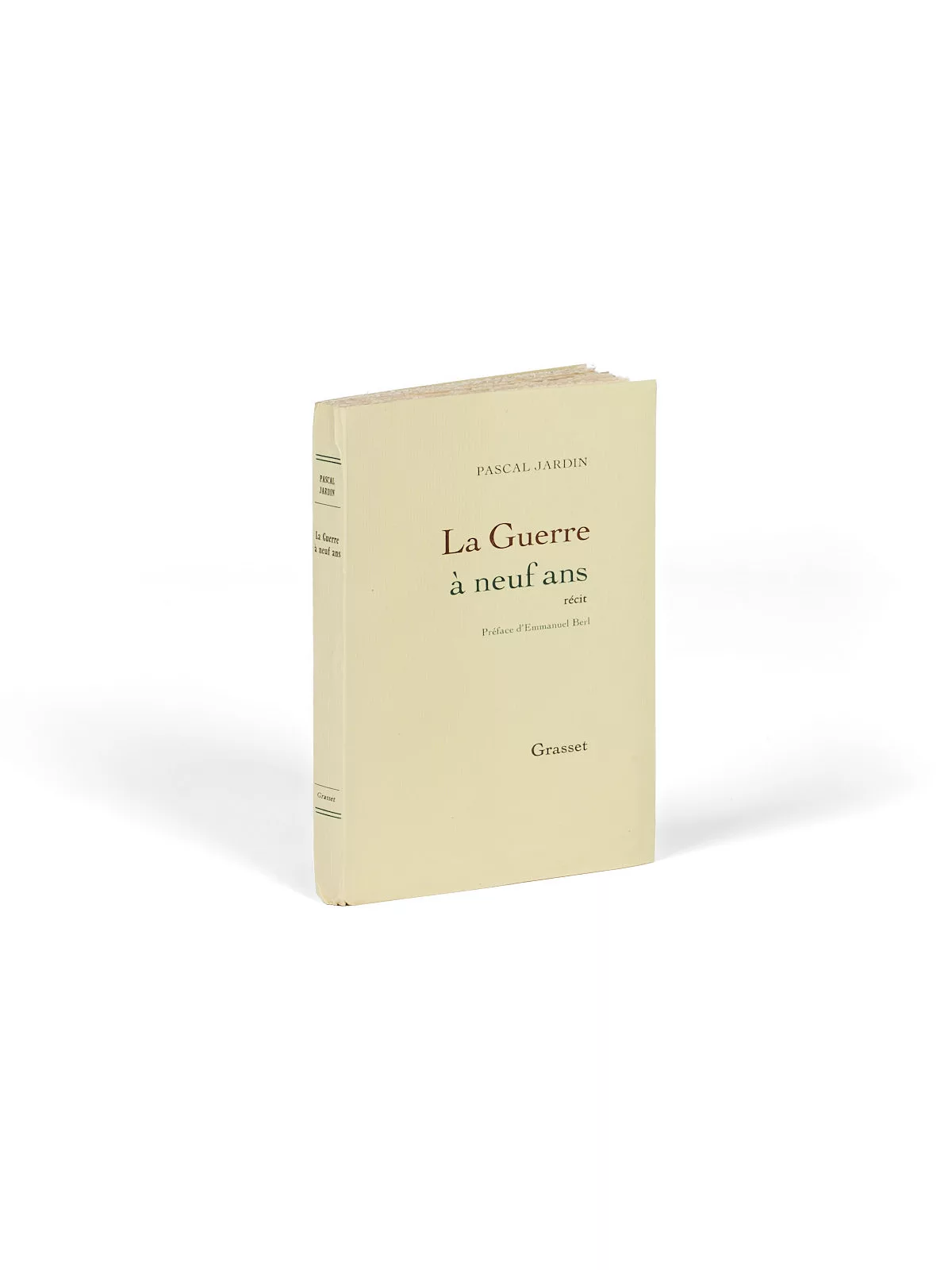
La Guerre à neuf ans
One of 24 copies on alfa paper, the only paper used for the deluxe issue, this copy no. 1.
For Denis Gombert, “La Guerre à neuf ans is a book full of fury and controversy, and yet it is the most delicate of books. It is the miracle of literature to know how to marry contraries.” Pascal Jardin’s father, Jean Jardin, Laval’s chief of staff under Vichy, hastened to denounce his son’s book on its release as a tissue of aberrations not to be taken seriously — as though the whole thing were essentially false, even shameful. As a privileged observer of a strange episode that he chose to recount with great nonchalance, the young Pascal followed his father in the 1940 debacle, first to Trouville, then to Bernay, before crossing into the “free zone” — a phrase that intrigued the young man — finally settling with their bags at the Hôtel du Parc in Vichy, the elegant seat of the French government and true epicenter of collaboration.
When he wrote La Guerre à neuf ans, Pascal Jardin was thirty-six. Ten years later he would be dead, worn out. He spent his life rushing about and writing, above all dialogue for films — nearly a hundred of them. He is remembered for Classe tous risques, Compartiment tueurs, Le Chat, La Veuve Couderc and the Angélique series, that delightful entertainment which shaped the erotic daydreams of an entire generation. As with Audiard, one has the impression that Jardin’s name appears in the credits of every film between 1960 and 1980. Meeting Morand one day, the latter noticed that Jardin was not listening but staring at some invisible point in the distance. “Convinced that life unfolds beyond the horizon, he spent his time trying to catch up with it.” He carried within him, as the author of The Little Prince put it, “the nostalgia for elsewhere.”
The book opens with a quotation from Saint-Exupéry’s Pilote de guerre (Flight to Arras): “One is of one’s childhood as one is of a country.”
Preface by Emmanuel Berl, who had known the author as a child.
Fine condition.