

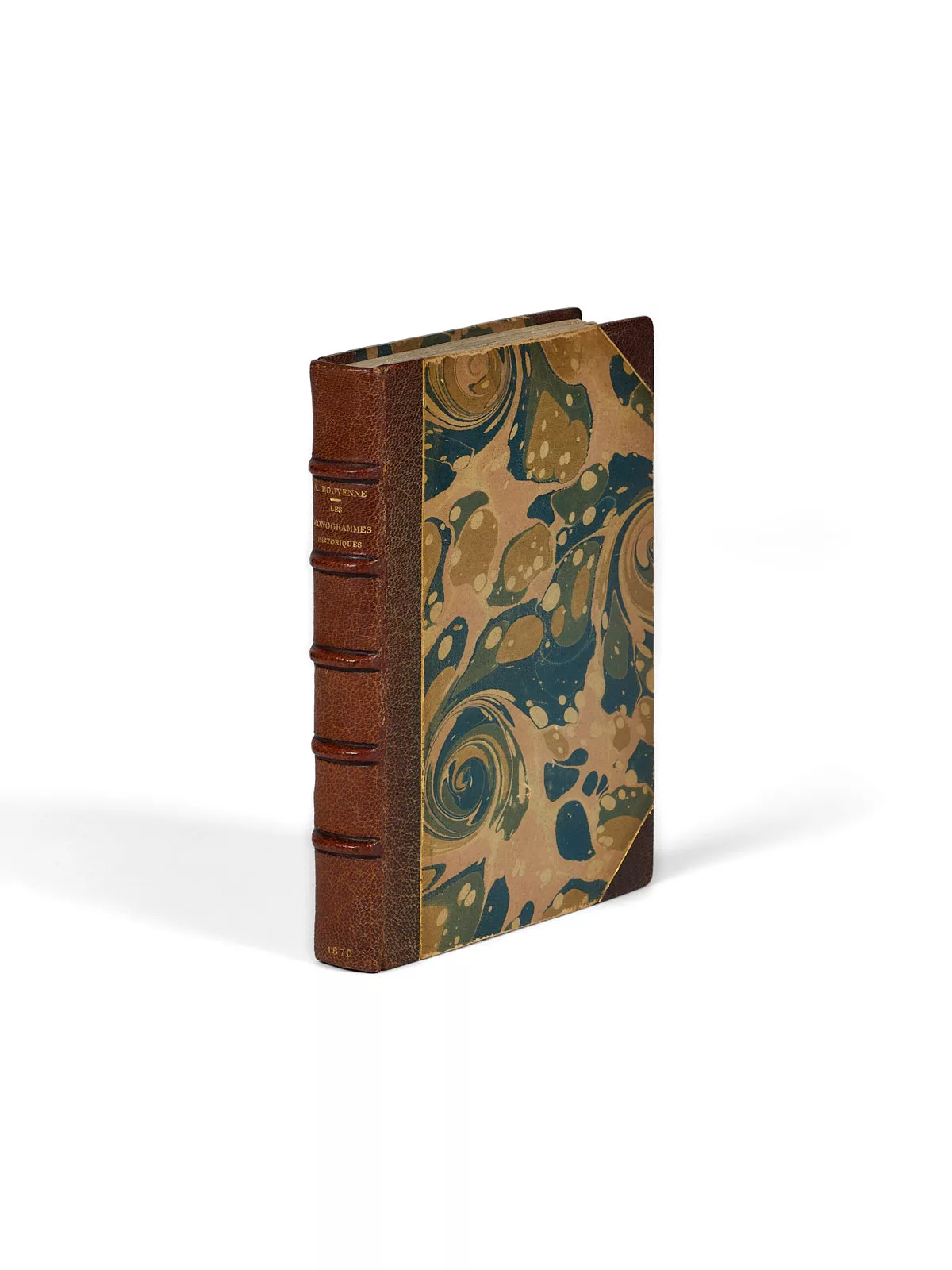
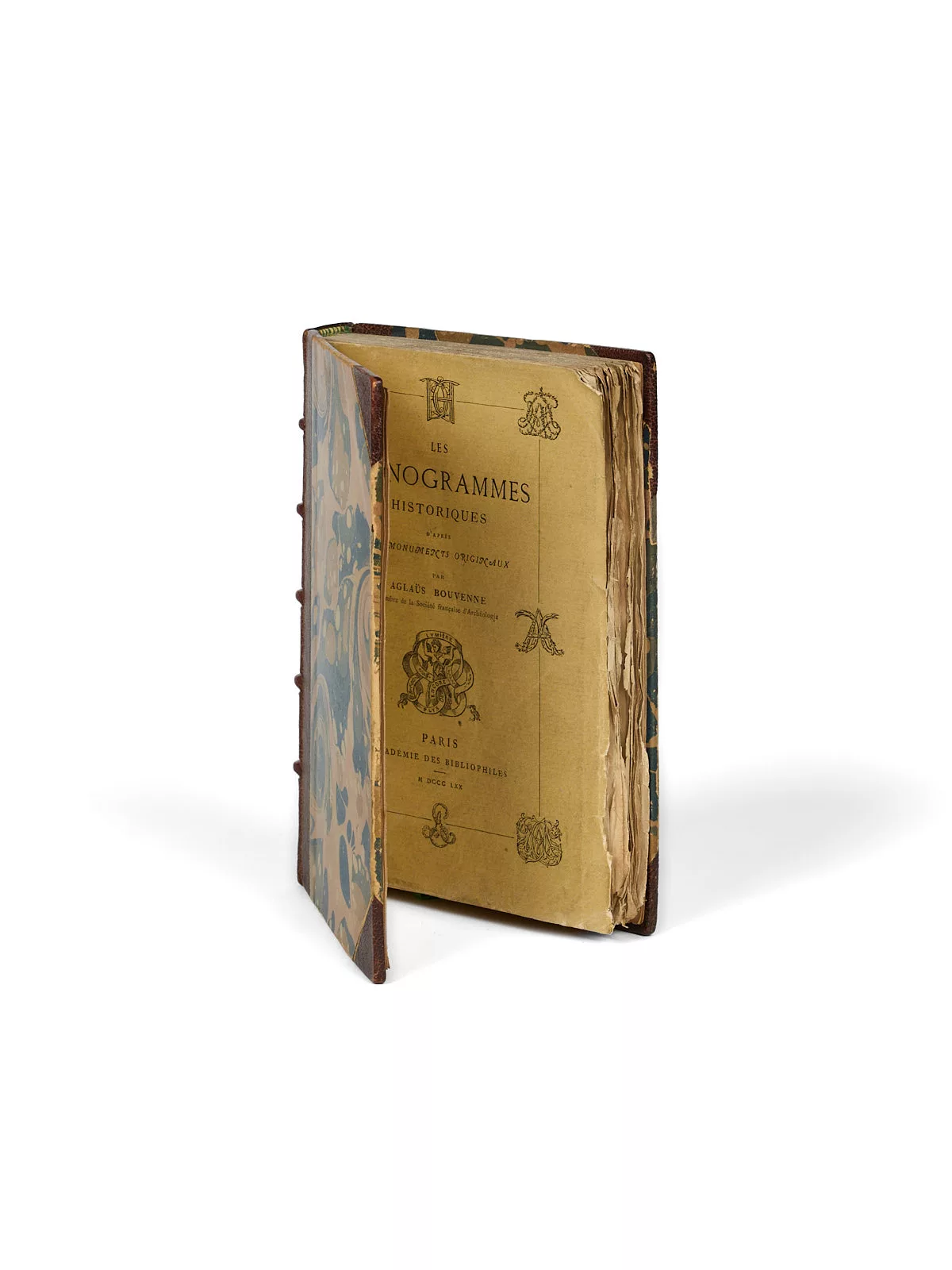
Les Monogrammes historiques d’après les monuments originaux
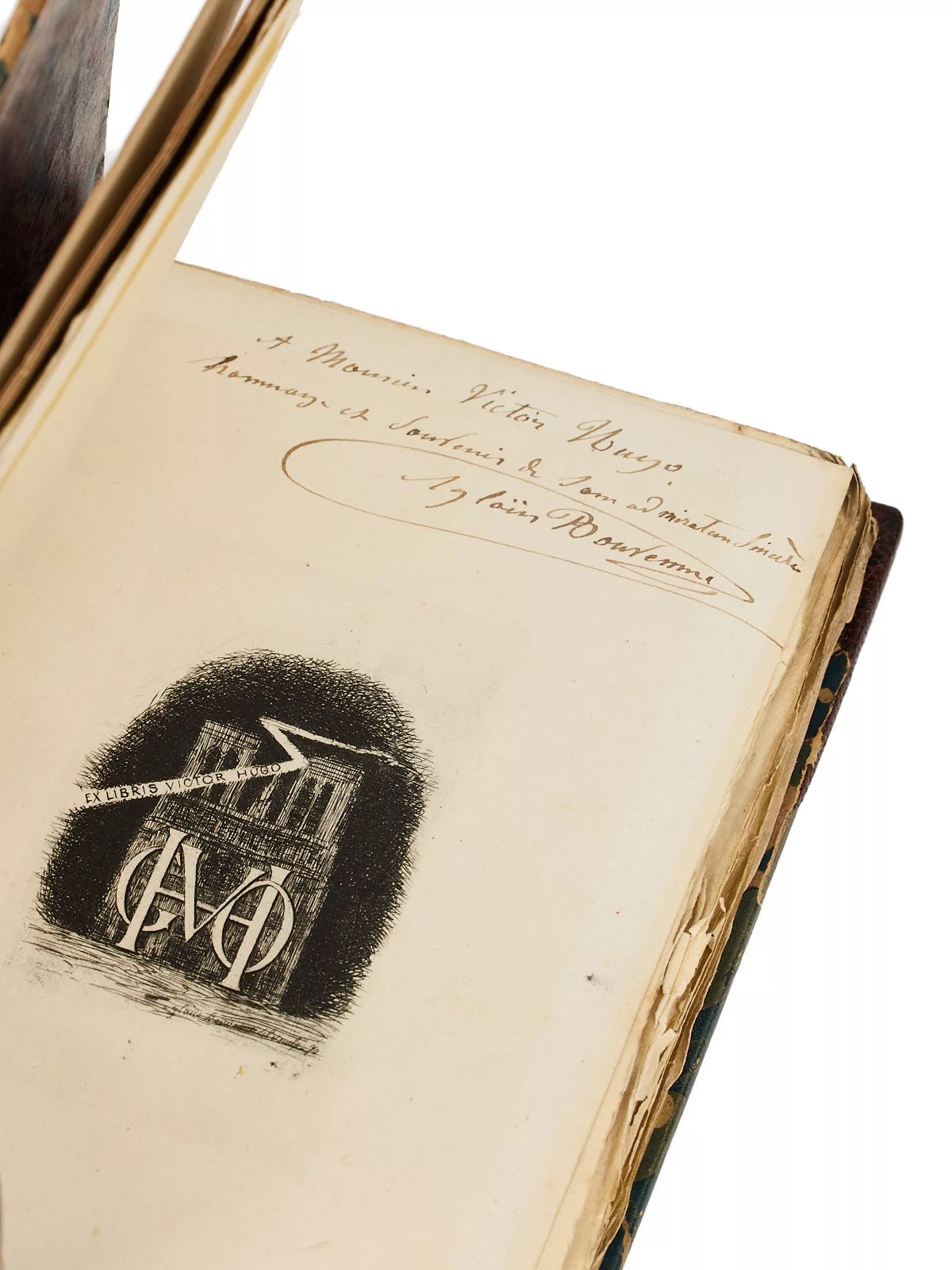
A precious copy, containing the original proof of Victor Hugo's bookplate, presented by its creator to the poet. It is mounted at the front, with this signed presentation inscription in the upper margin: “à monsieur Victor Hugo hommage et souvenir de son admirateur sincère Aglaüs Bouvenne.”
With this copy, Bouvenne presented Victor Hugo with the design for his future bookplate: the towers of Notre-Dame at night, interlaced with his initials, V. and H., with the inscription “Ex-libris Victor Hugo” flashing like lightning. The drawing inspired Auguste Vacquerie (1819–1895), whose brother Charles had married the poet’s daughter Léopoldine, to write the famous line “Les tours de Notre-Dame étaient l’H de son nom” (Mes premières années de Paris, Paris, Michel Lévy frères, 1872, book I, III, “À Paul M.”, p. 12).
Moved, Hugo replied at once: “Hauteville-House, 10 juillet [1870]. Monsieur, j’ai reçu avec un vif intérêt votre excellent et curieux travail. Votre ex-libris fait par vous pour moi me charme. J’accepte avec reconnaissance cette jolie petite planche. Comment vous en remercier ? S’il est un livre de moi que vous désiriez tenir de ma main, veuillez me le dire, et j’aurai l’honneur de vous l’offrir. Votre ex-libris marquera tous les livres de la bibliothèque de Hauteville-House. Je vous serre la main avec une vive cordialité. Victor Hugo” (Correspondance, ed. 1898, vol. III).
Yet the bookplate itself appears never to have been used by the poet: contrary to his stated wish, none of the books from Hauteville-House bear it. The cause was surely “the great war that was coming: the fall of the Empire, Victor Hugo’s return to Paris, and, amid so much upheaval and excitement, the poor bookplate seems to have been forgotten. After the poet’s death, counterfeits flooded the market, and many unwary collectors found themselves searching for a copy of a work bearing this bookplate […]. Bouvenne, who owned the original copper plate, nevertheless allowed impressions to be made from it” (Walter Hamilton, A Handbook for Ex-libris Collectors, 1892). These were published in two volumes: Auguste Poulet-Malassis’s Les ex-libris français depuis leur origine jusqu’à nos jours (1875), and the Archives de la Société Française des Collectionneurs d’Ex-Libris (June 1895 issue), with a facsimile of Victor Hugo’s letter of thanks quoted above.
The engravings from these two works are the ones now found at the Maison de Victor Hugo – Hauteville House: they are readily identified, as they bear the pagination of the work in the upper right corner (“p. 38”). Very often, the leaves have been trimmed to remove this mark so that the bookplate could be affixed to any given copy and passed off as one that had belonged to Hugo.
Aglaüs Bouvenne also designed the bookplate of Théophile Gautier; Bracquemond designed his own. A few years later, Bouvenne wrote a fascinating and surprising study of Hugo, Victor Hugo: ses portraits et ses charges (Paris, Baur, 1879).
Our copy appears in both inventories drawn up by Julie Chenay, in 1870 and again in 1879. In the most recent survey, carried out more than a century later (by the Groupe d’étude Jussieu-Paris VII), it is listed as [missing]. Since when, no one knows — probably since it was rebound, early in the last century, the copy having appeared in wrappers in the Chenay inventories. “A few private collectors own works that appeared in one or another of the Chenay inventories […], and, for the luckiest, even an inscription addressed to the writer. For now the harvest is slim (only 4 volumes, excluding the sale of Georges Hugo’s books), but I have no doubt that further searching through sale catalogues will bring new discoveries to light” (M. J. Chassier, Composition de la bibliothèque de Hugo à Hauteville-House).
Here, then, is one such volume — and perhaps the only one — combining a presentation inscription, the presence of the bookplate, here in its founding state, and a listing in the Chenay inventories, thereby confirming, if any confirmation were needed, its provenance.