

L’action de la justice est éteinte
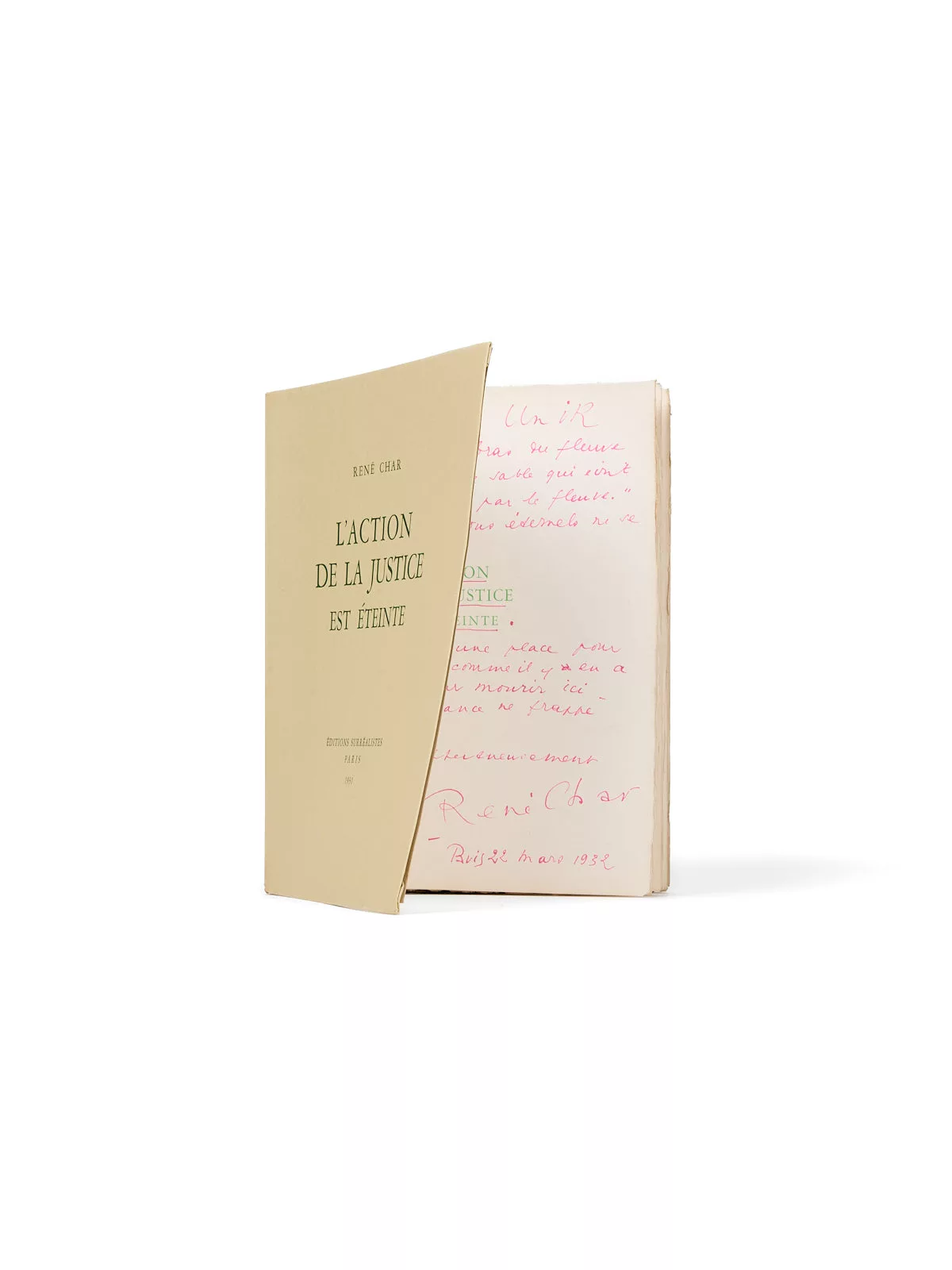
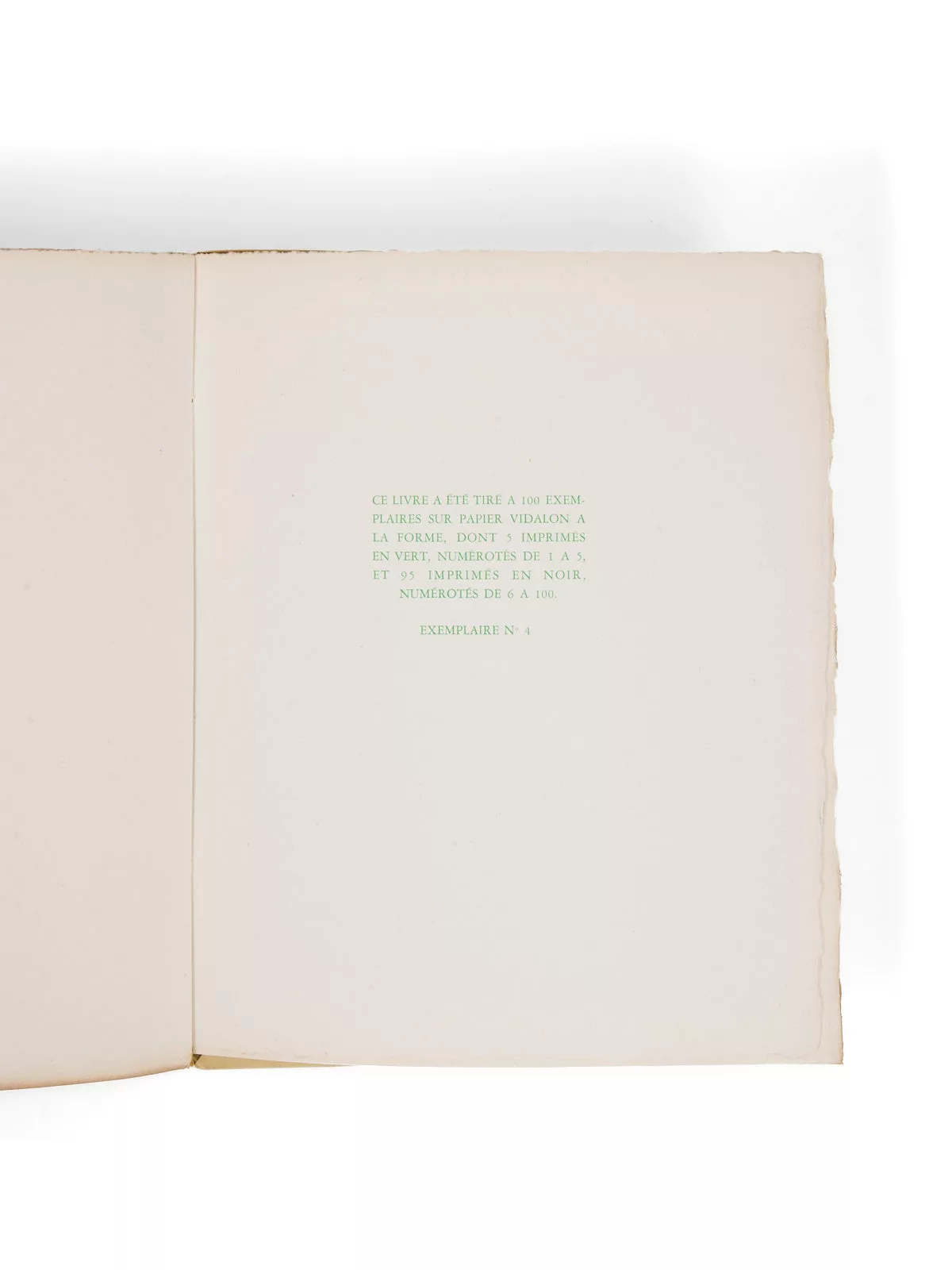
One of 5 deluxe copies printed in green, on handmade Vidalon paper (no. 4). A single printing of 100 copies on this Vidalon paper — the following 95 copies were printed in black, including at least one trial copy.
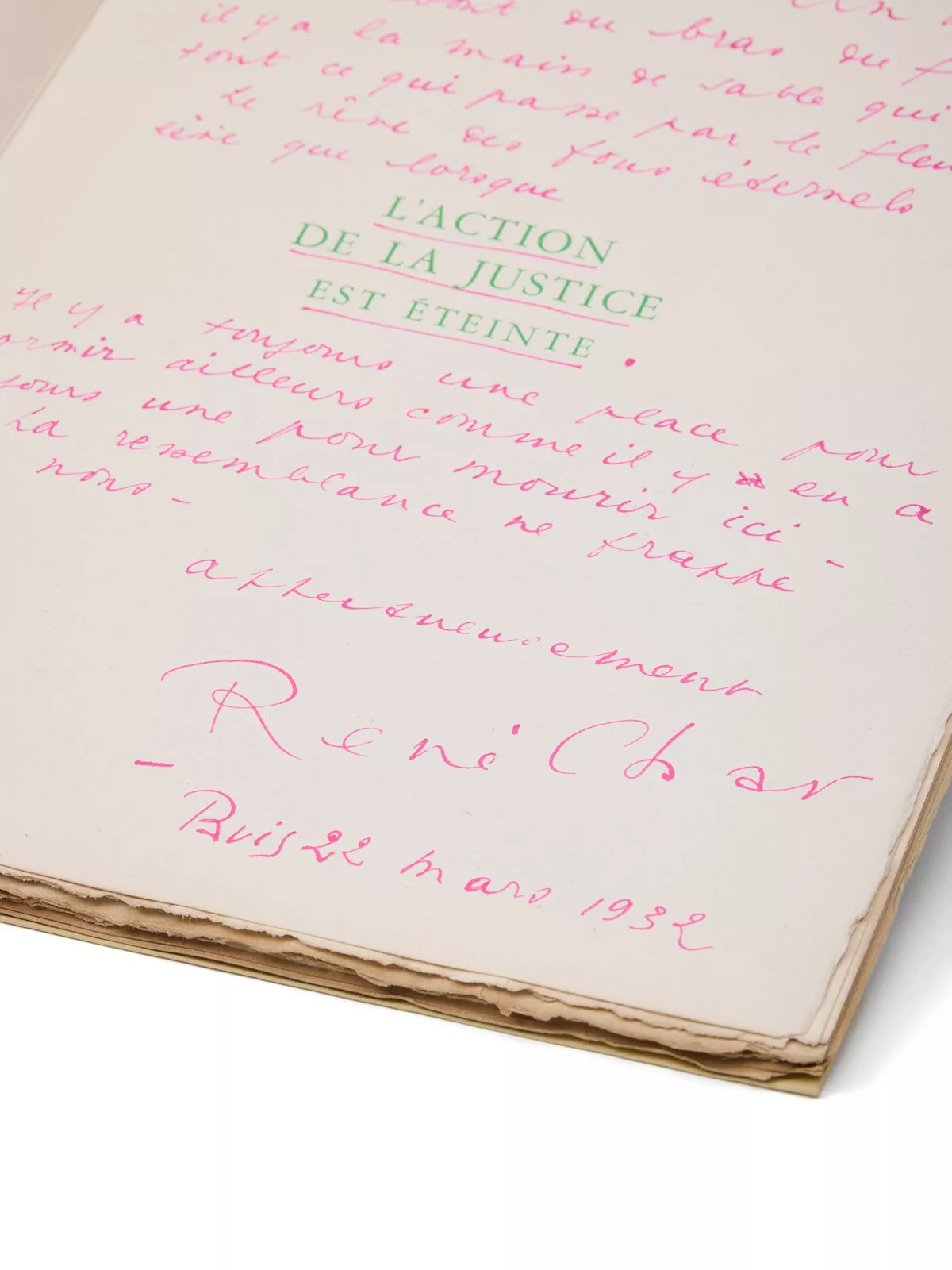
Inscribed in pink ink: “à Pierre Unik, ‘au bout du bras du fleuve il y a la main de sable qui écrit tout ce qui passe par le fleuve’. Le rêve des fous éternels ne se lève que lorsque [L'action de la justice est éteinte]. Il y a toujours une place pour dormir ailleurs comme il y en a toujours une pour mourir ici. La ressemblance ne frappe que nous. Affectueusement, René Char. Buis, 22 mars 1932.” The quotation in the inscription is drawn from the poem “L'Esprit poétique,” dedicated to Louis Aragon.
This is the fourth collection published by René Char (after Arsenal, Le Tombeau des secrets and Artine): it comprises twelve poems (“Poème,” “Sommeil fatal,” “Voyageur sans tunnel,” “La main de Lacenaire,” “Le Fantôme de Lola Abat,” “L’Artisanat,” “Poètes,” “L’Esprit poétique,” “Les Messagers délirants de la poésie frénétique,” “Les Soleils chanteurs,” “L’Instituteur révoqué” and “L’Amour”), printed in July 1931 by Ducros et Colas, master printers in Paris, for the Éditions surréalistes, directed by José Corti. It is dedicated to André Breton and takes its title from an incomplete sentence drawn from Char’s text À Rimbaud (“L’action de la justice est éteinte là où brûle, où se tient la poésie, où s’est réchauffé quelques soirs le poète”).
A rare copy on deluxe paper, dating from the height of Char’s collaboration with Breton and Éluard. As Corti recalled in his Souvenirs désordonnés: “Char probably does not believe much in inspiration, but rather in the magnetism of chance encounters between beings and things. He knows that the poet is a medium who perceives, who knows the place and the grip. When he ploughs, he bears down on the earth; he always goes further; he returns to the furrow as many times as needed. A manuscript by Char is always the pursuit of ultimate perfection. By the time it reaches printing, second thoughts intervene: a word, an inversion, and no sooner is the book finished than what might have perfected it becomes apparent. Some poems of only a few lines went through no fewer than seven or eight states, each definitive for a few hours or a few days […].”
The collection was reprinted, with some corrections, in Le Marteau sans maître, again published by Corti, in 1934. It was later incorporated into the collection Moulin premier.
We have traced only two other copies on green paper: copy no. 5, inscribed to Georgette Char (Fonds Char, Collection Yvonne Zervos, Bibliothèque Doucet), and the Paul Éluard copy (no. 3), bound by Leroux (Christie’s, Collection Pierre Leroy, June 2002, lot 125). There is also a hors commerce copy printed in green, marked “exemplaire A,” presented to Benjamin Péret (Artcurial, October 2013, lot 136).
From the library of Paul Destribats (Christie’s, 2019, I, lot 313).