

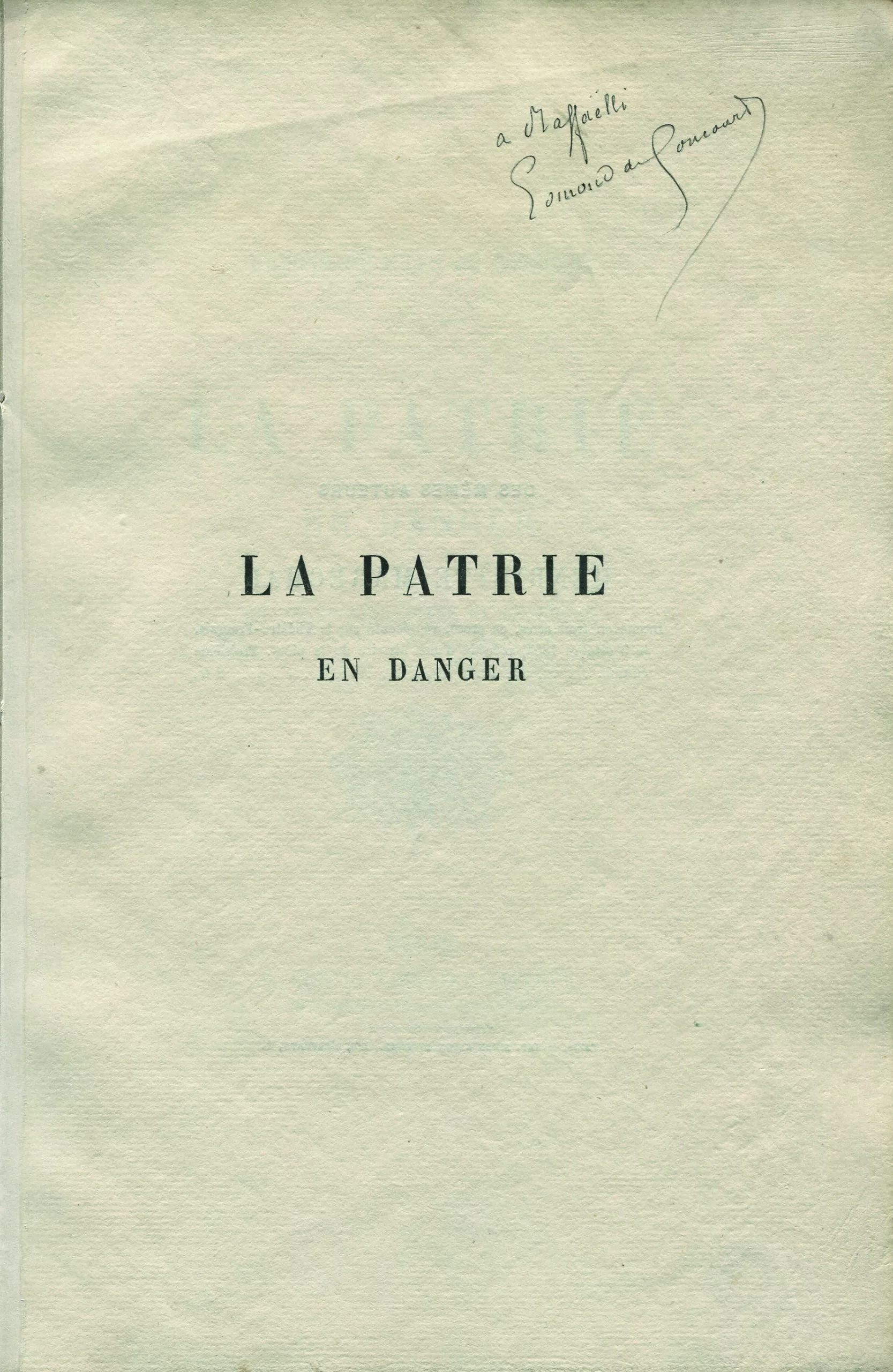
La Patrie en danger
One of 10 copies on Hollande paper.
Presentation copy inscribed by Edmond de Goncourt: “à Raffaëlli, Edmond de Goncourt.”
On 27 December 1860, as recorded in their Journal, the Goncourt brothers first mention their future “play about the Revolution,” initially entitled “Blanche de la Rochedragon.” Rejected by the Théâtre-Français in 1868, it was finally published in 1873 under its definitive title, La Patrie en danger (a genuine marquise de la Rochedragon had objected to the earlier title), earning praise from Maupassant, who wrote in 1879 that reading it had “given him an intense desire to see this work on stage.”
A rare deluxe copy, with distinguished provenance:
In Les Goncourt dédicateurs, Christian Galantaris recorded eleven inscribed copies of La Patrie en danger, including this Raffaëlli copy — the only inscribed copy printed on Hollande paper, despite other prestigious dedicatees such as George Sand, Charles Asselineau, Victor Hugo, Charles Monselet and Jules Claretie.
This distinction reflects the high esteem in which Goncourt held Raffaëlli.
Since Galantaris’s 1993 census, other inscribed copies have come to light: to Alphonse Daudet, Poulet-Malassis and Ernest Renan. Only one further copy on Hollande paper has surfaced, that sent to Paul de Saint-Victor.
This copy and the Raffaëlli copy are therefore, to date, the only two known Hollande copies with a presentation inscription.
Jean-François Raffaëlli was highly regarded by the Naturalists. He illustrated for them an important collection, Les Types de Paris (with texts by Zola, Huysmans, Goncourt and Maupassant), and in 1889, for the Goncourts, Germinie Lacerteux, with ten original etchings, in only three copies — a kind of illuminated manuscript avant la lettre, commissioned by the bibliophile Paul Gallimard, whose memory is preserved in the Goncourt Journal: “Friday 21 June [1889]. — Lunch at Asnières, at Raffaëlli’s, with the Gallimards, to arrange and settle the illustration of the edition of Germinie Lacerteux (…). Raffaëlli’s home, a small suburban bourgeois house, with none of the usual bric-a-brac or china of studios, but where, on an easel or hung here and there on the walls for the view, in a prettily gilded frame, one sees a landscape of Asnières or Jersey, most often painted with Faber oil-color pencils, a landscape that looks like a fixed pastel. In this world of bibliophiles, this world of servants of the old printed book, this Gallimard is truly a revolutionary, about to spend 5,000 francs to give himself, like a fermier général, a modern deluxe edition all to himself…”
Provenance: Jean-François Raffaëlli (presentation inscription); Pierre Bérès (cat. 17, 1937, no. 130); Daniel Sicklès (sale XII, 1992, no. 4816).
Defects to the spine, some creasing to the wrappers.