

Mexico 86
The competition is remembered above all for two legendary matches: the two quarterfinals in Guadalajara, between Brazil and France, and between Argentina and England. During the latter, Diego Maradona scored two of the most famous goals in World Cup history: the first, the “Hand of God,” scored in the 51st minute with his left hand and wrongly allowed by the referee; the second, voted “Goal of the Century,” scored four minutes later after he ran the length of the opposing half, dribbling past five English players — Peter Beardsley, Peter Reid, Terry Butcher (twice), Terry Fenwick, and goalkeeper Peter Shilton.
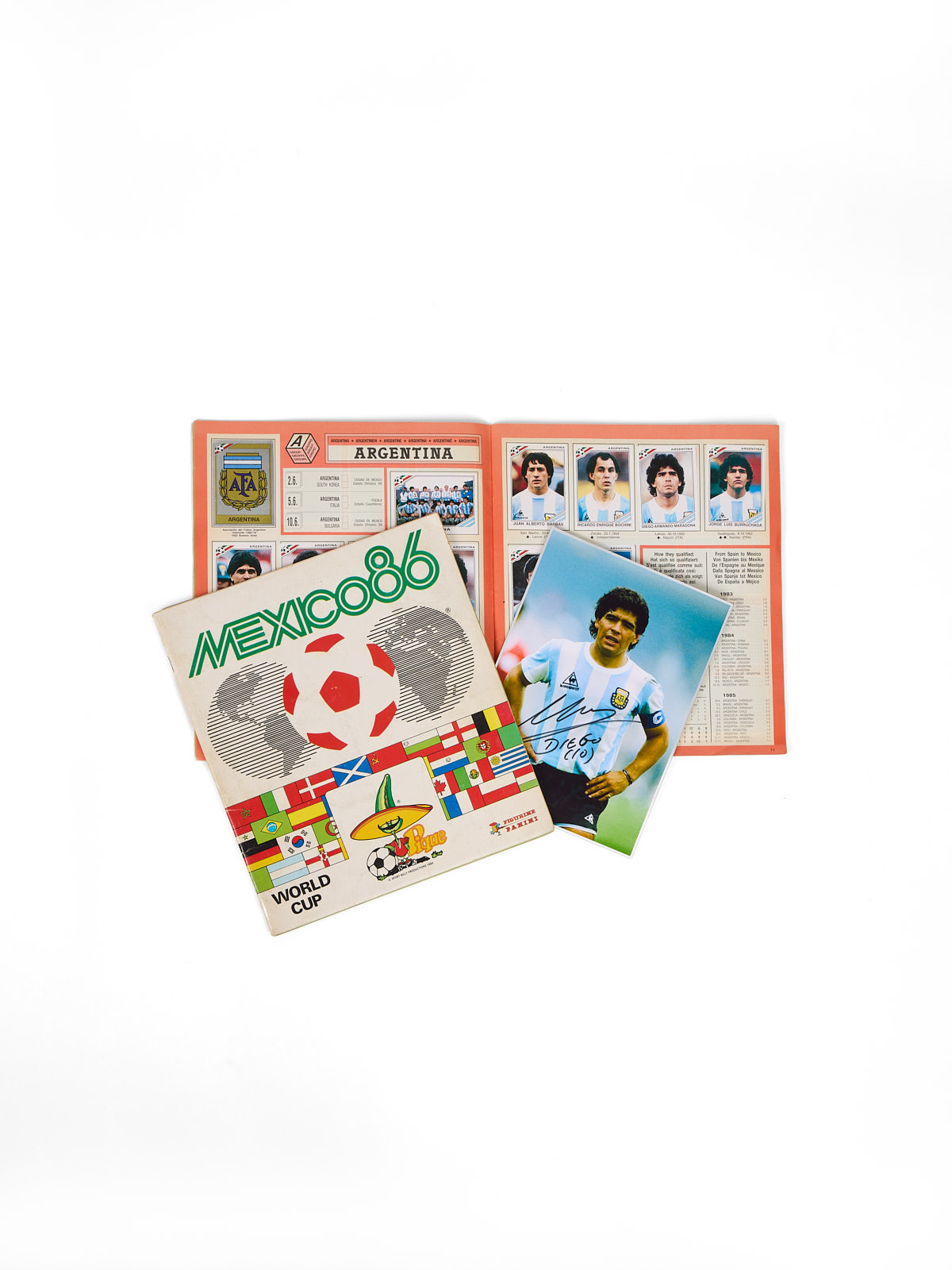
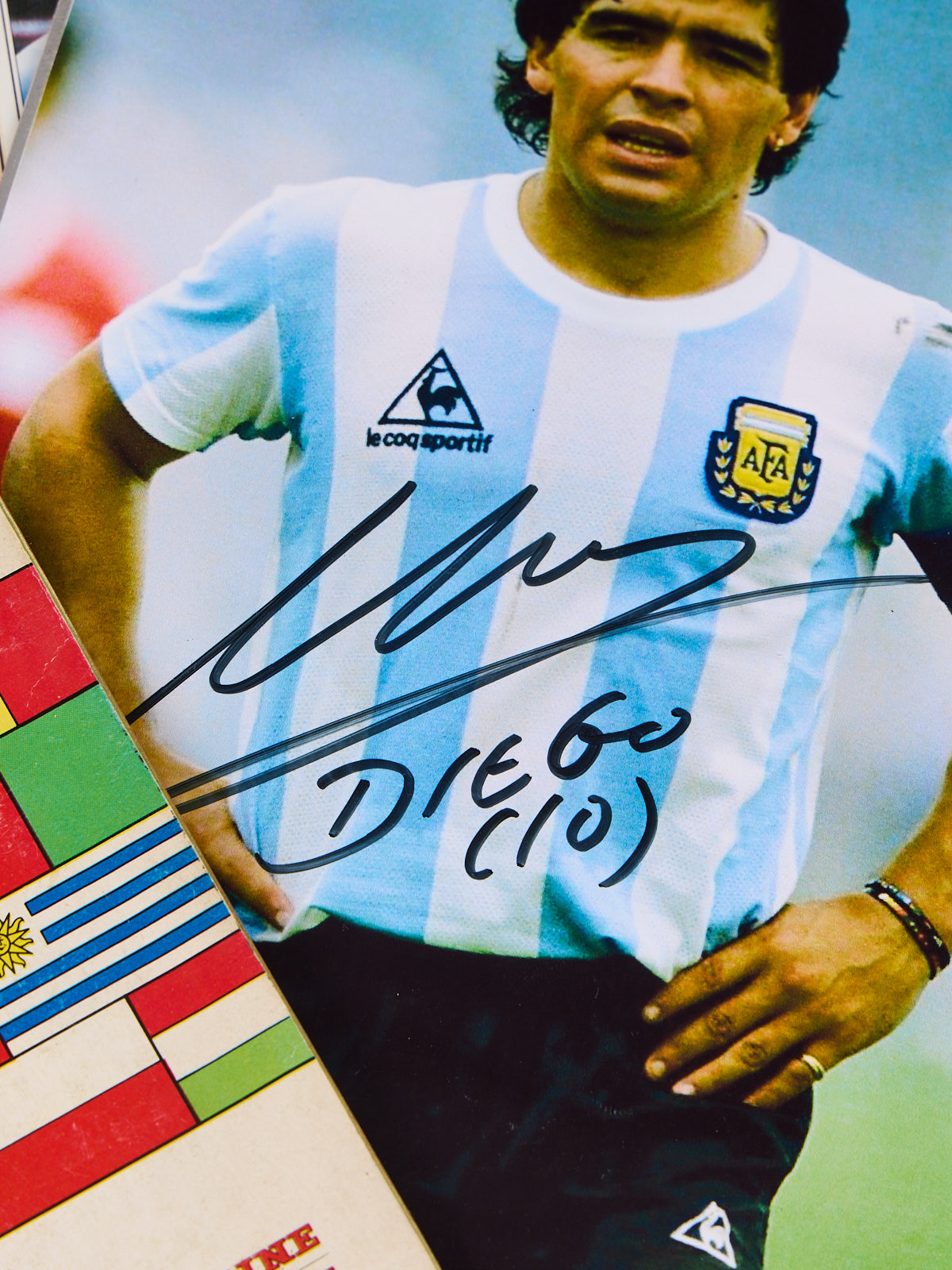
The copy is enriched with a photograph of Maradona, wearing the Argentine national team kit, signed in black felt-tip pen.
This is the fifth album published by Panini for a football World Cup.
In 1961, two newspaper-selling brothers from Modena, Giuseppe and Benito Panini, noticed children fighting over pictures of football players tucked inside chocolate bars. To help sell their magazines, they had the idea of doing the same. The result was an immediate success: they launched Calciatori (“Footballers” in Italian), a collectible card album featuring players from the Italian football championship — the first Panini album ever. Glue was even supplied with the magazine to stick the pictures in, which were sold in small packets. Subsequent albums were devoted to animals and other sports, and were equally successful. Two more Panini brothers then joined the company, and one of them, Umberto, developed the Fifimatic, a packaging machine that mixed the stickers to ensure fair distribution: every sticker was produced in equal quantity, and the machine guaranteed there would be no duplicates within a single pack.
With the 1970 World Cup in Mexico came the first international edition of the album, bringing together images of all participating national teams. It was a great success, soon enhanced by the creation of the fully self-adhesive sticker: the following international edition, produced for the 1974 World Cup in Germany, was the first to use the definitive sticker format still in use today. Seventy percent of the firm’s revenue comes from football-related sales: this sport remains Panini’s absolute bestseller in France, where more than 150 million stickers (i.e., 30 million packets of five stickers) are sold per World Cup album, the most popular of all its releases.
A rare complete album, accompanied by a fine portrait of the captain of the Argentine team, taken during the second Group B match, against South Korea. It was a historic match for the Koreans, being their first ever World Cup appearance. That day, Maradona provided the assists for all three goals, while himself suffering eleven fouls — long the record for fouls sustained by a player in a World Cup match — seven of them committed by Huh Jung-moo, assigned to mark him, including a tackle that prompted the Argentines to say that this defender, later a national team manager, “wasn’t playing football, he was doing taekwondo!” The two men would meet again twenty-four years later, this time from opposing benches, at the South African World Cup.