

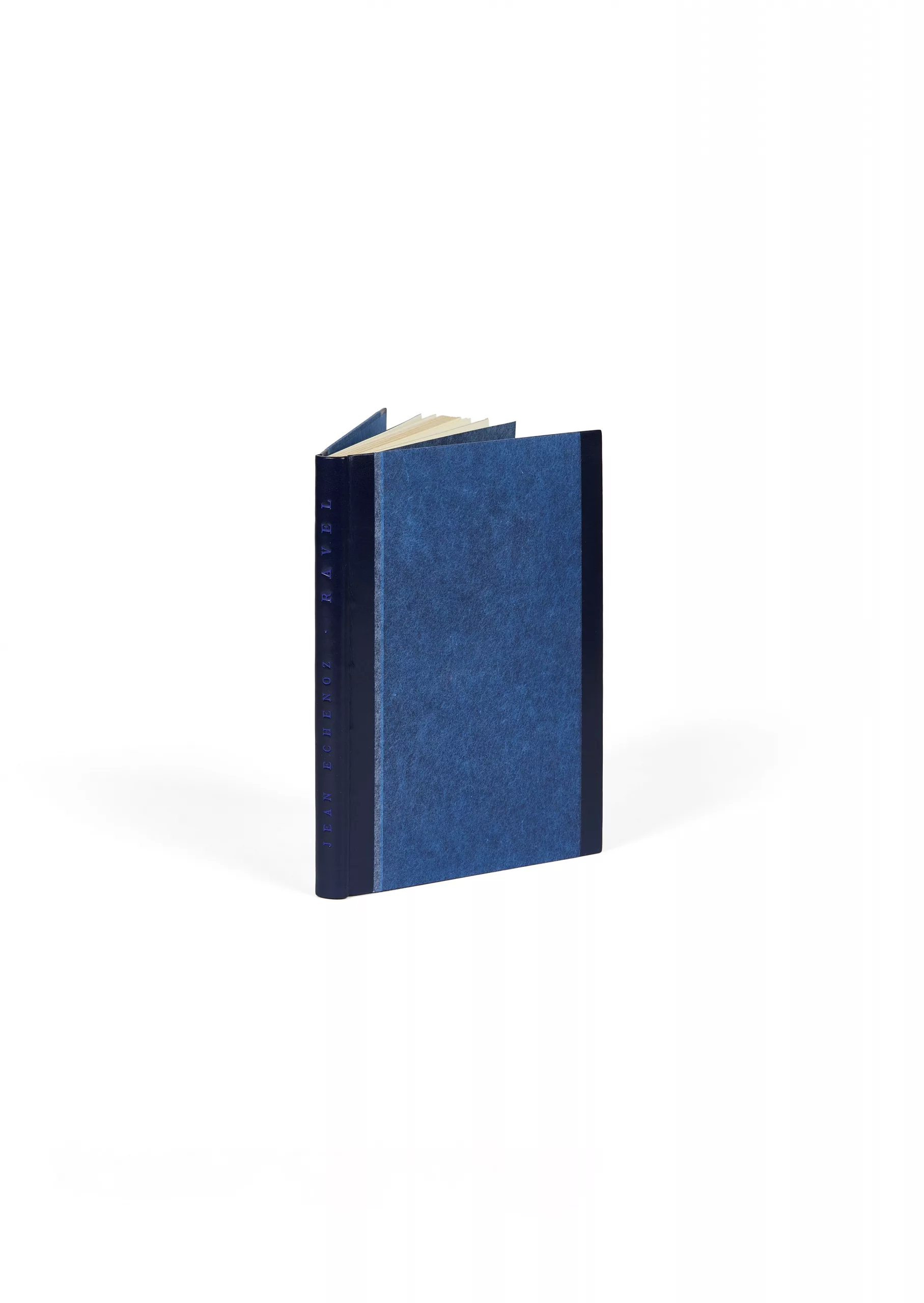
Ravel
One of 106 copies on vergé de Vizille, this copy no. 21.
His tenth novel, Ravel, demonstrates brilliantly, and in a way quite unexpected for readers accustomed to his stories crafted with a clockmaker-grammarian’s precision, that Echenoz had not yet opened every door, and that the resources of “real life” (to return to that phrase) were far from exhausted. His impeccable art of writing remains as supple, as refined and as full of promise as ever.
“Whether he dreams or jokes, whether he is ironic or anguished, Jean Echenoz never loses sight of concrete life — his own, ours, and above all that of the man in the street, the man without qualities — even though he knows it to be perfectly elusive (…) As for qualities, Maurice Ravel, the French composer born in Ciboure (Basses-Pyrénées) on 7 March 1875 and who died in Paris on 28 December 1937, had eminent, recognized and duly documented ones. The author has by no means omitted or trivialized them. He is indeed the musician of genius who, upon Debussy’s death in 1918, became the towering figure of French music. He is adored — even though he failed four times to win the Prix de Rome — invited and performed everywhere… But this is not a fictionalized biography of the musician, not even of the final years of his life, to which Echenoz devotes himself with a kind of empathy and questioning distance. So where are we?
In a novel whose central character is a great, at least by reputation, French composer. As in “real life,” he is named Maurice Ravel, or simply Ravel. In New York, on 7 March 1928, he celebrates his 53rd birthday. Shortly before, he had recalled the war and his own excessive lightness, his body too frail amid that theater of immense brutality (…) One day in the autumn of 1932, he is the victim of a car accident. From that point on — that is, from the end of Ravel’s life and of Echenoz’s novel — everything accelerates, for the novelist is the master of time. Ravel loses words, thoughts, objects. He explains “that his ideas, whatever they may be, always seem to remain imprisoned in his brain.” He undergoes surgery, but to no avail. Ten days later, he is dead. By what mystery, by what effect of his art and his sensibility, and above all by what admirable balance of style — never conventional, never predictable — does Jean Echenoz achieve his aim? And first, what is that aim? As we have said, not to write a fragment of Ravel’s life, but a novel, a simple novel brimming with life and death, with unease, mystery, fantasy, alarm, humanity, tenderness. And, finally, with music.” (Patrick Kéchichian, in Le Monde, 12 January 2006).
One of Jean Echenoz’s finest titles, delicately bound by Clara Gaevert.