

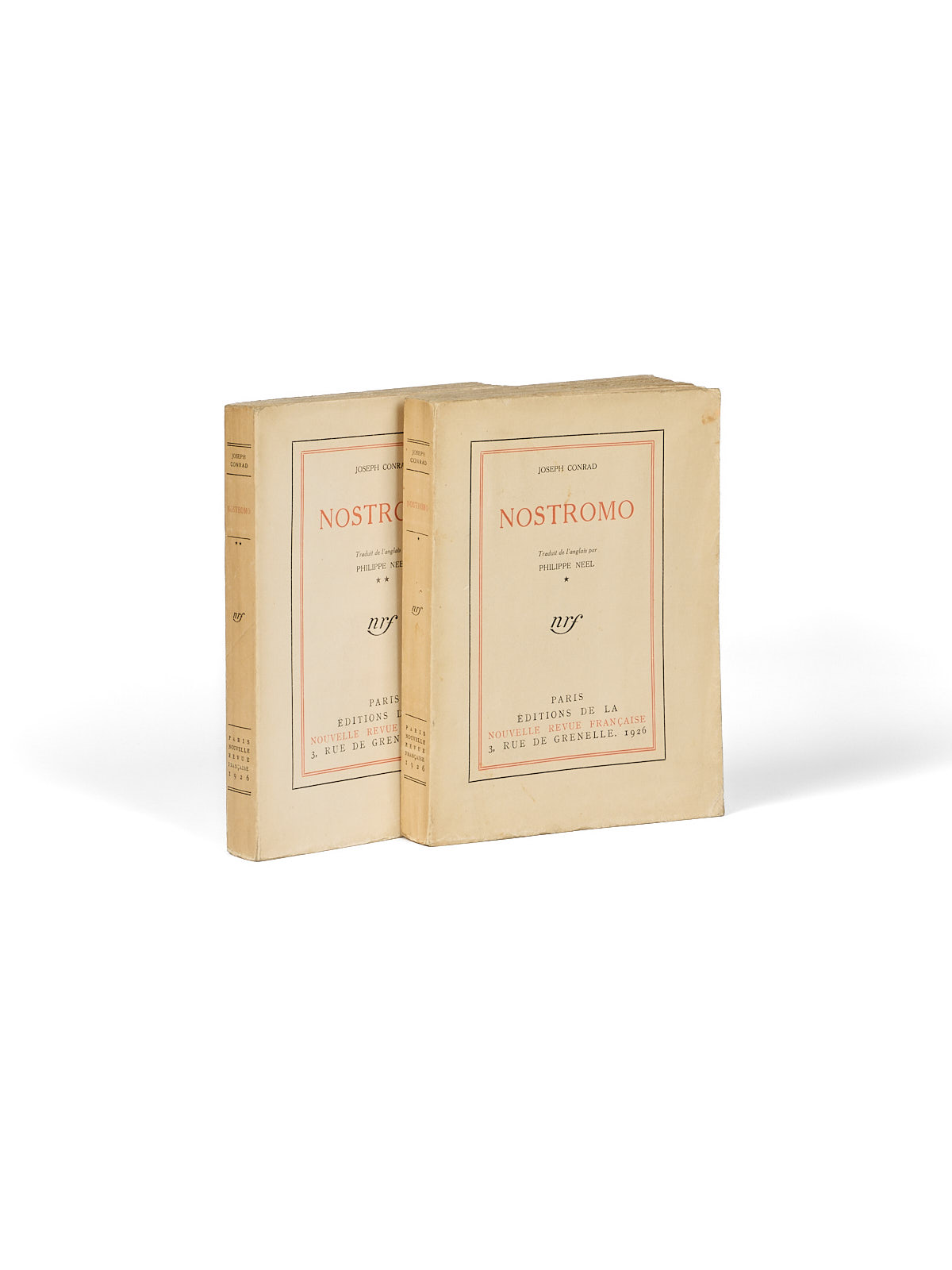
Nostromo
One of 109 copies from the deluxe réimposé issue on vergé Lafuma, this copy nominative for P. Guastalla (no. XXXVIII).
“If I had to choose a single novelist, I would choose Joseph Conrad. There is something epic about Conrad; one thinks of him as a man who has been everywhere, one thinks of him as one thinks of the ocean.” When Jorge Luis Borges made this remark, he almost certainly had in mind Nostromo, published in 1904 — one of Conrad’s most powerful, dense and darkest novels.
The book was the culmination of an extraordinary project that cost the novelist more than two years of effort: the invention of an entire imaginary Latin American republic, Costaguana, complete with its own history, geography, institutions, customs, economic system, social classes and web of tensions plunging the country into chaos. It was ranked 47th in the Modern Library’s 1998 list of the hundred best English-language novels of the twentieth century, and its title was borrowed in 1979 for the cinema: the Nostromo is the name of the cargo ship in which the entirety of Ridley Scott’s Alien takes place. Scott, who had initially considered naming the ship the Leviathan, explained that “the way in which the same event and the same place can affect different people is a Conradian concept,” adding that “Alien is in that sense comparable to the book Nostromo.”
A fine copy, from the library of Pierre Guastalla. A painter, illustrator and lithographer trained at the Académie Ranson, he produced nearly 600 plates between 1921 and 1968. He was one of the founders of the association La Jeune Gravure contemporaine in 1929 and illustrated numerous books. A bibliophile, he had been, since the early 1920s, a subscriber to the réimposé copies issued by Librairie Gallimard.