

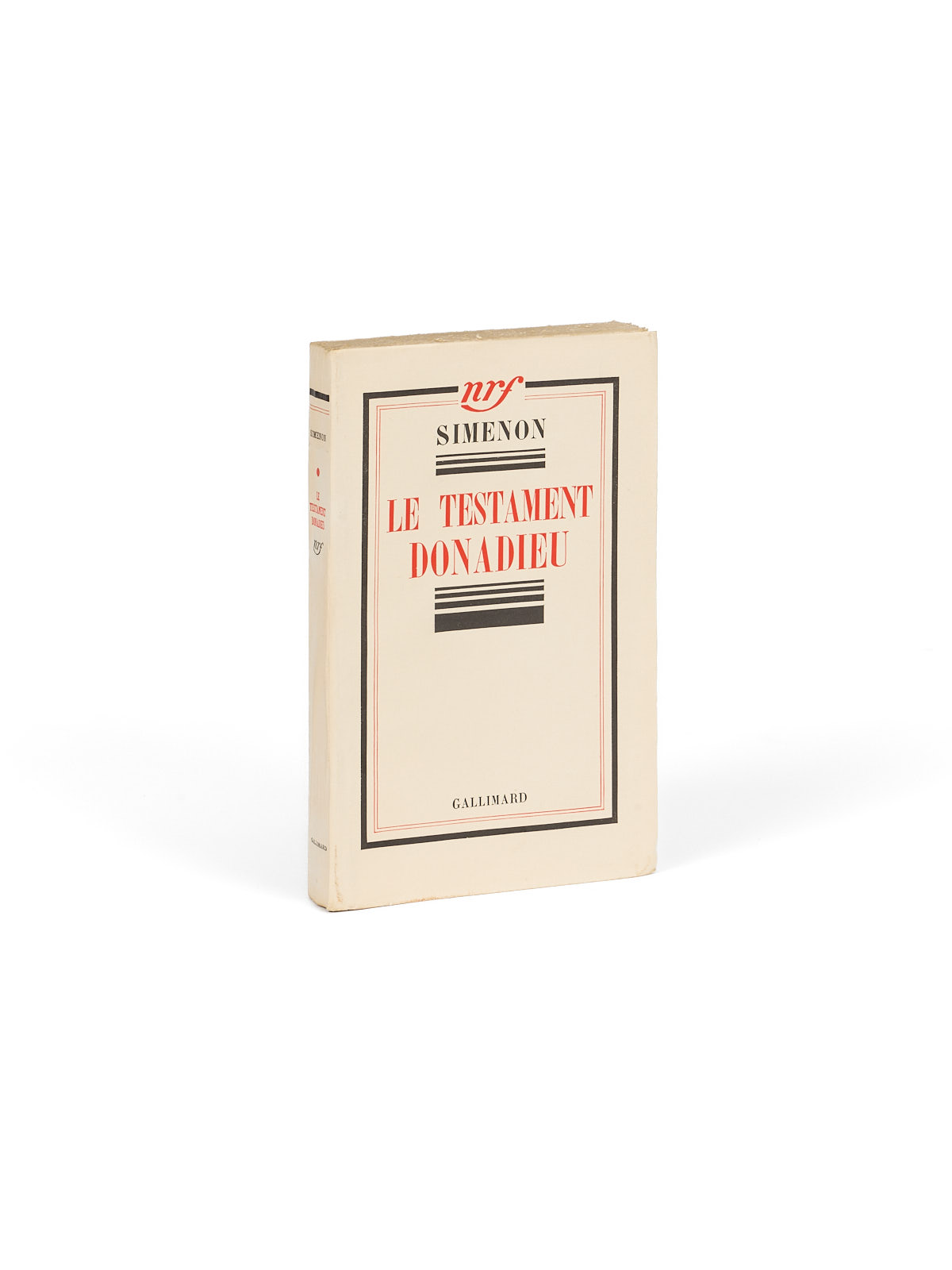
Le Testament Donadieu
One of 30 copies on alfa paper (no. 8), the only paper issue.
In the villa Les Tamaris, which he had rented at Porquerolles, Simenon wrote, during the summer of 1936, the novel to which he entrusted all his hopes: to break free (at last) from the detective novel, to be recognized as a writer in his own right, and to be crowned with a literary prize — in this case the Goncourt, for which he was considered a serious contender. Simenon himself called Le Testament Donadieu his “first great novel.” This substantial book (750 typescript pages) cost him dearly. In an interview with a journalist from Liège for L’Indépendance belge (5 December 1936), he revealed what lay behind it: “I might have produced this book sooner had I been certain of sustaining the nervous and muscular effort I knew it would require of me.” Unlike his earlier novels, the work demanded by Le Testament Donadieu — by its scale and the direction he gave it — bore no relation to the ten days or so his novels usually took him: “Until now I had been able to hold out for ten days, but this time it was a month’s labor. I emerged from the task half neurasthenic, and had to undergo a restorative treatment […].” So great was his horror of making “the slightest correction” to a finished manuscript that, as he put it, “since I make no plan at all, I could hardly remove certain details without harming the balance of the whole.”
Simenon narrowly missed the Goncourt, despite two serious supporters: Gaston Gallimard — to whom he was now bound by contract (since 1933), and to whom he would give four texts in 1937 (Faubourg, L’Assassin, Le Blanc à lunettes and Le Testament Donadieu) — and one of the Goncourt jurors, the turbulent Lucien Descaves. Descaves maneuvered a great deal to see a foreign-born author win the prize, eventually succeeding with the Liège-born Charles Plisnier, crowned for Faux-passeport. Simenon had nonetheless accomplished his purpose: Le Testament Donadieu answered, in his own words, “an observation that had often been made to him. […] ‘When,’ the critics asked, ‘will Simenon give us “his” book?’”