

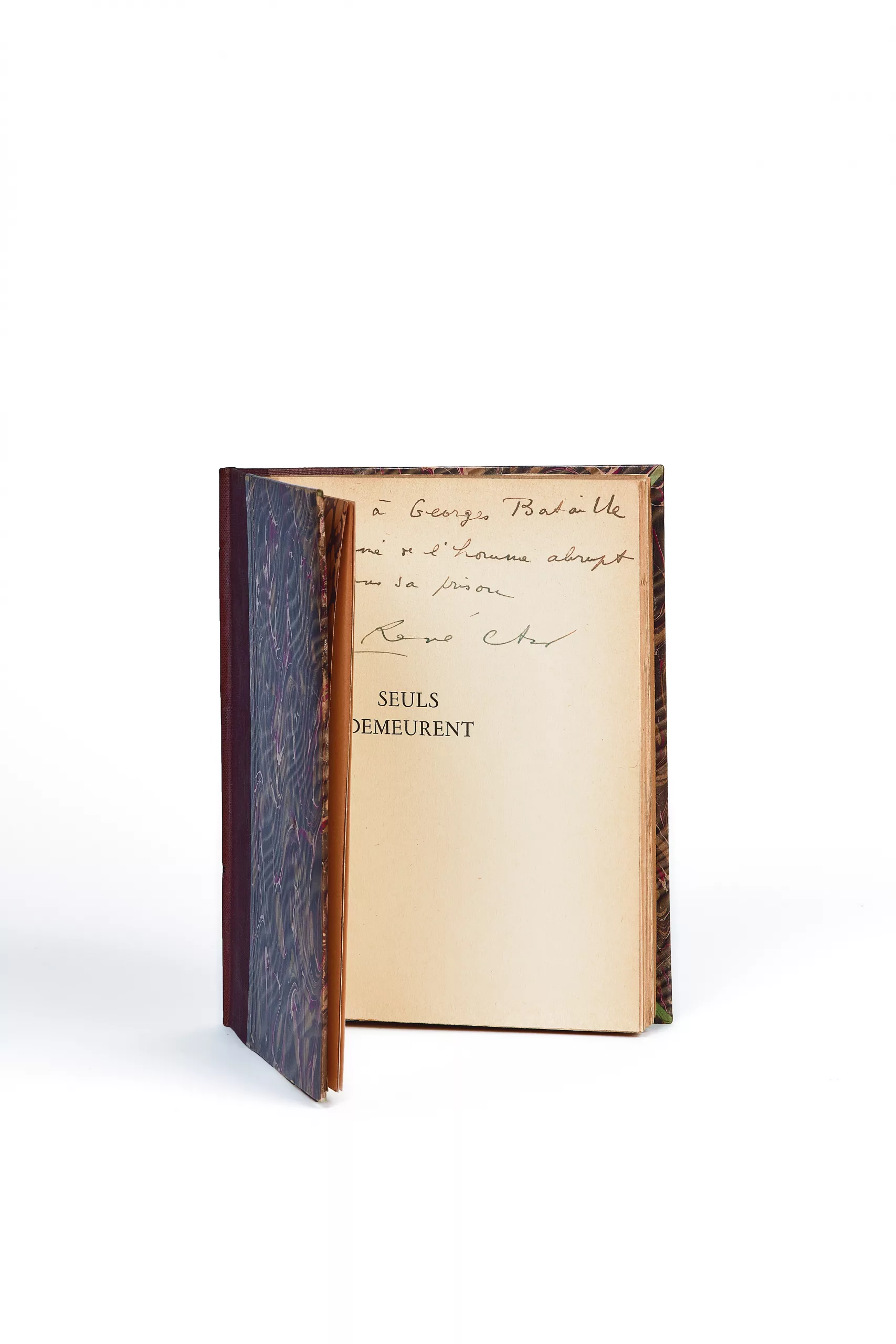
Seuls demeurent
One of 1,000 copies on châtaignier paper (no. 457).
Signed presentation inscription: “À Georges Bataille, intime de l'homme abrupt dans sa prison, René Char.”
Seuls demeurent is the earliest title by René Char present in Georges Bataille’s library, and this inscription is, in all likelihood, the very first he ever received from Char, according to the inventory established by the Librairies du Sandre and Vignes. It is also one of the few volumes Bataille had bound, in this case by J. Moreau in Orléans, where he was transferred in July 1951 as librarian. Fewer than twenty copies among the 1,283 titles catalogued so far in his library received this treatment, confirming, as the booksellers note, that “the difficult postwar living conditions of the writer are perceptible even in the modesty of his copies,” at least as regards their condition. It is surely because this copy of Seuls demeurent, inscribed to him, was particularly dear to him that Bataille had it bound in this way, in the same modest library binding as Apollinaire’s L’Œuvre du marquis de Sade, Max Ernst’s Œuvres de 1919 à 1936, Leiris’s L’Âge d’homme or Queneau’s Exercices de style.
Bataille gave Char a copy of L’Expérience intérieure in Paris on 7 April 1945; it is possible that the inscription in this copy of Seuls demeurent dates from the same day, in an exchange of courtesies during a Parisian meeting — the first documented encounter between the two men, of which Bataille confessed he was “ultimately delighted to have met René Char today” (in Dans l’atelier du poète, p. 378).
Their relationship deepened when they were reunited in Carpentras, where Bataille took up the post of curator at the municipal library. Char subsequently gave him L’Héraclite d’Éphèse (1948), Le Soleil des eaux (1949), Les Quatre Fascinants (1951), À la santé du serpent (1954) and La Bibliothèque est en feu (1956).
A rare connection and a very fine provenance.