

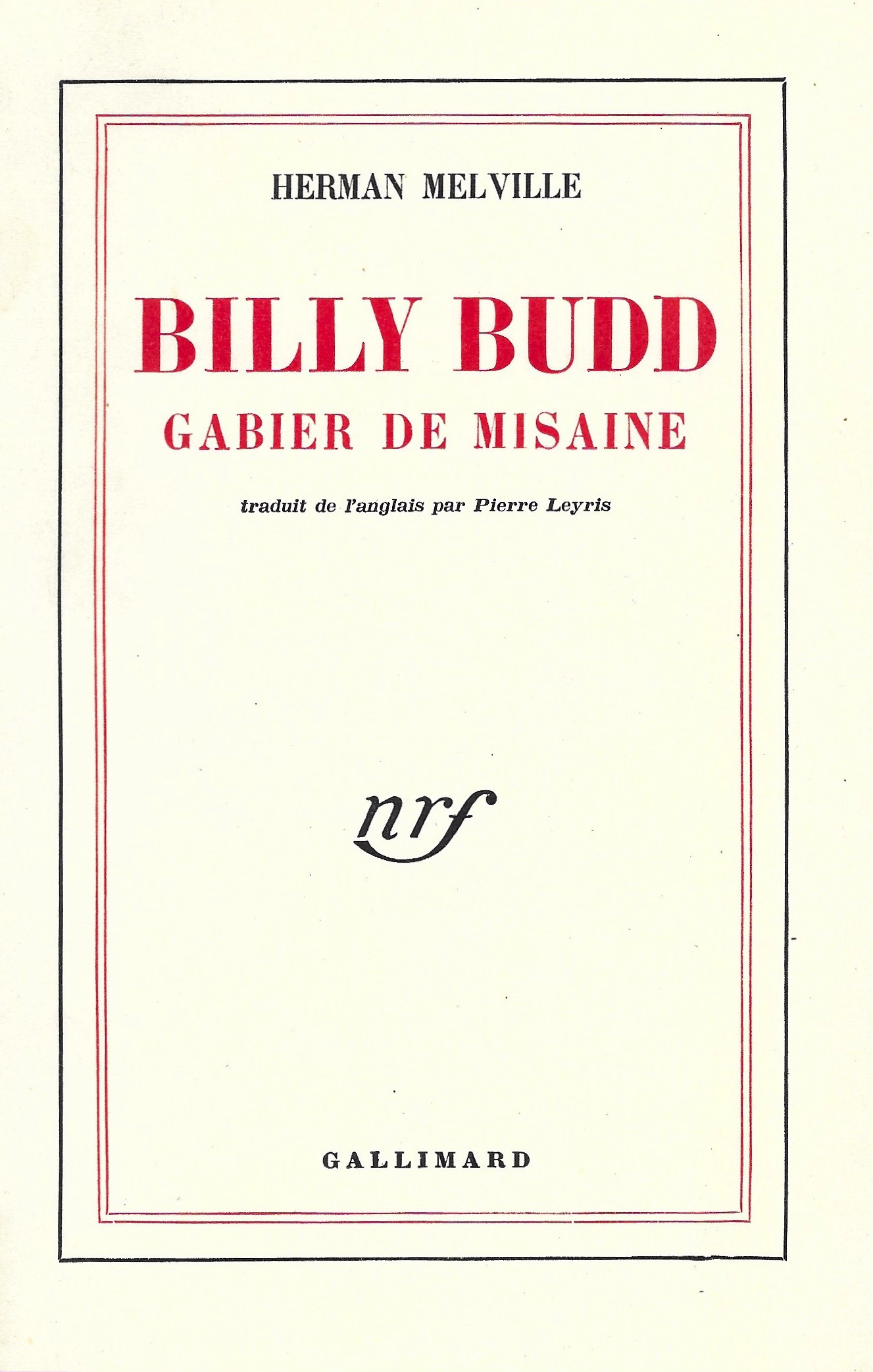
Billy Budd. Gabier de Misaine
Issued here with a relay wrapper from Éditions Gallimard, who acquired the rights to Melville's works in the late 1930s. During the war, Gallimard would publish, in Giono's translation, the reference edition of Moby Dick, before Giono produced his famous Pour saluer Melville.
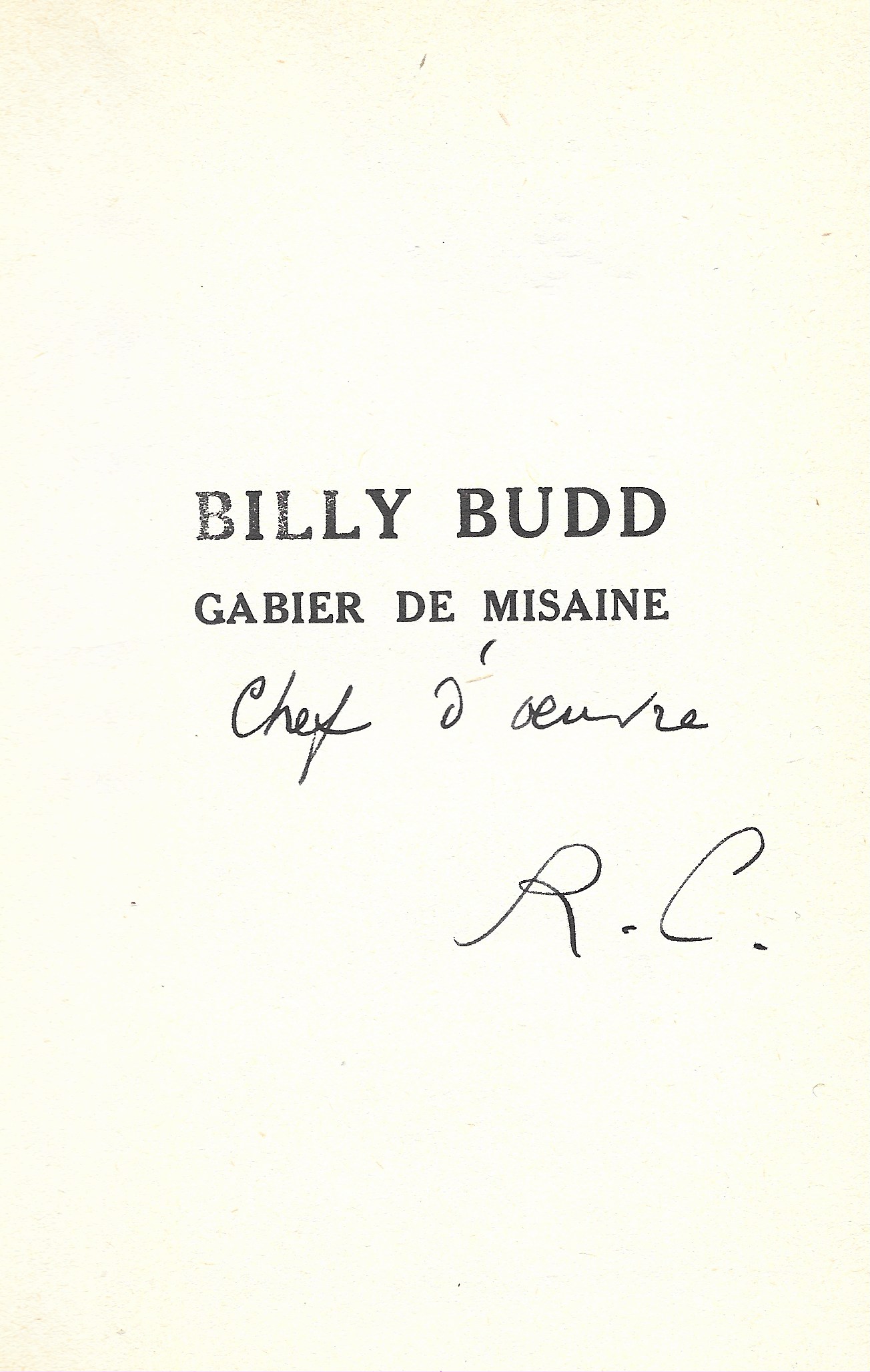
René Char's own copy, with this autograph note: “Chef d'œuvre. R.C.”.
A wonderful copy, read with fervor by the poet. Like Melville, Char was not a traveling writer, nor even a geographically peripatetic pen: his territories remained those of the South, of his native Provence. Nonetheless, from Conrad to London and Melville, Char the reader took his fill of their open-air narratives.
Billy Budd tells the story, aboard the British warship Avenger in 1797, of a shy and exemplary sailor who arouses the irrational hatred and jealousy of the ship’s master-at-arms. The latter wrongly accuses him of fomenting a mutiny. Defenseless, the young sailor accidentally kills his accuser. He is condemned to death and executed, to the great dismay of the captain, a man of humanity yet unable to override naval law. The novel was adapted for the opera in 1951 by Benjamin Britten, and, ten years later, became an excellent film directed by Peter Ustinov, based on the play staged on Broadway in 1951 by Louis Coxe.
This is a posthumous novel by Melville, who began writing Billy Budd in 1886. Extensively revised, his last corrections date from April 1891, five months before his death on 28 September of that year. The manuscript, however, was not published until 1924, after being found in a biscuit tin.
“There are novels whose heroes, actions, character and motives cannot be grasped through the categories of biography or psychology… Billy Budd, the figure of the perfect innocent, in Herman Melville’s eponymous novel, which he left partially unfinished the year of his death in 1891… it is the testament to the human impossibility of deciding between antagonistic conceptions of the good and the just, as manifested in the highly questionable, though perfectly reasoned, decision to hang Billy Budd, the Handsome Sailor, the perfect innocent defeated by the forces of evil, or triumphant over them, as one prefers.” (in Billy Budd. L’innocence et le mystère d’iniquité, by Michel Terestchenko, Revue Mauss, 2016, pp. 413 et seq.)
More recently, it inspired a song by Morrissey (on the album Vauxhall and I, 1994).
Unlike many twentieth-century poets — Saint-John Perse, Yves Bonnefoy or Philippe Jaccottet, for instance — Char had no extended formal education; he left school early, worked selling fruit and vegetables in Cavaillon, and attended, rather loosely, one year at a business school in Marseille. He was thus self-taught, his knowledge built not through systematic study but through chance reading, discoveries in other people’s libraries and friendships. Contrary to what he sometimes claimed, Char proves to have been a great reader of novels, even worrying over translation choices: “They are retranslating Histoires inquiètes under the insipid title Inquiétudes. The admirable ending of Lord Jim — ‘he was one of us’ — is distorted into ‘it was one of us’… I am ashamed of this mental waste.” Anne Reinbold testifies that Char had read Melville, Conrad and Hamsun well before meeting her (Daniel Leclair, in Bibliothèque d’écrivains: René Char, le poète et ses livres, 2018) — and this copy proves it: the annotation “masterpiece” is not a late judgment but contemporary with the book’s publication, at the very end of the 1930s.
Melville seems never to have left Char afterward: later editions remained in his library, and references to Melville appear here and there throughout his work. Char repeatedly cited the sentence from Melville that Camus loved above all others: “Truth uncompromisingly told will always have its ragged edges.” Melville belonged, with Baudelaire and Van Gogh, among Char’s “wild gods,” and the poet — a rare occurrence in his collections — eventually used a quotation from Melville as an epigraph to Faire du chemin avec…, in 1976: a tribute to Melville the poet, for he was indeed one, devoting himself to intense poetic activity, as attested by the roughly 18,000 lines of the monumental Clarel (1876) and three collections of “minor verse” — John Marr and Other Sailors (1888), Timoleon (1891) and Last Poems, from which comes The Return of the Sire de Nesle, quoted by René Char at the opening of his own collection.