

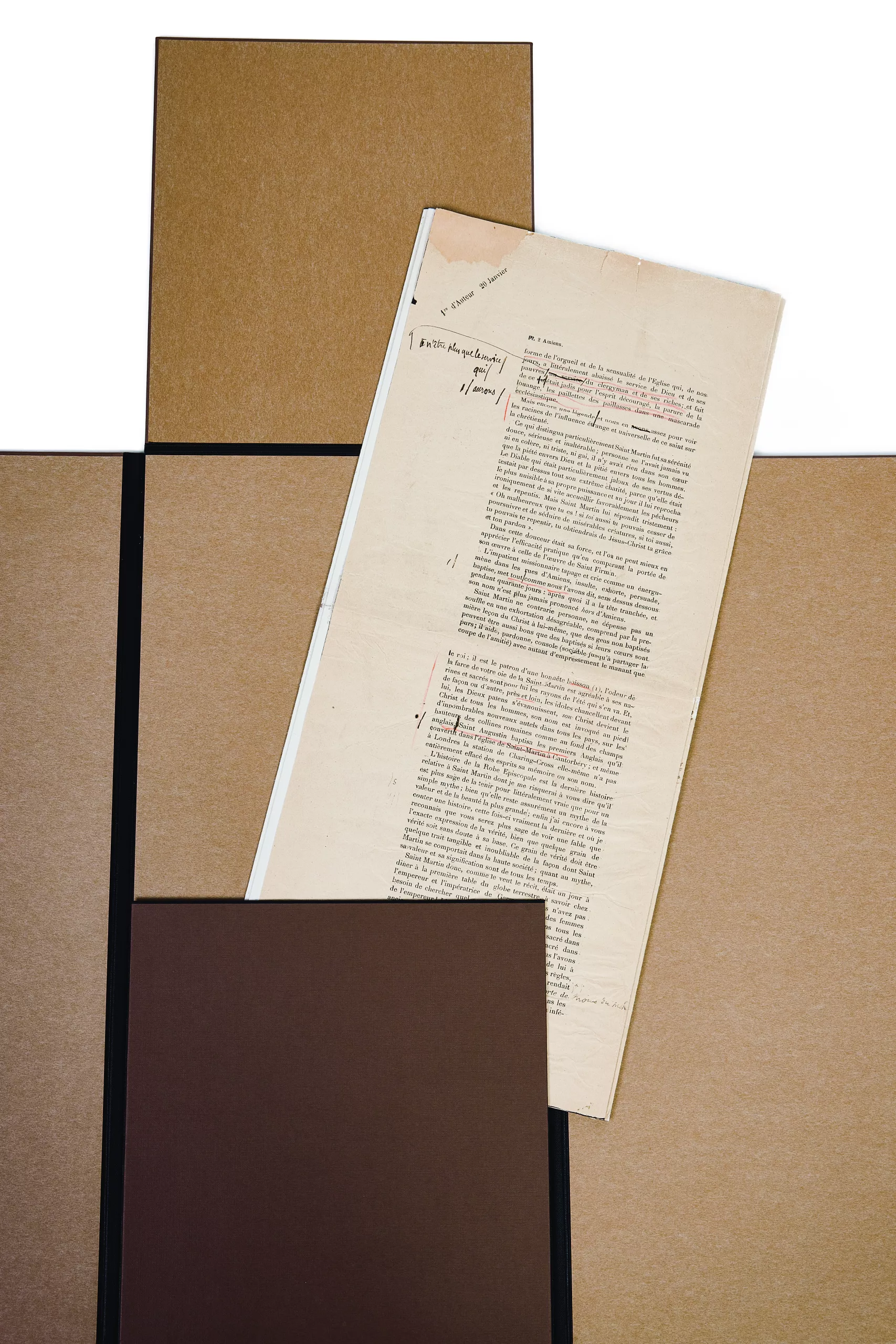
La Bible d’Amiens
Numerous autograph corrections, giving several previously unrecorded variants, attesting to the meticulous care Proust brought to this translation, whose success encouraged him to undertake the exercise a second time with Sesame and Lilies two years later.
Marcel Proust began reading Ruskin’s works in the autumn of 1899, immediately upon his return from Évian-les-Bains, immersing himself in the work of the man he called “this great man” after discovering the chapter entitled “The Lamp of Memory” in The Seven Lamps of Architecture. It was a revelation. A few months later, he learned of the art critic’s death from Le Figaro of 21 January 1900 and wrote at once to Marie Nordlinger, an English friend from Manchester and cousin of Reynaldo Hahn, expressing his sorrow and his wish to ensure the lasting survival of Ruskin’s work. He then began drafting several tributes to Ruskin, in the form of obituary articles and notes, which, considerably expanded, would become the surrounding texts of his future translation of La Bible d’Amiens.
The first — and only — extracts appeared in February and March 1903, a year before the book’s publication.
The text of these proofs concerns episodes from the hagiography of Saints Martin, Geneviève and Jerome, and appeared in the literary review La Renaissance latine (issue of 15 February 1903), edited by the Prince de Brancovan, despite the latter’s reservations: only the previous month he had mocked what he considered Proust’s “slight” translation. Proust answered him memorably: “I believe that this translation — not on account of my talent, which is nil, but of my conscientiousness, which has been infinite — will be a translation such as there are very few of, a true reconstitution […]. By dint of probing the meaning of every word, the scope of every expression, the connection between every idea, I have arrived at so precise a knowledge of this text that whenever I have consulted an Englishman — or a Frenchman with a thorough command of English — about some difficulty, it generally took an hour before the difficulty even emerged, and he would congratulate me on knowing English better than an Englishman. In which he was mistaken. I do not know a word of spoken English, and I do not read English well. But after four years of working on La Bible d’Amiens, I know it entirely by heart, and it has attained for me that degree of complete assimilation, of absolute transparency, where one perceives only the nebulae that belong not to the insufficiency of our sight, but to the irreducible obscurity of the thought being contemplated.”
The task was indeed arduous, for Proust knew almost no English: his mother produced a word-for-word version, which he then reworked with the advice of Marie Nordlinger and Robert d’Humières, Kipling’s translator. After these long years of relentless labor and personal reflection on art and creation, Proust finally completed his preface, translation and notes, some of which run to several pages.
The book, finished a year later in February 1904, bore a dedication to Adrien Proust, who had just died, in place of the one intended for Reynaldo Hahn: “to the memory of my father, struck down while working on 24 November 1903, died on 26 November, this translation is dedicated.” Proust later apologized for this in a personal dedication when he gave Hahn a copy, explaining that “my little Papa so wished to see it published that I preferred to withdraw it from you in order to offer it to him.” Proust nevertheless dedicated to Hahn the second Ruskin text he translated three years later, Sesame and Lilies.