

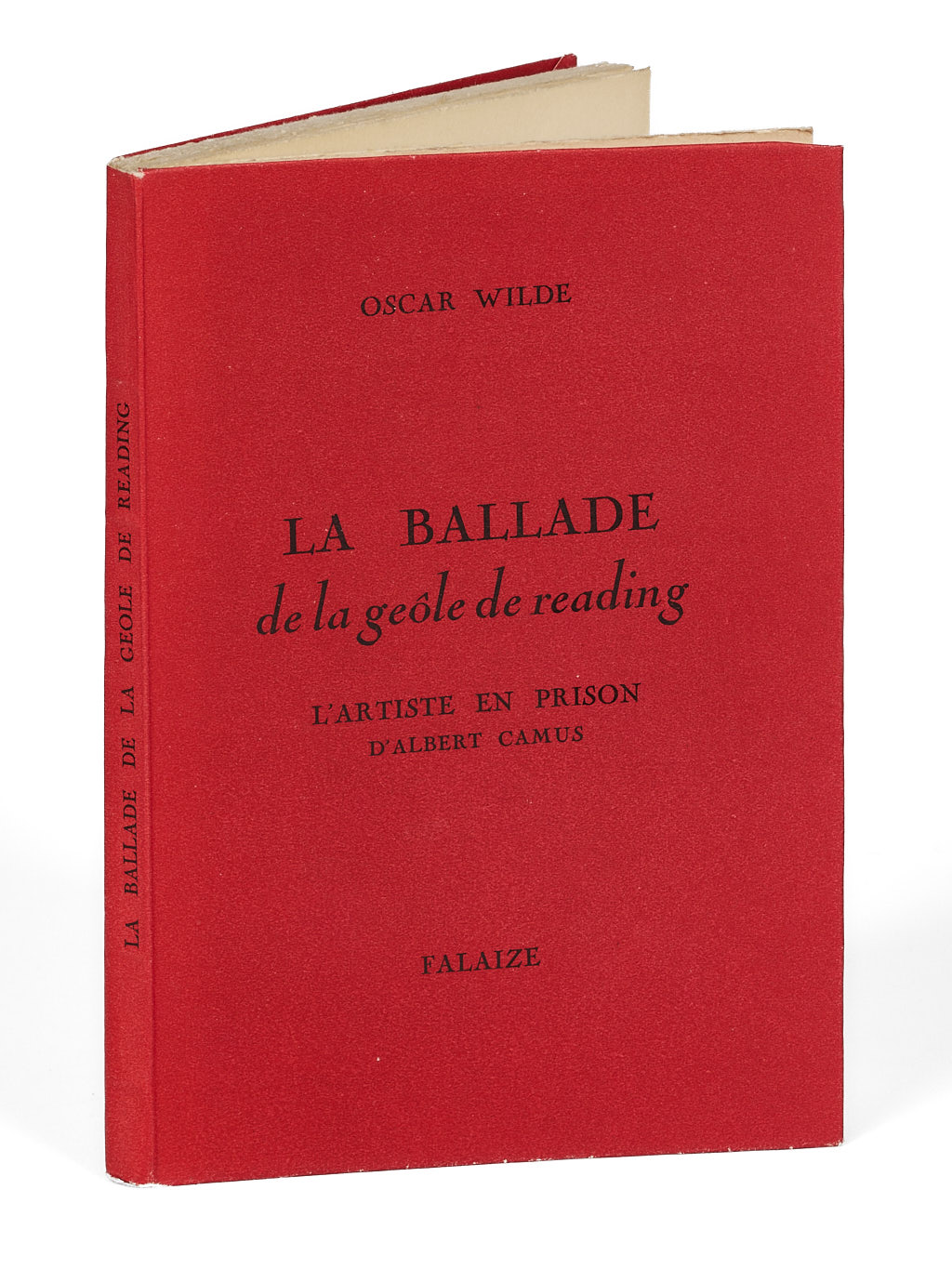
La Ballade de la geôle de Reading
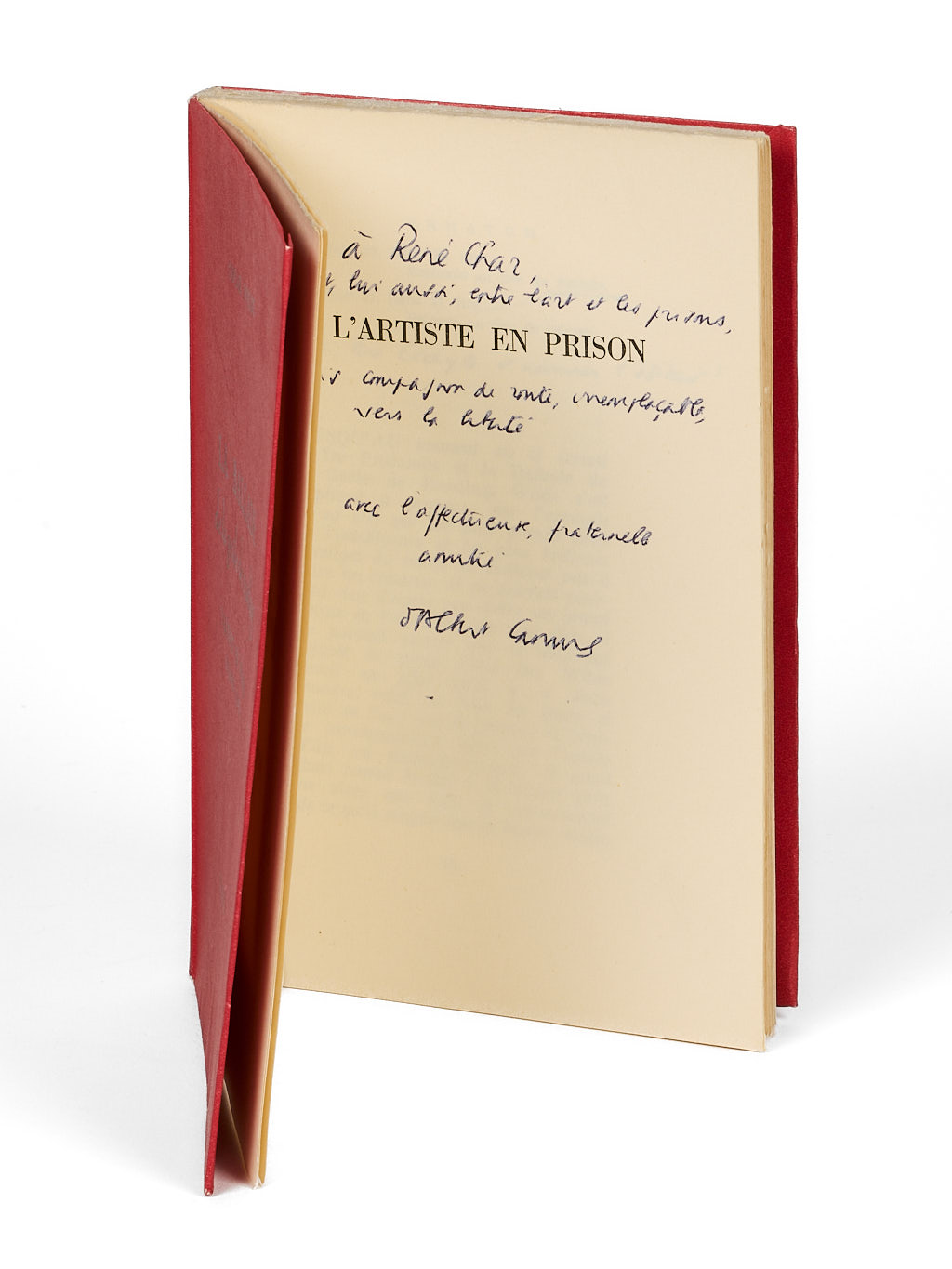
Presentation copy inscribed by Camus to René Char: “à René Char, debout, lui aussi, entre l'art et les prisons, mais compagnon de route, irremplaçable, vers la liberté. Avec l'affectueuse, fraternelle amitié, d'Albert Camus.”
In late autumn 1954, Albert Camus was in Italy at the invitation of the Italian Cultural Association. He had not visited since 1938 and looked forward to “the joy of rediscovering it” (Carnets, III). There he delivered a lecture, repeated on six occasions: L’Artiste et son temps. Camus would take up this text again in Stockholm three years later, in his Nobel Prize addresses: it forms the substantial speech given at Uppsala University on 14 December 1957.
Published in the Discours de Suède, following the speech given at the banquet closing the Nobel award ceremonies on 10 December, Camus added a dedication there to his old schoolteacher in Algeria, Louis Germain.
An earlier draft of the text had already appeared as the conclusion to Actuelles II, in the form of interviews gathered under the same title, L’Artiste et son temps: “we must accept the dangers: the age of artists sitting comfortably is over.” But its first appearance as such was as a preface to this edition of Wilde: here Camus reopens the case against “committed” art: “One may be sure that a talent capable of producing only an artificial work could sustain only a frivolous and inconsequential life. Dining every night at the Savoy does not necessarily require genius, nor even aristocracy, but only wealth… It is doubtful that Wilde, before his conviction, ever thought that prisons existed. If he did think of them, it was with the tacit conviction that they were not made for men of his quality […].”
Oscar Wilde wrote this book a few months after leaving prison, at Berneval near Dieppe and then in Naples, during the summer of 1897. All his publishers shunned the outcast except Leonard Smithers, a bookseller-publisher of pornographic works, who brought out the book in January 1898 in an edition of 800 copies, without the author’s name. After the Ballad, Wilde produced nothing more. Camus imagines that he “no doubt knew the unspeakable misfortune of the artist who knows the paths of genius but no longer has the strength to take them. Poverty, hostility or indifference did the rest.” The first French translation was Henry Davray’s, for Le Mercure de France, made in collaboration with Wilde himself, who wrote of his Ballad: “It is my swan song […] I have become the ruin, the collapse of what was once marvelous, brilliant and terribly improbable in me […]. I do not think I shall ever write again: the joy of living has fled, and with the will, that is the basis of art.” At his death Wilde “left us, a royal inheritance, De Profundis and the Ballad…” This legacy, Camus predicted, “announced to the initiated that a great artist, only recently born, had just died.”
Éditions Falaize had been founded in 1949 by Georges Fall, a native of Tunis, once literary director for Edmond Charlot, Camus’s first publisher. Camus, with mischievous humor, corrected in several copies the errata slip added to them: the publisher had written “read Sophocles instead of Aeschylus.” Camus added his own personal erratum: “Here, read Aeschylus and admire the publisher!”
Beyond this, there is little need to elaborate further on the significance of such a provenance, especially for a text whose importance would only grow for Camus.
An admirable inscription, and an admirable provenance.