

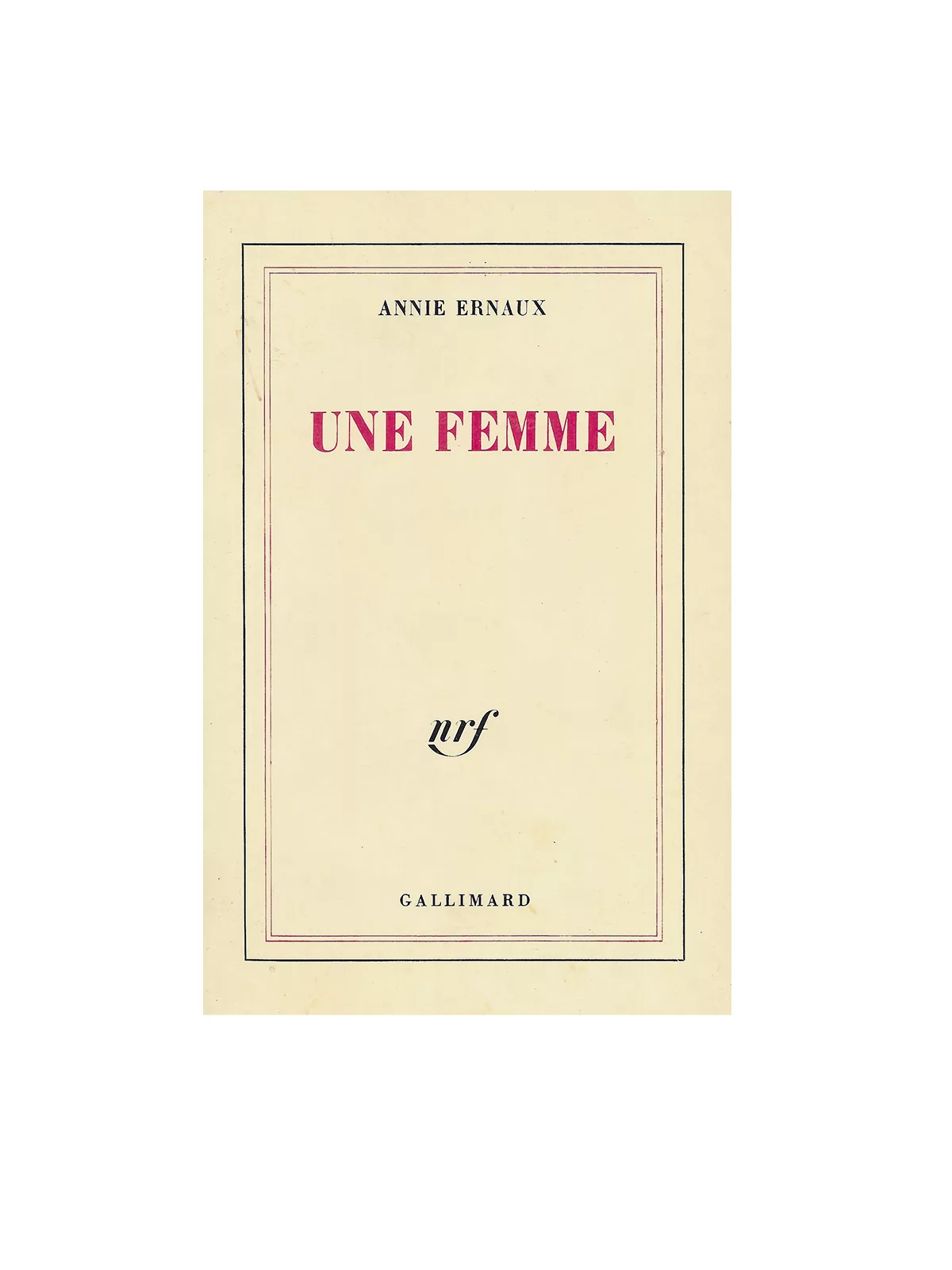
Une femme
Julien Gracq's copy — he also owned the first editions of La Place and Passion simple in his library. These were the only three titles by Annie Ernaux that it contained.
Following La Place, awarded the Prix Renaudot in 1984 and devoted chiefly to the life of her father, this book recounts the life and death of Annie Ernaux’s mother. “When one learns that she is returning, four years later, with Une femme, an equally short account — 106 pages — about her mother, one cannot help feeling a certain apprehension: the father, then the mother… the same social class, the same café-grocery in Normandy, the same little girl — herself — going to school and gradually distancing herself from her background… But in four years, Annie Ernaux has gained even further in sobriety and mastery. The narrative is even more “bare” than La Place. It proceeds from the same constant determination in Ernaux’s work to “not hide what hurts,” to “make something burst open in people.” Her aim is not to dwell on memories of a poor little girl, but, as the title Une femme itself indicates, to bear witness to a life: one that goes from the factory — from adolescence onward — to the retirement home (…) And, in the end, to leave nothing behind but the plastic bag that Annie will find in her mother’s room: the hospital staff had placed in it the few clothes owned by the woman who has just died (…) That is all that remains of eighty years of an ordinary existence, ending in a kind of amnesia, an absence from the world that leads old friends and family to say: “What was the point of her living several more years in that state (…). It is a sentence, a certainty, that I do not understand.”” (Savigneau, in Le Monde, 15 January 1988).
The very first printing, from December, is extremely difficult to find.
A fine copy of fine provenance.